
Germany’s High-Speed Rail: DB, Siemens Tech & Future Mobility
German rail sets new speed record of 405 km/h on Erfurt–Leipzig line, boosting future mobility.
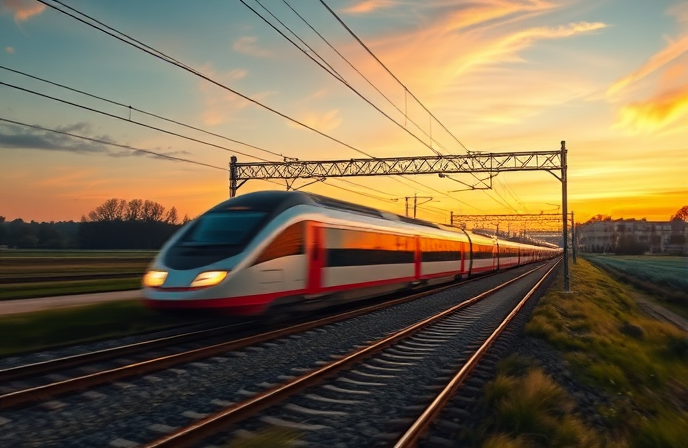
German High-Speed Rail Shatters Records, Paving the Way for Future Mobility
In a landmark achievement for European rail, Deutsche Bahn (DB) and Siemens Mobility have jointly set a new speed record on the Erfurt–Leipzig/Halle high-speed line in Germany, achieving a breathtaking 405.0 km/h with an ICE test train on June 28th. This groundbreaking feat, conducted solely for testing purposes, underscores the robust capabilities of the infrastructure and the continuous advancement of high-speed rail technology. The ‘who’ is a collaboration between DB and Siemens Mobility. The ‘what’ is a new speed record achieved on an ICE test train. The ‘when’ was June 28th. The ‘where’ is the Erfurt–Leipzig/Halle high-speed line. The ‘why’ is to test infrastructure capabilities and advance high-speed train technology. The ‘how’ is through collaborative testing and advanced train technology. This record-breaking run serves as a testament to the ongoing investments in Germany’s rail infrastructure and provides invaluable data for maintaining and upgrading high-speed lines, further solidifying Germany’s position as a leader in rail innovation and paving the way for enhanced passenger experience and more sustainable transportation solutions.
Infrastructure Performance and Capabilities
The successful test runs at 405.0 km/h are not merely about speed; they are a crucial validation of the Erfurt–Leipzig/Halle high-speed line’s construction and maintenance. Dr. Philipp Nagl, CEO of DB InfraGO AG, emphasized that the ability to achieve such speeds after ten years of continuous operation is a direct result of long-term infrastructure investment. This demonstrates the robustness of the track and signalling systems and the effectiveness of regular maintenance protocols. The line, part of the German Unity Transport Project No. 8 (VDE 8) and opened in 2015, was specifically designed for high-speed operation and has undergone thorough expert inspections before the record-breaking run, confirming its excellent condition. Currently, the line is closed for maintenance and optimization, including the installation of low-maintenance bridge bearings, ensuring ongoing reliability. These activities are essential to maintaining the high standards necessary for consistent, safe, and punctual high-speed rail services.
Velaro Novo: Advancing Train Technology
Siemens Mobility’s Velaro Novo test train, designated #seeitnovo, played a pivotal role in achieving the new speed record. Thomas Graetz, Vice President High Speed and Intercity Trains at Siemens Mobility, highlighted that the tests were designed to gather detailed insights into acoustics, aerodynamics, and handling at extreme speeds. The Velaro Novo represents the latest evolution of the Velaro family, incorporating numerous innovations aimed at improving efficiency by up to 30%, reducing investment and maintenance costs, and increasing seating capacity by 10%. The train’s flexible configurations offer adaptability to various operator needs, making it future-proof for the evolving demands of rail transport. The successful tests validate the advanced technologies integrated into the Velaro Novo, which will significantly impact passenger travel and rail operations.
Data-Driven Insights for Future Operations
The data collected during these high-speed trials is invaluable for optimizing future operations and enhancing the safety and efficiency of high-speed rail networks. Dr. Hiie-Mai Unger, Chairwoman of DB Systemtechnik, emphasized the crucial role of the ICE-S test train in collecting data on acoustics, aerodynamics, vehicle dynamics, and train-track interaction at very high speeds. This data will support future track renovations, particularly in high-speed traffic. The ICE-S, operated by DB Systemtechnik, is equipped with extensive instrumentation designed to evaluate new lines, inspect infrastructure, and conduct high-speed trials. This systematic approach ensures that the advancements in train technology are seamlessly integrated with the existing infrastructure to maximize safety and performance. This also extends to regular train maintenance that will benefit from such data, with improved processes and reduced downtime.
Governmental Support and Future Prospects
The achievement has garnered significant recognition, including from Christian Hirte, Parliamentary State Secretary at the Federal Ministry of Transport, who emphasized the importance of high-quality infrastructure and a strong industrial base. These test results are expected to benefit DB AG in future procurements, as well as provide customers with faster, safer, and more punctual travel. The success further strengthens Germany’s position as a key economic and export nation. The government’s continuous support for infrastructure projects, combined with industry innovations, creates a virtuous cycle of improvement. The positive results demonstrate the ongoing commitment to advancing high-speed rail, with benefits extending to improved services for passengers and the broader economy.
Conclusion
The record-breaking speed achieved by DB and Siemens Mobility on the Erfurt–Leipzig/Halle high-speed line represents a significant milestone in the evolution of high-speed rail technology and operational excellence. The validation of the infrastructure’s capabilities, the data-driven insights gained, and the innovations incorporated in the Velaro Novo train collectively point to a future where high-speed rail plays an even more critical role in sustainable transportation. This achievement has significant industry implications; it underscores the importance of continuous infrastructure investment and the power of collaborative innovation. Furthermore, it validates the need for enhanced testing and data analysis to optimize performance, safety, and operational efficiency. Looking ahead, the findings from these tests will influence future procurement strategies, maintenance practices, and technological advancements within the industry. The long-term goal is to provide a more punctual, safe, and eco-friendly service to passengers, ensuring the continued leadership of the rail sector in the transportation landscape. The momentum from this breakthrough will propel further advancements in the field, ultimately benefiting rail customers, operators, and the environment.
Company Summary
Deutsche Bahn (DB) is Germany’s national railway company, and a leading European transport provider. Its core business involves passenger and freight transport via rail, as well as related logistics and infrastructure services. DB InfraGO AG manages the rail infrastructure, while DB Systemtechnik is responsible for testing and maintaining rolling stock.
Siemens Mobility is a global leader in transport solutions, offering a comprehensive portfolio of products and services across rolling stock, rail infrastructure, and automation. Siemens Mobility is integral to the development of advanced signaling systems, train control technology, and complete rail systems. Their commitment to innovation ensures the modernization and expansion of rail networks across the world.
RELATED POSTS

September 27, 2023 11:02 am
UIC Leaflet No: 527-1 – Chapter 5 is a comprehensive...
October 21, 2025 4:54 pm
Siemens Mobility donates a Class 332 carriage to Humberside Fire...

Trump's firing of Surface Transportation Board member Primus sparks rail...
August 18, 2025 8:42 pm
Greenbrier completes $8.9M acquisition of GTO Transportes S.A., solidifying railcar...

April 19, 2025 5:09 pm
KiwiRail’s Strategic Investment in Modernized Rolling Stock: A Comprehensive Analysis...

June 19, 2007 6:57 pm
The UK government today confirmed it was considering a high-speed...