
Spanning the Gap: The Difference Between a Bridge and a Viaduct
While often used interchangeably, railway bridges and viaducts serve different structural roles. Discover the engineering differences between spanning a river and crossing a long valley.
⚡ In Brief
- A railway bridge is any structure that carries the track over an obstacle — a river, road, valley, or gap — regardless of span length, structural form, or construction material. A viaduct is a specific type of bridge: a long, multi-span structure carried on a series of arches or piers, used to carry a railway across a wide valley, lowland, or urban area where an embankment would be impractical or where the structure must remain elevated for several hundred metres or more.
- Railway bridges must withstand dynamic loading — the moving, impacting, vibrating loads of trains — at frequencies and magnitudes that static structures (road bridges, buildings) do not experience. The dynamic amplification factor (DAF) specifies how much greater the dynamic bridge loads are compared to the equivalent static load; for high-speed trains, the DAF can reach 1.5–2.0, meaning the structure must be designed for 50–100% more load than the train’s static weight alone.
- The principal structural bridge types used on railways are: masonry arch (historically dominant, still carrying many trains today); plate girder (steel or concrete); box girder; prestressed concrete beam; and composite deck (steel girder with concrete deck). Each type has characteristic span ranges, deflection behaviour, and maintenance requirements that determine its suitability for specific railway applications.
- Bridge deck deflection under train loading is a critical design parameter for railway bridges — excessive deflection changes the track geometry over the span, disturbing the vertical profile seen by passing trains and generating additional dynamic forces. EN 1991-2 (Eurocode 1 for railway bridges) specifies maximum allowable vertical deflection as L/600 to L/1000 (bridge span divided by 600 to 1000), depending on the track category and the speed of operation.
- The world’s longest railway viaduct is the Danyang–Kunshan Grand Bridge on China’s Beijing–Shanghai high-speed railway, completed in 2011 — a 164.85-kilometre elevated structure that spans the Yangtze River delta region across what is essentially a vast flat floodplain, chosen because an embankment of equivalent length would have required enormous quantities of fill material and presented significant settlement risk on the soft alluvial subsoil.
In 1848, Robert Stephenson completed the Britannia Bridge across the Menai Strait between mainland Wales and the Isle of Anglesey. The crossing was required by a new railway line from London to Holyhead — the ferry port for Ireland — and the Strait was too wide and too deep for a conventional masonry arch. Stephenson’s solution was unprecedented: two enormous wrought-iron rectangular tubes, each large enough for a train to pass through, suspended from tall stone towers. The tubes were fabricated on shore, floated into position on pontoons, and raised to their final position using hydraulic jacks. It was among the most ambitious engineering projects in history, and it worked perfectly for over a century.
The Britannia Bridge is not just a milestone in engineering history. It illustrates the defining characteristic of railway bridge engineering: the constraints imposed by the train. A road bridge can flex relatively freely under vehicle loads — a road surface with slight deflection or vibration is tolerable. A railway bridge must be stiff enough that a train at line speed experiences the crossing as a continuation of embankment track — no visible geometry change, no unacceptable dynamic amplification, no resonance between bridge frequency and train frequency. Stephenson’s tube design achieved this through sheer mass and stiffness. Every railway bridge designed since faces the same fundamental challenge: the loads are dynamic, the geometry tolerances are tight, and the consequences of structural inadequacy are immediate and visible.
Bridge vs Viaduct: The Technical Distinction
In everyday usage the two terms are often interchangeable. In engineering usage, the distinction is more specific: a bridge spans a single obstacle with a limited number of spans; a viaduct spans an extended distance on multiple repetitive spans supported by a series of piers or arches. The etymological root is clear — “viaduct” derives from the Latin via (road/way) and ducere (to lead): a viaduct leads the way across extended terrain, rather than crossing a single defined obstacle.
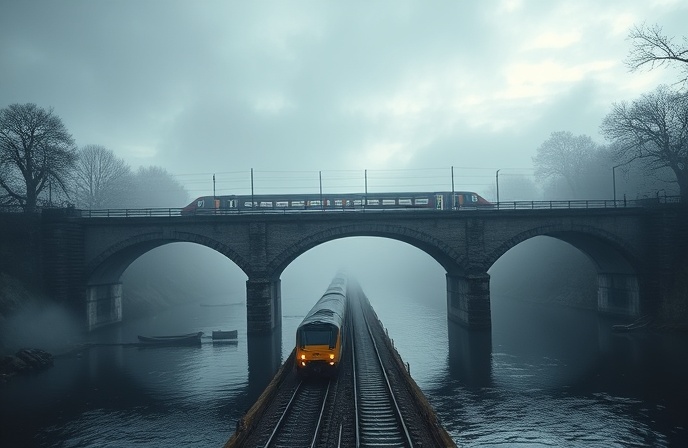
The practical threshold is not universally defined, but structures above approximately 100–200 metres in total length with three or more spans are generally called viaducts; shorter, fewer-span structures are bridges. The Glenfinnan Viaduct in Scotland (380 metres, 21 arches) is unambiguously a viaduct. The 50-metre single-span plate girder carrying a rural branch line over a river is unambiguously a bridge. The precise boundary between the two is a matter of engineering convention rather than a defined regulatory threshold.
Railway Bridge Structural Types
| Bridge Type | Structural Principle | Typical Span Range | Primary Material | Railway Examples |
|---|---|---|---|---|
| Masonry arch | Load transferred as compression through arch ring to abutments; no tensile stress in arch | 5–75 m per arch | Brick, stone | Glenfinnan Viaduct; Ribblehead Viaduct; most Victorian railway overbridges |
| Plate girder | Deep steel I-beam carries bending and shear; most common railway bridge type worldwide | 10–100 m | Structural steel | Millions of railway overbridges and underbridges globally |
| Box girder | Hollow box cross-section provides high torsional stiffness; used for curved spans and long spans | 40–250 m | Steel or prestressed concrete | LGV viaducts; Øresund Bridge rail deck; many HSR structures |
| Prestressed concrete beam | Concrete pre-tensioned or post-tensioned to resist bending in tension zone; economical for medium spans | 15–60 m | Prestressed concrete | Standard spans on many HSR viaducts (LGV, Shinkansen) |
| Steel truss | Open lattice of compression and tension members; historically common for long spans before prestressed concrete | 50–300 m | Structural steel | Forth Bridge (cantilever truss); many North American railroad trestles |
| Cable-stayed | Deck supported by diagonal cables from tower(s); efficient for very long spans | 150–600 m main span | Steel deck; concrete/steel towers | Øresund Bridge (cable-stayed section over Flinterenden channel); less common on pure rail |
| Suspension | Deck hung from catenary cables suspended between towers; maximum span capability | 300–2,000+ m main span | Steel | Rare for railway use — deck flexibility conflicts with train dynamics; Britannia Bridge was an alternative solution to this problem |
Dynamic Loading: Why Railway Bridges Are Harder to Design Than Road Bridges
The critical difference between railway and road bridge design is dynamic loading. A road bridge receives many small, randomly-spaced vehicles of varying weight — the statistical effect is a relatively smooth, distributed load that approaches the static design load only rarely. A railway bridge receives a single train — perhaps 800 tonnes of closely spaced axle loads advancing at 200+ km/h — that is much heavier, faster, and more regularly structured than road traffic.
The dynamic effects of railway loading produce several phenomena that bridge designers must address:
- Dynamic amplification: The ratio of the maximum dynamic response of the bridge (deflection, stress) to the equivalent static response is the Dynamic Amplification Factor (DAF). For conventional trains at normal speeds, the DAF is typically 1.1–1.4 (10–40% above static). For high-speed trains approaching a bridge’s natural frequency, resonance can push the DAF above 2.0 — the structure must be designed for double the static load.
- Resonance risk: When the frequency of the regular axle loading of a high-speed train matches a natural frequency of the bridge structure, resonance amplifies dynamic deflections dramatically. EN 1991-2 requires dynamic analysis for all bridges on lines where trains exceed 200 km/h, verifying that no resonance conditions exist within the operating speed range.
- Braking and traction forces: A train braking from line speed on a bridge applies significant horizontal forces to the deck through the rail-fastening system. These forces must be transmitted through the expansion joints, bearings, and abutments without causing excessive deck movement.
- Track geometry recovery: After a train passes, the deflected bridge deck must return to its designed position quickly enough that the next train’s wheel-rail contact forces are not amplified by residual deformation. Bridge stiffness and damping characteristics determine how quickly the structure recovers.
Deflection Limits: The Track Geometry Constraint
Railway bridge vertical deflection limits are among the most stringent in structural engineering — far more restrictive than for road bridges of equivalent span — because the track geometry seen by passing trains must remain within tight tolerances even as the bridge deck deflects under load.
EN 1991-2 vertical deflection limit (indicative):
δ_max ≤ L / 600 (for lines up to 200 km/h; track category 2)
δ_max ≤ L / 800 (for lines 200–280 km/h; track category 1)
δ_max ≤ L / 1000 (for lines above 280 km/h; high-speed)
Example: 50-metre span bridge at 300 km/h:
Maximum allowable deflection = 50,000 mm / 1,000 = 50 mm
(Bridge may deflect no more than 50 mm under the passing train)
A deflection limit of L/1000 for a 50-metre span means 50 mm of maximum mid-span deflection — approximately 0.1% of span length. This requires a substantially stiffer structure than would be required for pure structural safety — the track geometry requirement drives the bridge design to higher stiffness (and therefore higher cost and mass) than load-bearing capacity alone would demand.
Notable Railway Bridges and Viaducts: Engineering Milestones
| Structure | Country | Completed | Key Dimension | Engineering Significance |
|---|---|---|---|---|
| Britannia Bridge | UK (Wales) | 1850 | 461 m total; 140 m main span | First large wrought-iron tubular girder bridge; established principle of box section for stiffness |
| Forth Bridge | UK (Scotland) | 1890 | 2.5 km total; 521 m cantilever spans | World’s longest cantilever bridge at opening; 50,000 tonnes of steel; UNESCO World Heritage Site |
| Ribblehead Viaduct | UK (England) | 1875 | 402 m long; 24 arches; 32 m max height | Iconic Settle-Carlisle line masonry viaduct; 2,300 navvies; 100 deaths during construction |
| Millau Viaduct | France | 2004 | 2,460 m; tallest pier 245 m; max deck height 270 m | Road viaduct (not railway); world’s tallest bridge structure; cable-stayed multi-span |
| Øresund Bridge | Denmark/Sweden | 2000 | 7.85 km bridge + 4.05 km tunnel; dual road+rail | Longest combined road-rail bridge in Europe; two-level deck; 490 m cable-stayed main span |
| Danyang–Kunshan Grand Bridge | China | 2011 | 164.85 km total length; world’s longest | World’s longest viaduct; HSR on elevated structure over Yangtze delta floodplain; 10,000 workers, 4 years |
| Glenfinnan Viaduct | UK (Scotland) | 1901 | 380 m; 21 arches; 30 m max height | First large-scale mass concrete viaduct in Britain; West Highland Line; cultural icon (Harry Potter) |
Why Viaducts Are Essential for High-Speed Railways
On high-speed railway lines, viaducts are not merely a solution to specific geographic obstacles — they are often the preferred alignment solution across extensive lowland and flat terrain, chosen over embankments for several engineering reasons:
- Soft subsoil avoidance: In delta regions, river floodplains, and reclaimed coastal areas (particularly common in East Asia), the natural subsoil is so soft and compressible that an embankment would require enormous ground improvement investment to achieve the uniform, stiff formation required for high-speed track. A viaduct bypasses the subsoil issue entirely — the piers transfer load to deep competent strata, and the track sits on a stiff concrete deck regardless of the soft ground below. The Danyang-Kunshan viaduct on China’s Beijing-Shanghai HSR is the extreme example: building 165 km of embankment across the Yangtze delta’s soft alluvium would have been geotechnically challenging and extremely expensive; building a continuous viaduct was, paradoxically, more economical.
- Settlement control: Embankments settle over time — particularly on soft foundations. HSR track geometry tolerances are extremely tight, and progressive embankment settlement requires frequent track correction. A viaduct deck does not settle (negligible long-term deformation compared to embankment fill), providing a stable platform that maintains HSR track geometry over the design life with minimal intervention.
- Gradient maintenance: Viaducts can maintain a perfectly constant gradient across terrain that would require significant earthwork volumes for an embankment. The deck geometry is set during construction and does not change.
- Land use: In densely populated regions (suburban Japan, coastal China), a viaduct has a much smaller land footprint than an embankment of equivalent height — the space beneath the viaduct can be used for roads, cycle paths, or other purposes, reducing the effective land take of the railway.
Bridge Maintenance: The Scale of the Challenge
Railway networks contain tens of thousands of bridges. Network Rail alone manages approximately 30,000 bridges and viaducts on the UK network, many dating from the Victorian era. The maintenance challenge is substantial:
- Masonry arch bridges: Victorian brick and stone arch bridges are generally structurally sound — masonry in compression is extremely durable — but suffer from deterioration of mortar joints, drainage failures that allow water infiltration, spalling, and vegetation growth in cracks. Many Victorian arches carry 21st-century train loads significantly greater than their design loads, and structural assessment must demonstrate adequate capacity before they are approved for uprated traffic.
- Steel bridges: Steel bridges — particularly older ones with complex riveted or bolted connections — require regular inspection for fatigue cracking (which initiates at stress concentrations in connections), corrosion, and bearing deterioration. Repainting steel bridges is a continuous, expensive activity because the paint system is the primary corrosion protection and its failure leads to rapid section loss.
- Concrete bridges: Post-war concrete bridges suffer from carbonation (reducing the protective alkalinity of the concrete surrounding reinforcement), chloride ingress (from de-icing salts and marine environments), and reinforcement corrosion that causes spalling. Many concrete bridges built in the 1950s–1970s are reaching end of design life and require either repair or replacement.
Editor’s Analysis
The choice between an embankment and a viaduct on a new railway line is one of the most consequential cost decisions in HSR route design — and it is rarely as straightforward as comparing the construction cost per kilometre of each option. Viaducts are typically 5–10 times more expensive per kilometre than embankments in direct construction cost. But they come with a maintenance cost advantage that accrues over decades: a concrete viaduct deck does not require tamping, does not suffer from formation failure, does not need ballast renewal, and maintains its geometry over its design life with minimal intervention beyond periodic inspection and bearing replacement. An embankment on soft ground, by contrast, may require continuous geometry maintenance, periodic formation remediation, and eventually reconstruction. When whole-life costs are calculated over the 100-year design life of a high-speed line, the gap between viaduct and embankment narrows substantially — and in unfavourable subsoil conditions, the viaduct may actually be cheaper over the full asset life. China’s extensive use of elevated viaducts on its HSR network — over 50% of total HSR route length is elevated — reflects this whole-life cost logic applied at a massive scale, combined with the land-use efficiency of structures that leave the ground beneath available for other uses. European networks, with their different land use pressures and subsoil conditions, have not adopted the same default preference for elevation. But the Danyang-Kunshan Grand Bridge makes the case more eloquently than any cost-benefit analysis: 165 km of viaduct where 165 km of embankment on soft alluvium was the technically inferior and probably more expensive alternative. The engineering answer to “bridge or embankment?” is always: it depends, and the dependency is on a whole-life analysis, not a construction cost comparison. — Railway News Editorial
Frequently Asked Questions
- Q: Why are suspension bridges almost never used for railways?
- Suspension bridges are the ideal structural form for very long spans over water — their efficiency in using high-strength steel cable in pure tension allows spans of over 2,000 metres that would be impossible with any other structural type. But they have a fundamental characteristic that is problematic for railway use: flexibility. A suspension bridge deck deflects significantly under concentrated load, and the deck moves vertically and laterally in response to wind and changing load distributions. For road traffic, this flexibility is acceptable — vehicles can tolerate minor deck movements. For railway use, deck deflection changes the track geometry, creating geometry deviations that are seen as speed-limiting irregularities by passing trains, and potentially generating additional dynamic forces that amplify the structural response further. The Britannia tubular girder bridge was designed specifically because a conventional suspension bridge would have been too flexible for a railway crossing at that span. The Storebælt (Great Belt) Fixed Link in Denmark uses a suspension bridge for its road deck but a separate immersed tube tunnel for its railway crossing — a direct reflection of the incompatibility between suspension bridge flexibility and railway track geometry requirements.
- Q: What is “ballasted deck” vs “direct fastening” on railway bridges, and why does it matter?
- A ballasted deck bridge carries a conventional ballast bed on the bridge deck — the track structure is essentially the same as on embankment, with ballast, sleepers, and rail laid in the normal way. A direct fastening (or ballast-free) bridge has no ballast — the rail is attached directly to the bridge deck through a specially designed fastening system bonded or cast into the concrete deck. Ballasted deck bridges have the advantages of familiar track construction, simpler alignment correction (tamping adjusts the ballast as on normal track), and better noise and vibration isolation (the ballast acts as a damping medium). Their disadvantages are weight (200–300 kg/m² for ballast plus sleepers) and the risk of ballast displacement under extreme dynamic loading. Direct fastening bridges are lighter, require no tamping, and eliminate ballast displacement risk — but alignment correction is more difficult (requires the fastening system to be adjusted rather than simply tamping), the fastening system must accommodate all track geometry variation and thermal expansion/contraction of the deck, and the noise and vibration transmission to the deck is higher. Most modern HSR viaducts use direct fastening systems specifically to eliminate the weight and maintenance burden of ballast at elevation, while conventional-speed bridges often retain ballasted deck construction for the maintenance and geometry correction advantages.
- Q: What is the longest railway bridge in Europe?
- The Øresund Bridge between Denmark and Sweden, completed in 2000, is the longest combined railway and road bridge in Europe at approximately 7.85 kilometres. The bridge carries a two-level deck — road on top, railway below — from the Swedish coast to an artificial island, where the route transitions to an immersed tube tunnel for the remaining distance to Copenhagen. The bridge’s main span is a cable-stayed section of 490 metres over the Flinterenden navigation channel, with the remainder of the bridge being standard span concrete box girder construction. For pure railway bridges (carrying only rail traffic), the Tay Bridge in Scotland (3.4 km, rebuilt 1887 after the original collapsed in 1879) was long the longest in the UK, now surpassed by structures associated with the Channel Tunnel Rail Link (HS1) and other modern projects.
- Q: How is a railway bridge load-tested before opening?
- New railway bridges undergo load testing — applying defined test loads and measuring the structure’s response — as part of the commissioning process before the first train is permitted to cross. The test load is typically applied using heavy locomotives or multiple loaded wagons placed at defined positions on the bridge, with deflection measured by surveying instruments or displacement transducers at multiple points across the span. The measured deflections and strains are compared against the theoretical predictions from the structural analysis used in the design — close agreement confirms that the structure has been built as designed and that its stiffness and load distribution behave as calculated. For major structures or novel structural forms, additional dynamic testing may be performed — passing test trains at various speeds and measuring the dynamic response to verify that the resonance analysis predicts the actual behaviour accurately. The test results become part of the structure’s permanent record, providing a baseline against which future inspections can detect changes in structural behaviour that might indicate developing defects or deterioration.
- Q: Why do so many Victorian masonry arches still carry trains today, when they are 150–180 years old?
- Masonry arch bridges remain structurally competent after 150–180 years of service because masonry in compression is an extremely durable structural form. Brick and stone are not subject to fatigue — they do not crack under repeated loading the way steel or concrete does. They do not corrode. They have excellent durability against weathering when properly built with quality materials. And the masonry arch is inherently robust against moderate overloading — its failure mode is gradual formation of a four-hinge mechanism as load increases beyond capacity, not sudden brittle fracture. The arch form is also geometrically compatible with the additional loads placed on it over time: as ballast depth and axle loads have increased above original design values, the increased dead load has actually improved the stability of some arches by increasing the compression in the arch ring (masonry arches benefit from higher compressive stress, within limits). What Victorian masonry arches do suffer from is deterioration of mortar joints, drainage failures leading to water infiltration behind spandrel walls and through the arch ring, and damage to the backing fill and drainage above the arch. These are maintenance-manageable problems rather than fundamental structural deficiencies. Structural assessment of Victorian masonry arches using modern methods (MEXE method, ring analysis, finite element analysis) has consistently demonstrated that most of them have adequate capacity for current and foreseeable future loads — the structures that Robert Stephenson, Joseph Locke, and Isambard Kingdom Brunel built in the 1840s and 1850s will probably still be carrying trains in 2100.

Railway infrastructure, rolling stock and transport technologies specialist focused on global rail industry developments, high-speed rail systems, signaling technologies and freight transportation. Covering railway investments, public transport modernization, rail operations and international mobility projects across Europe, Asia and North America.
RELATED POSTS
June 2, 2026 8:44 am
⚡ In Brief: The UK Office of Rail and Road...
June 1, 2026 9:19 pm
300 IBEW signal workers initiated a strike against Canadian Pacific...

June 4, 2026 11:05 am
California High-Speed Rail Authority awarded a $3.5 billion track and...
June 4, 2026 6:22 pm
Network Rail and HS2 demolishes two strategic rail bridges, Saltley...
June 2, 2026 10:31 am
⚡ In Brief: The UK’s Office of Rail and Road...
June 2, 2026 11:37 am
⚡ In Brief: The UK’s Office of Rail and Road...