
FRA Mandates Safety Overhaul for US Rail ‘Shove’ Movements
FRA mandates stricter safety for “shove” movements at grade crossings. Enhanced procedures aim to prevent collisions, emphasizing clear track confirmation for public safety.
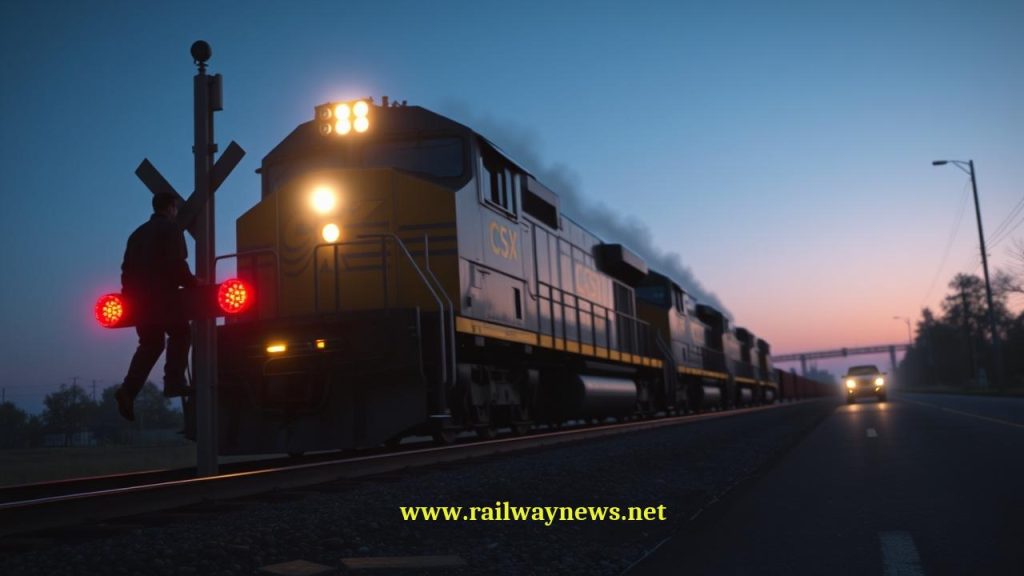
WASHINGTON – The Federal Railroad Administration (FRA) has issued a critical safety advisory targeting the heightened risks of “shoving” or “pushing” rail movements across grade crossings equipped with only passive or flashing-light warning systems. Published in today’s Federal Register, the directive compels railroads to reinforce procedures for visually confirming tracks are clear, a move underscoring the operational complexities seen in daily network maintenance, such as CSX’s planned switch installation in Augusta, Georgia.
| Category | Details |
|---|---|
| Issuing Authority | Federal Railroad Administration (FRA) |
| Advisory Subject | “Track is Clear” Determination for Shove/Push Movements |
| Applicable Infrastructure | Grade crossings with only passive warnings or flashing lights (no gates) |
| Key Mandates | Enhanced job briefings, visual assessments, and crossing evaluations |
| Contextual Example | CSX track switch installation at Laney-Walker Blvd, Augusta, GA (Dec. 16-18, 2025) |
Main Body:
In a direct response to ongoing safety concerns, the Federal Railroad Administration’s latest advisory places a strong emphasis on procedural discipline during reverse rail movements. The agency specifically highlighted the need for railroads to conduct adequate job briefings and rigorous visual assessments before any equipment is pushed over a crossing. The advisory mandates that if a crew cannot definitively determine that a track is clear of vehicular and pedestrian traffic, the movement must not proceed. It further calls on railroad operators to proactively evaluate specific crossings to assess the feasibility of an employee, often riding on the lead car of a shove move, being able to make a reliable track-is-clear determination from their position.
The technical challenge addressed by the FRA stems from the inherent lack of forward visibility in shoving operations. When a locomotive pushes a string of cars, the crew’s line of sight from the cab is obstructed, making it difficult to spot hazards at upcoming crossings. At locations equipped only with passive warning signs (like crossbucks) or flashing lights, there is no physical barrier to prevent a vehicle from entering the crossing. Unlike crossings with active gates, safety relies entirely on the vehicle driver’s awareness and the train crew’s ability to see and react. The advisory implicitly acknowledges that in these scenarios, technology alone is insufficient, and robust human-centric procedures are the primary defense against a collision.
This federal focus on crossing safety protocols is timely, as rail networks are in a constant state of maintenance and renewal. For instance, planned railroad improvements by CSX in Augusta, Georgia, will necessitate the closure of Laney-Walker Boulevard from December 16 to 18, 2025, for the installation of a new track switch. Such construction activities often involve numerous low-speed pushing and shoving movements to position equipment and materials precisely. The FRA’s advisory serves as a stark reminder that even during planned work in controlled environments, the fundamental safety principles of managing grade crossings must be strictly enforced to protect both the public and rail employees.
Key Takeaways
- Railroads are now under increased federal pressure to review and enforce safety protocols for shove movements at non-gated crossings.
- The advisory mandates a halt to any pushing movement if a clear visual confirmation of the crossing cannot be achieved by the crew.
- Operators are encouraged to identify and evaluate high-risk crossings where the physical layout may prevent a crew member from effectively monitoring for traffic.
Editor’s Analysis
This FRA advisory is more than a simple reminder; it’s a clear signal that the agency is focusing on operational discipline as a key pillar of grade crossing safety. While billions are spent on infrastructure upgrades, this directive targets the human factor in the thousands of crossings that will not see gate installations for years to come. By placing the onus on railroads to re-evaluate their procedures for these high-risk, low-visibility movements, the FRA is aiming to close a persistent safety gap. For the global market, this highlights a shift towards reinforcing procedural safety and may foreshadow more stringent crew visibility and communication regulations if incident rates do not decline.
Frequently Asked Questions
- What is a “shoving” or “pushing” movement in railroad terms?
- A shoving or pushing movement occurs when a locomotive pushes one or more rail cars from the rear, rather than pulling them from the front. This practice often means the lead car is unoccupied, significantly reducing the crew’s forward visibility when approaching obstacles like a grade crossing.
- Why does this advisory specifically target crossings with passive or flashing-light warnings?
- These types of crossings lack active gates that create a physical barrier to stop road traffic. Safety at these locations depends entirely on motorist compliance and clear sightlines, both of which are severely compromised during low-visibility shove movements, making them inherently more dangerous.
- What action does the FRA recommend if a crew cannot determine if a track is clear?
- The advisory is unequivocal: the movement must not proceed across the crossing. Crews are required to stop and use established safety protocols, which may involve a crew member dismounting to physically observe the crossing and ensure it is clear before giving the signal to proceed.
RELATED POSTS

February 21, 2018 8:18 am
Modernizing India's Railways: Upgrade signaling, track, and rolling stock...
June 21, 2023 5:48 pm
This article explores the strategic partnership between Siemens Mobility and...

January 10, 2025 6:30 pm
Introduction This article delves into the significant seven-year extension of...

November 15, 2012 11:46 am
Siemens has signed a €2.5bn letter of intent with Russian...

December 15, 2024 2:02 am
EN 16186-3 defines critical standards for railway driver cab displays,...
January 2, 2017 2:21 pm
Here's a voiceover excerpt tailored for railway professionals:"TransLink's $877 million...