
Inland Rail: Hamilton Bridge Milestone Fuels Rail Infrastructure Growth
Inland Rail project advances with Hamilton Street bridge beam installation in Broadford, Victoria.
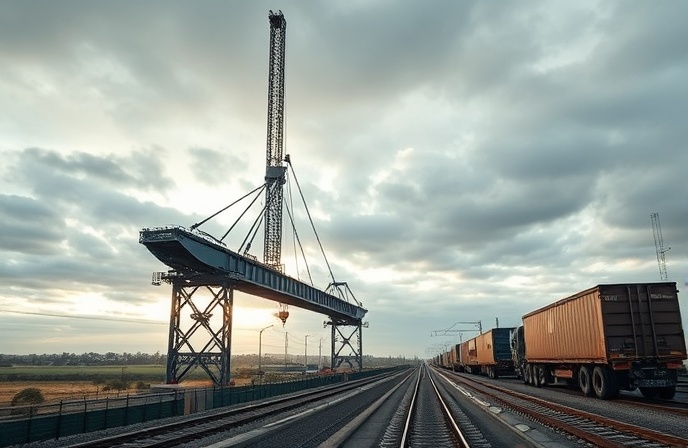
Hamilton Street Bridge Milestone Marks Significant Progress for Inland Rail Project
The hum of progress echoes across Broadford, Victoria, as the first two massive beams of the new Hamilton Street bridge were successfully installed this week. This achievement, a crucial step in the Inland Rail project, involved the complex placement of the pre-fabricated steel girders over the active rail corridor. This project, a vital component of the Beveridge to Albury Tranche 2 (B2A), is replacing the existing bridge with a higher structure while simultaneously lowering the rail tracks below to accommodate double-stacked freight trains. The “who” is Inland Rail and their construction partner, John Holland; the “what” is the beam installation; the “when” was this week; the “where” is Broadford, Victoria; the “why” is to facilitate double-stacked freight trains for the Inland Rail project; and the “how” involved a 650-tonne crane and a 15-hour railway line closure. This article will delve into the specific technical aspects of the bridge construction and its importance for the broader Inland Rail initiative.
Engineering Marvel: The Beam Installation Process
The core of this week’s operations revolved around the precise placement of the two 35.5-metre long steel beams, each weighing a substantial 35 tonnes. Fabricated at Haywards Fabrication facility in Launceston, Tasmania, the beams were transported across Bass Strait and then via truck along the Hume Freeway to the Broadford site. The installation demanded meticulous planning and execution due to the complex operational requirements, including the complete closure of the railway line for 15 hours. A 650-tonne crane was crucial for lifting and precisely positioning the beams, forming the initial structural framework for the new bridge. This new structure will eventually support a shared-user pathway for pedestrians, cyclists, and users of mobility aids, enhancing community connectivity. The temporary use as a single-lane vehicular bridge will maintain crucial road access during the upcoming demolition and reconstruction of the adjacent road bridge.
Intermodal Logistics and Supply Chain Efficiency
The successful placement of the Hamilton Street bridge beams underscores the intricate logistics involved in major infrastructure projects like the Inland Rail. The journey of the beams, commencing at Haywards Fabrication in Launceston, highlights the integration of different transport modes – sea freight, followed by road transport – to deliver critical components to the construction site. The utilization of the Hume Freeway exemplifies strategic infrastructure for freight movement. The precision timing, coordination and communication between various stakeholders, including the fabrication facility, transport companies, and John Holland, are essential to ensure that components are delivered on schedule and meet rigorous quality standards. This streamlined supply chain directly contributes to the project’s overall efficiency and ultimately plays a part in the reduction of freight times.
Integrated Site Management and Concurrent Operations
The Inland Rail project, in this instance managed by John Holland, demonstrates effective integrated site management with concurrent operations across multiple locations. While the Hamilton Street bridge beams were being installed, John Holland teams were simultaneously undertaking related work in Benalla, Wandong, and on the Short Street and Marchbanks Road sites in Broadford. This simultaneous approach minimizes downtime and maximizes resource utilization. This multi-site approach demands efficient project management, strict adherence to safety protocols, and strong communication networks to ensure seamless coordination between various work crews and activities. These concurrent operations are crucial to the project’s overall schedule and the delivery of the B2A tranche.
Community Collaboration and Project Communication
Effective communication with the Broadford community is a vital aspect of the Hamilton Street bridge project, ensuring that residents are well-informed about ongoing activities, any disruptions to transportation and the overall progress of the Inland Rail project. The Inland Rail team recognizes the importance of community engagement and maintains proactive communication channels to share updates on work progress and address any concerns. Project team members thanked the Broadford community for their patience and understanding as work ramps up across the eight Inland Rail sites in the area. This commitment to community collaboration is pivotal for project success, and minimizes disruptions during the construction process.
Conclusion
The installation of the first beams at the Hamilton Street bridge represents a major milestone for the Beveridge to Albury Tranche 2 of the Inland Rail project. It showcases the successful implementation of complex logistics, engineering expertise, and integrated site management. The bridge itself plays a crucial role in enhancing the regional freight network and promoting efficient movement of goods across Victoria. The project highlights the benefits of intermodal logistics, emphasizing the importance of collaboration and precision during all phases. Furthermore, the installation signifies a significant step towards realizing the full potential of the Inland Rail project, which will transform the rail freight landscape across Australia. As the remaining beams are installed and construction progresses, this project will become a catalyst for economic growth and will greatly improve transport infrastructure in the region. Continued focus on community engagement and collaborative partnerships will be essential to further advance the successful completion of this critical infrastructure project.
RELATED POSTS

August 12, 2010 11:27 am
Oman has unveiled plans to extend a 1,000km rail network...

July 11, 2016 12:52 pm
As part of the East Coast Digital Programme, Welwyn Garden...
July 28, 2016 4:52 am
Infrastructure issues caused a significant percentage of delays. Further analysis...
U.S. freight rail traffic fell 1.6% last week, with carloads...
July 1, 2025 11:33 pm
USTDA funds key Philippine freight rail project, Subic-Batangas line. ...
July 2, 2020 12:10 am
The integration of contactless payment systems into public transportation networks...