
UAE Etihad Rail: High-Speed Passenger Service Shaping Transport
UAE’s Etihad Rail passenger service launches, aiming to connect 11 cities by 2026. High-speed trains projected to carry 36 million annually.
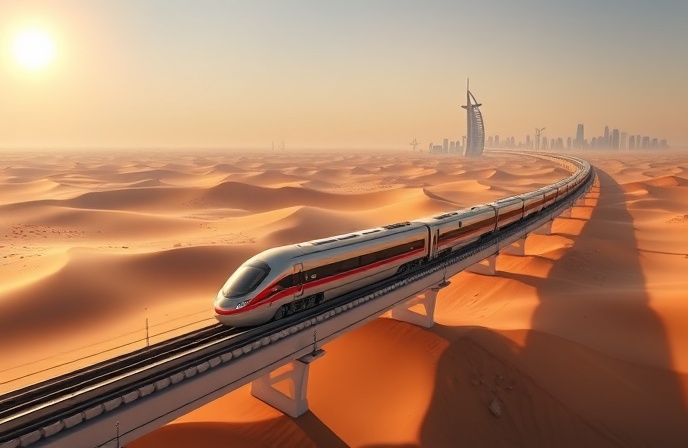
UAE Rolls Out Etihad Rail Passenger Service, Targeting 36 Million Riders by 2030
In a landmark move for the United Arab Emirates’ (UAE) transportation infrastructure, Sheikh Mohammed bin Rashid Al Maktoum, Vice President and Prime Minister of the UAE and Ruler of Dubai, recently experienced a journey on the Etihad Rail passenger train. This ride, from Dubai to Fujairah, marked a significant milestone in the development of the nation’s first national passenger rail service. The project, spearheaded by Etihad Rail, aims to connect eleven cities and regions across the UAE, from Al Sila to Fujairah, significantly boosting the country’s transportation capabilities. Passenger operations are slated to commence in 2026, with the high-speed trains designed to reach speeds of up to 200 km/h. This initiative, which the UAE government is committed to delivering, is poised to transform regional travel and is expected to serve 36 million passengers annually by 2030. The “what,” “when,” “where,” “who,” “why” and “how” of the project is detailed in the following sections.
A Journey of Vision and Implementation
The recent journey undertaken by Sheikh Mohammed highlighted the advanced state of the Etihad Rail passenger service. This inspection not only demonstrated the physical progress of the railway but also underscored the UAE’s broader vision for a sustainable and efficient transport network. The train, during its operation, will connect eleven key urban centres including Abu Dhabi, Dubai, Sharjah, and Fujairah, integrating the country’s transportation infrastructure. The core of the project lies in a nationwide 900 km network. The initial phases will cover the seven emirates, thereby facilitating both intra-emirate and inter-emirate travel, and contributing towards reducing traffic congestion. The ongoing construction and engineering are expected to generate AED 200 billion in economic gains over the next half-century.
Enhanced Connectivity and Operational Efficiency
One of the primary goals of the Etihad Rail passenger service is to enhance connectivity within the UAE. The service will drastically cut travel times between major cities. For instance, the journey from Abu Dhabi to Dubai is estimated to take approximately 57 minutes, while a trip to Fujairah will be around 105 minutes. This represents a substantial improvement over current road travel times, making rail transport a more appealing option for both commuters and tourists. The efficient network facilitates both daily commuting and tourism expansion, further solidifying its position as a critical component of the country’s transportation system. The project anticipates carrying 36 million passengers by 2030.
Economic and Environmental Benefits
The Etihad Rail passenger project is projected to serve as a catalyst for economic diversification, creating job opportunities in the transportation sector, boosting tourism, and stimulating related industries. The project is also aligned with the UAE’s sustainability goals. By offering a high-capacity rail system, the network will contribute to reduced transportation emissions. The ambitious goals of reducing transportation emissions by up to 21% annually by 2030 are set to align with the country’s climate objectives. In February 2025, a cabinet meeting saw the service being described as a transformative infrastructure project with economic returns exceeding AED 145 billion (USD 39.4 billion) over 50 years.
Future Outlook and High-Speed Expansion
The future of Etihad Rail extends beyond its initial passenger services. The system is designed with the capacity for future expansion, including potential high-speed phases that could see trains operating at speeds of up to 350 km/h. This positions the UAE at the forefront of regional rail innovation, setting a new benchmark for transportation infrastructure. The project, led by Sheikh Theyab bin Mohamed bin Zayed, exemplifies the UAE’s commitment to continuous progress and development. The ongoing collaboration across government agencies and private sector entities will be essential in fulfilling the long-term vision of the railway. The first phase of the project is slated to begin in 2026, showcasing the practical implementation of cutting-edge railway technology and reflecting the UAE’s commitment to a sustainable future.
Conclusion
The Etihad Rail passenger service marks a significant leap forward for the UAE’s transportation infrastructure. The recent demonstration journey by Sheikh Mohammed exemplifies the government’s commitment to a sustainable, high-speed transport network. This ambitious project promises to connect key cities, significantly reducing travel times, and providing an efficient alternative to road travel. Moreover, it is expected to fuel economic diversification, create job opportunities, and contribute to the UAE’s climate goals by reducing transportation emissions. The project’s phased implementation and future expansion plans, including the potential for high-speed operations, position the UAE as a regional leader in rail innovation. The success of Etihad Rail has the potential to inspire similar projects globally and sets a new standard for infrastructure development.
RELATED POSTS

December 8, 2016 8:38 pm
Bombardier and New United Group (NUG) Signaling Solutions Co. Ltd....

September 5, 2015 11:17 am
In the Port of Zeebrugge, to the south of the...

August 3, 2018 1:28 pm
The UK's £300 million investment in rail accessibility is transforming...
December 29, 2022 12:03 am
Stadler Secures Major TRAMLINK Contract with Transports publics genevois (TPG)...

August 14, 2025 12:33 pm
Czech Republic's ambitious high-speed rail project modernizes transport, connecting major...

July 24, 2015 7:03 am
The city of Sioux Falls plans to pay $27.3 million...