
Australia Rail: Refrigerant Transition Insights & Knorr-Bremse Solutions
Australian rail faces refrigerant obsolescence. International agreements require a swift transition away from high-GWP refrigerants. Operators must replace air conditioning systems now to avoid shortages and penalties.
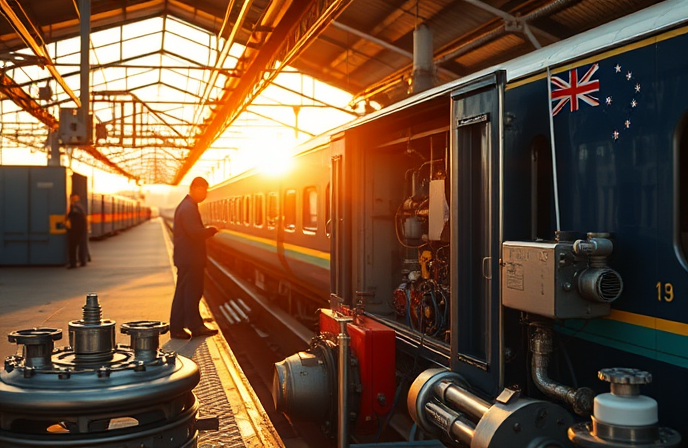
The Cooling Curve: Australia’s Rail Sector Faces a Refrigerant Revolution
Australia’s rail operators are staring down a significant challenge: the refrigerants keeping passengers comfortable are on a collision course with obsolescence. Driven by international environmental agreements, specifically the Kigali Amendment to the Montreal Protocol, the industry must swiftly transition away from high-Global Warming Potential (GWP) Hydrofluorocarbons (HFCs). This means replacing the refrigerants in air conditioning systems. This article investigates the urgent need for action, the technical hurdles involved, and the potential solutions facing the rail sector. This is a pivotal moment. Suppliers are already winding down their stock of legacy refrigerants, and operators who delay face potential shortages and significant financial penalties. Who must act? Rail operators. What must be done? Replace existing systems. When must it start? Now. Where is this happening? Across Australia’s rail network. Why is it happening? To comply with international environmental regulations. How will it happen? Through careful planning and strategic upgrades during maintenance cycles.
The Kigali Mandate: A Global Push for Cleaner Cooling
The Kigali Amendment, a crucial component of the Montreal Protocol, serves as the driving force behind this refrigerant overhaul. The Montreal Protocol, initially enacted in 1987 and ratified by nearly 200 nations, was designed to protect the ozone layer by phasing out ozone-depleting substances like chlorofluorocarbons (CFCs). This landmark agreement proved remarkably successful, with the ozone layer showing signs of healing. The Kigali Amendment builds upon this success by targeting HFCs, potent greenhouse gases used extensively in refrigeration. These substances can have a global warming impact thousands of times greater than carbon dioxide. Australia, committed to aggressive reduction targets, must slash HFC imports by over two-thirds by 2026, placing significant pressure on the rail industry, which imports all its refrigerants.
Supply Chain Squeeze: The Looming Crisis
The phase-down of HFCs is not just an environmental imperative; it is also a supply issue. Australia relies entirely on imported refrigerants, making it vulnerable to global market fluctuations. European markets, having entered the phase-down earlier, have experienced dramatic price spikes. “The price of some refrigerants initially jumped tenfold in Europe,” notes Joshua Pitcher, Engineering Manager at Knorr-Bremse Australia. If operators fail to prepare, Australia may see similar price shocks. Compounding the problem, component manufacturers are also transitioning away from legacy refrigerant-compatible systems, meaning spare parts for older air conditioning units will become increasingly scarce. The entire ecosystem—refrigerants, compressors, seals, and valves—must evolve together to stay operational, creating a supply chain pinch.
Navigating the Technical Transition: Challenges and Solutions
Replacing refrigerants is not always a simple “like-for-like” swap. While some systems can be readily adapted to low-GWP alternatives, others require more extensive reengineering. For instance, R134a systems can often be retrofitted to use R513a, a non-flammable refrigerant with a significantly lower GWP. However, R407c, a popular refrigerant in rail, has no such non-flammable equivalent, forcing operators to consider low-flammability alternatives. This introduces concerns about safety, as trains carry large volumes of refrigerant and transport hundreds of passengers. However, modern engineering, as demonstrated by Knorr-Bremse’s latest designs, can mitigate these risks, ensuring that any leaks will dilute quickly to a non-flammable level, while also eliminating the risk of leaks inside the passenger areas.
Strategic Planning: The Key to Success
The ideal approach to refrigerant transition is to synchronize upgrades with scheduled maintenance cycles. HVAC systems undergo major overhauls every eight to twelve years. Rather than simply replacing a compressor with an identical unit, operators can install a unit designed for a new refrigerant. This proactive strategy minimizes both cost and disruption. Failing to plan ahead can lead to doubled expenses or, worse, trains sitting idle due to the lack of essential components. The industry needs to act now to secure parts and plan ahead for maintenance. As Knorr-Bremse’s Brett Barty notes, “There’s only so much capacity in the system. If everyone waits until 2026 to start planning, we won’t have enough people to do the work.”
Looking Ahead: Industry Implications and Outlook
The Australian rail sector faces a pivotal moment. The shift away from high-GWP refrigerants is not merely a technical issue but a fundamental restructuring of the industry’s approach to air conditioning. While the initial investment may seem daunting, delaying action carries far greater risks: potential supply chain disruptions, increased operating costs, and, ultimately, the grounding of rolling stock. The key to success lies in a proactive, phased approach, integrating refrigerant transitions with existing maintenance schedules. As more rail operators embrace this transition, the Australian rail industry will not only meet its environmental obligations but also future-proof its operations. Innovation in the space continues with Knorr-Bremse exploring propane and CO2 refrigerant systems to ensure safety and efficiency. By embracing these advancements, the industry can ensure the comfort of passengers and build a sustainable future for rail transport across Australia.
Company Summary
Knorr-Bremse is a global leader in braking systems and related systems for rail and commercial vehicles. Through its Merak brand, Knorr-Bremse is at the forefront of HVAC technology, offering innovative and sustainable solutions for the rail industry. Their expertise encompasses a wide range of refrigerants, including low-GWP options, ensuring that rail operators can meet environmental regulations while maintaining passenger comfort and operational efficiency. The company’s Australian design center is playing a crucial role in providing tailored solutions, and the company is helping operators across Australia to adapt by presenting options, and running risk assessments to satisfy engineers and asset managers.
RELATED POSTS

August 14, 2025 5:33 pm
Teignmouth railway cliffs are being strengthened, a crucial investment for...

March 2, 2019 1:36 pm
The Turin-Lyon high-speed rail project: massive delays, political gridlock, and...
December 2, 2017 6:43 pm
The Downer EDI freight rail sale reshapes Australia's rail future....

May 31, 2015 11:40 pm
The new 109E Emil Zátopek locomotive from the Czech manufacturer...
September 25, 2025 5:55 pm
Siemens completes Frankfurt's digital train control system testing, paving way...

September 7, 2025 4:00 pm
Kontron and Qualcomm team up on a 5G FRMCS modem,...