
Turin-Lyon High-Speed Rail: Delays, Politics, and Funding Crisis
The Turin-Lyon high-speed rail project: massive delays, political gridlock, and ballooning costs threaten its future. Learn how this mega-project’s struggles offer vital lessons for railway professionals.
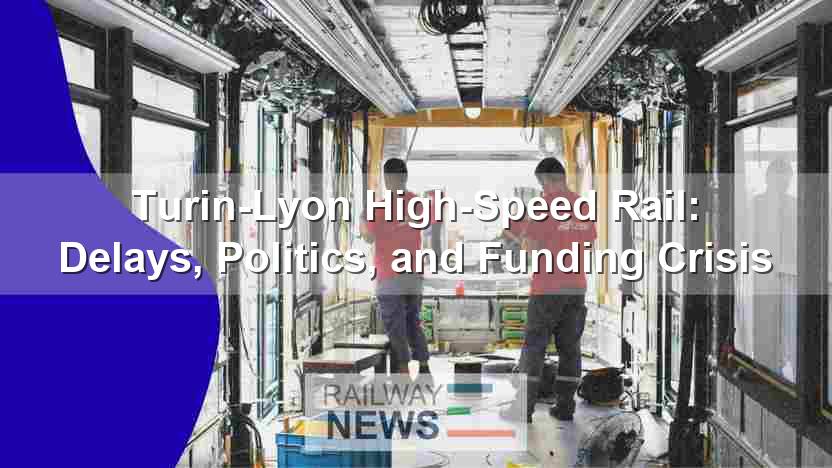
This article examines the significant delays and subsequent funding challenges faced by the Turin-Lyon high-speed rail project, a crucial component of Europe’s high-speed rail network. The project, originally slated for completion in 2025, has encountered substantial hurdles, leading the European Union (EU) to consider canceling €300 million ($340 million) in allocated funding. This situation highlights the complex interplay of political, economic, and engineering factors that can impact large-scale infrastructure projects. We will delve into the reasons behind the delays, exploring the technical complexities of the Alpine tunnel construction, the political opposition within Italy, and the economic viability assessments that have cast doubt on the project’s long-term sustainability. By analyzing these factors, we aim to understand the challenges inherent in such ambitious undertakings and the potential consequences for future large-scale infrastructure developments within the EU.
Technical Challenges of Alpine Tunnel Construction
The core of the Turin-Lyon project is the construction of a 58km Alpine base tunnel (also referred to as the Lyon-Turin railway line). This significant engineering undertaking presents numerous challenges. The geological complexities of the Alps necessitate advanced tunnel boring machine (TBM) technology and meticulous geological surveying to mitigate risks of ground instability, water ingress, and unexpected geological formations. The sheer scale of the excavation, coupled with the need for precise alignment and construction tolerances, presents logistical and engineering management challenges of considerable magnitude. Any unforeseen geological difficulties can lead to significant time and cost overruns, as evidenced by the project’s current delays. The extensive nature of this undertaking contributes directly to the overall project delay, as even minor setbacks can have a ripple effect on the overall timeline.
Political Opposition and Internal Conflicts
The project has faced significant political headwinds, primarily from the 5-Star Movement, a major coalition partner in the Italian government. This opposition, alongside internal debates within the Italian Parliament, has led to delays in decision-making and project approvals. The political uncertainty surrounding the project has created an environment of instability, impacting investor confidence and potentially deterring necessary investment. The passage of a motion in the Italian Parliament to reassess the project itself illustrates the volatile political climate surrounding its future. This political discord has effectively hampered the timely execution of the project, contributing significantly to the funding crisis.
Economic Viability and Cost-Benefit Analysis
A recent Italian government-commissioned report raised serious concerns about the project’s economic viability. The projected costs have significantly escalated, impacting the overall cost-benefit analysis. Questions about the long-term return on investment (ROI) have been raised, especially in light of the substantial public funding involved. The economic justification for the project, initially predicated on improved regional connectivity and economic growth, has been called into question. This casts a shadow over the project’s future and exacerbates the pressure on EU funding agencies to reconsider their financial commitment.
The EU’s Response and Future Implications
The EU’s decision to consider canceling €300 million in funding underscores the seriousness of the situation. This action serves as a strong signal that the delays and uncertainty surrounding the project are unsustainable. The requirement for new tenders and a progress report from Tunnel Euralpin Lyon Turin (TELT) – the company responsible for the tunnel construction – demonstrates the EU’s intention to ensure greater transparency and accountability. The potential reallocation of funds to other projects highlights the EU’s commitment to efficient resource management. The implications of this case study extend beyond the Turin-Lyon project, serving as a cautionary tale for future large-scale infrastructure ventures. It emphasizes the critical need for robust project planning, transparent communication, effective risk management, and a thorough cost-benefit analysis that fully accounts for potential delays and political uncertainties.
To summarize, the Turin-Lyon high-speed rail project’s predicament serves as a compelling case study of the multifaceted challenges facing large-scale infrastructure projects. The intricate interplay of engineering complexities, political maneuvering, and economic assessments has contributed to significant delays and threatened the project’s viability. The EU’s threat to withdraw funding reflects a growing concern over cost overruns and lack of progress. The project’s future remains uncertain, but the situation highlights the critical need for meticulous planning, robust risk management, transparent governance, and a clear economic rationale for such ambitious undertakings. Failure to address these factors will likely lead to similar challenges in future large-scale infrastructure initiatives across Europe and globally. The project’s ultimate fate will serve as a crucial benchmark for future large-scale infrastructure developments, underscoring the need for robust planning, transparent governance, and a thorough consideration of both technical and political risks before embarking on such ambitious projects.

Railway infrastructure, rolling stock and transport technologies specialist focused on global rail industry developments, high-speed rail systems, signaling technologies and freight transportation. Covering railway investments, public transport modernization, rail operations and international mobility projects across Europe, Asia and North America.
RELATED POSTS

October 8, 2026 1:15 pm
Alstom secured a €1bn contract to build 13 automated trains,...

October 1, 2026 7:09 am
United States regulators confirmed a September 30 deadline for the...

October 8, 2026 12:18 pm
Siemens Mobility signed an agreement with VinSpeed to supply 350...

October 4, 2026 5:14 pm
Alstom secured a CA$4.7 billion order from VIA Rail Canada...

October 5, 2026 6:12 pm
AECOM and Jacobs secured a contract in September 2026 to...

October 1, 2026 12:13 am
Illinois approved $1.5 billion annually for the Northern Illinois Transit...