
BNSF-UP Salt Lake City Trackage Rights: Rail Operations Update
BNSF and Union Pacific settle Salt Lake City trackage rights dispute, averting potential disruptions to freight operations.
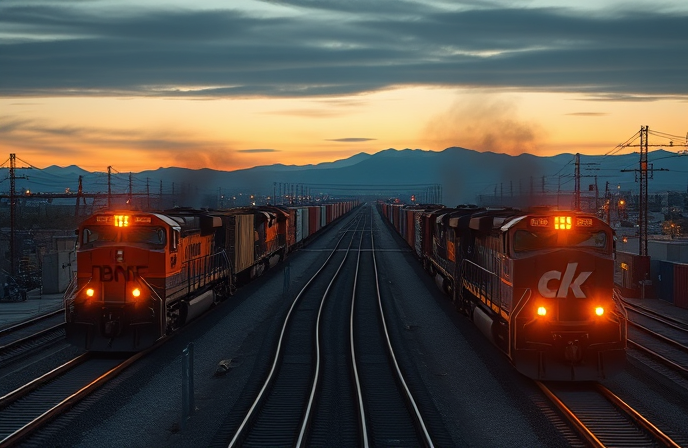
BNSF and Union Pacific Resolve Dispute Over Trackage Rights in Salt Lake City
In a move that averts potential operational disruptions, BNSF Railway Co. and Union Pacific Railroad (UP) have reached an agreement, resolving a dispute concerning trackage rights in Salt Lake City. This agreement addresses BNSF’s recent emergency petition filed with the Surface Transportation Board (STB). The petition sought to ensure access to trackage rights over UP lines, crucial for transporting intermodal trains for interchange with the Salt Lake Garfield & Western Railway (SLGW). The resolution, announced this week, signifies a win for both railways and ensures the continued smooth flow of freight through a vital transportation hub. This article will delve into the details of the dispute, the implications of the agreement, and the broader context of railway operations in the region.
The Genesis of the Dispute
Earlier this month, BNSF filed an emergency petition with the STB (Surface Transportation Board). The petition highlighted concerns that UP (Union Pacific Railroad) was impeding BNSF’s access to essential trackage rights. These rights, granted as a condition of the STB’s approval of the 1996 merger between UP and Southern Pacific Rail Corp, were crucial for BNSF to operate intermodal trains. BNSF specifically needed access to UP lines in California, Nevada, and Utah to reach the SLGW (Salt Lake Garfield & Western Railway) in Salt Lake City. The core of the issue was BNSF’s ability to move double-stack intermodal trains, a key component of modern freight transportation, for efficient interchange with the SLGW.
The Importance of Trackage Rights
Trackage rights are critical arrangements within the railway industry. They permit one railroad company to operate its trains over the tracks owned by another. This is often crucial in areas where a railroad doesn’t have its own dedicated infrastructure or for facilitating efficient interchange between different rail networks. In this case, BNSF’s access to UP tracks was essential to efficiently route intermodal traffic destined for or originating from the SLGW. Without these rights, BNSF’s operations would have faced significant delays, impacting the timely delivery of goods and the overall efficiency of the supply chain. The STB’s role in overseeing trackage rights underscores its commitment to ensuring fair access and promoting competition within the industry.
The Agreement and Its Implications
The details of the agreement between BNSF and UP have not been fully disclosed, but its existence signals a positive outcome for both companies. By resolving the dispute, both railroads can avoid costly legal battles and operational disruptions. It demonstrates a willingness to collaborate and prioritize the efficient movement of freight. The agreement also ensures the continued smooth functioning of the intermodal network in the Salt Lake City region. This collaborative approach is vital for the railway industry to efficiently service the needs of shippers and to maintain the flow of commerce, particularly in critical transportation hubs like Salt Lake City, which serves as a crucial gateway for goods moving through the intermountain west.
Conclusion
The resolution of the dispute between BNSF and Union Pacific over trackage rights in Salt Lake City underscores the importance of clear agreements and cooperative relationships within the railway industry. This agreement maintains the smooth operation of intermodal traffic, which benefits both carriers and shippers. The intervention of the STB in facilitating the initial granting of trackage rights and the eventual resolution highlights the regulatory body’s essential role in ensuring fairness, efficiency, and the overall health of the rail network. This incident also serves as a reminder of the complex relationships that govern rail transport and the potential disruptions when access to crucial infrastructure is threatened. In the future, we can expect to see increased scrutiny of these types of arrangements by the STB as the railroads continue to compete and serve the nation’s economic needs. The ability of both railroads to reach a consensus on trackage rights will lead to further collaborations.
Company Summary
BNSF Railway Co., a subsidiary of Berkshire Hathaway, operates one of North America’s largest freight railroad networks. Its lines traverse much of the western United States and extend into Canada. BNSF is a major player in intermodal transportation, coal, and agricultural products. Union Pacific Railroad, another major Class I railroad, operates a vast network primarily in the western United States. UP focuses on a diverse range of commodities, including agriculture, industrial products, and intermodal traffic. Both BNSF and UP play vital roles in the U.S. economy, transporting essential goods and materials across vast distances.
RELATED POSTS

July 3, 2025 5:33 am
GCRE launches rail retraining program, addressing UK skills gap, funded...

March 21, 2016 9:12 am
China-Thailand high-speed railway project advances, boosting regional connectivity and economic...

July 15, 2025 4:33 am
ITS expands Long Beach port terminal, boosting cargo capacity by...

November 8, 2025 4:54 am
The **Railways Bill** establishes Great British Railways (GBR), a unified...

June 28, 2025 10:33 am
US rail traffic up slightly, with carloads rising, but intermodal...
April 21, 2017 10:17 am
Here's a voiceover-friendly excerpt tailored for railway professionals:"The Los Teques...