
HS2 UK First: Viaduct Slide Halves M6 Motorway Disruption
HS2’s M6 viaduct successfully slid a 4,600-tonne deck over live traffic, a UK first. This innovation halved motorway closures, showcasing efficient infrastructure delivery.
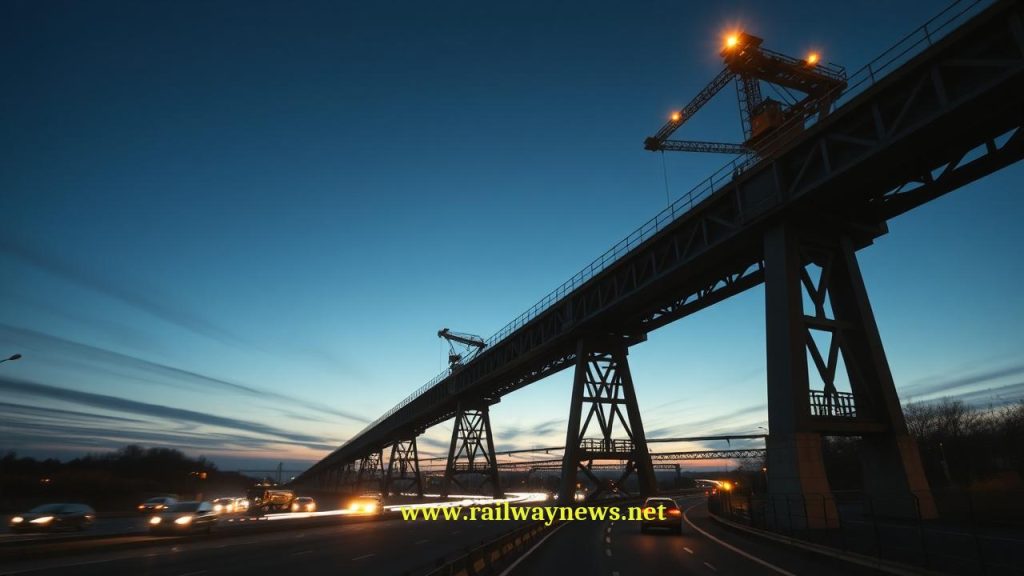
In a UK engineering first, HS2 has successfully slid a 4,600-tonne, 315-metre viaduct deck into its final position over the live M6 motorway near Birmingham. The landmark 17-hour operation was completed using an innovative ‘fully restrained’ technique that avoided the need for a full weekend closure of one of Britain’s busiest transport arteries, halving the expected disruption to motorists.
| Category | Details |
|---|---|
| Project Component | HS2 M6 South Viaduct (East Deck) |
| Structure Weight | 4,600 tonnes |
| Structure Length | 315 metres |
| Key Innovation | ‘Fully Restrained’ slide over live motorway traffic (UK First) |
| Design Partners | Design Joint Venture (Mott MacDonald, SYSTRA, WW+P Architects) |
The successful installation marks the culmination of an epic three-stage process and the halfway point for the M6 South viaduct’s construction. This East deck will eventually carry high-speed trains heading north towards Birmingham and Crewe. The operation represents a significant milestone for the HS2 project, showcasing a new focus on efficiency and minimising public disruption. “We believe this fully restrained slide was a first for the country, but most importantly it means we’ve been able to cut in half the number of times we’ve had to close the motorway,” said Caroline Warrington, Senior Project Manager for HS2 Ltd.
The pioneering technique was developed in close collaboration with National Highways. It involved an initial overnight closure to move the viaduct twelve metres forward, ensuring both ends of the enormous steel beam were fully supported on concrete piers. The final, main slide was then conducted on Saturday, with the structure moving at a steady 13 metres per hour over live traffic below. This was achieved using a series of powerful winches, known as strand jacks, with the viaduct gliding on non-stick pads made from a material similar to that found on household frying pans to reduce friction. The viaduct itself is made of weathering steel, which develops a stable rust-like layer that eliminates the need for painting, and was launched with 82 precast concrete deck slabs already in place to further reduce future road closures.
This achievement is a clear example of the strategic reset of the HS2 programme, currently being led by Mark Wild, which prioritises boosting productivity and delivering the railway at the lowest reasonable cost. By proving a method that drastically reduces impact on existing critical infrastructure, the project team has provided a valuable blueprint for future works. “Our key focus is the impact that these major construction works have on our roads,” commented Victoria Lazenby, Programme Leader for National Highways. “We are delighted that this innovative technique has meant that not only was this enormous structure slid into place without having to close the motorway during the day but also that the total number of closures needed has also been halved.” With the East deck now in place, focus will shift to constructing the parallel West deck, which will be launched in phases throughout 2026.
Key Takeaways
- UK-First Technique: The ‘fully restrained’ slide over a live motorway is believed to be the first of its kind in the UK, setting a new benchmark for infrastructure projects.
- Disruption Halved: The innovative method cut the number of required full motorway closures by 50%, significantly reducing the impact on road users on the M6/M42 interchange.
- Major Milestone Reached: The 4,600-tonne East deck is now complete, marking the 50% completion point for the entire M6 South viaduct structure, a key component of HS2 Phase One.
Editor’s Analysis
This successful viaduct installation is more than just a domestic engineering achievement; it’s a powerful demonstration of how mega-projects can mitigate their impact on heavily congested, existing transport networks. For the global rail market, the challenge of building new lines through dense urban and suburban corridors without causing crippling disruption is a primary concern. The ‘fully restrained’ slide technique employed here provides a tangible, proven methodology that could be adapted for projects worldwide, from Europe to North America and Asia. It also serves as a crucial public relations victory for HS2, shifting the narrative from cost and controversy to tangible engineering innovation and a clear commitment to minimising public inconvenience—a valuable lesson for any large-scale infrastructure programme seeking to maintain social and political support.
Frequently Asked Questions
- What is the ‘fully restrained’ slide technique?
- It is an engineering method that allows a massive structure, like a bridge deck, to be pushed into its final position over a live transport route. By ensuring the deck is fully supported on piers at both ends during the main slide, it provides the stability needed to operate safely above moving traffic, thereby avoiding the need for prolonged closures.
- How heavy and long is the HS2 M6 viaduct deck?
- The East deck of the M6 South viaduct weighs 4,600 tonnes and measures 315 metres in length. It is supported by four pairs of concrete piers, the tallest of which is 9.9 metres high.
- What is the next step for the M6 South viaduct?
- With the East deck now in place, the project team will begin finishing works on the structure. The primary focus will then shift to the construction and installation of the parallel West deck, which will carry southbound trains. This second deck will be launched into position using a similar multi-phase process throughout 2026.
RELATED POSTS

September 4, 2017 10:58 pm
Unlocking railway project success: Learn how comprehensive planning, funding,...
December 11, 2020 6:10 pm
This article examines the significant infrastructure development project undertaken in...

June 27, 2025 3:33 am
Greenbrier adds veteran railroad leaders to its board, boosting its...

May 29, 2025 4:00 am
Port of Indiana-Burns Harbor: A New Warehouse to Boost Logistics...

October 10, 2009 8:27 pm
The pre-feasibility study for a new rail network to connect...

March 13, 2025 10:47 am
Metro-North Railroad is poised to make history by introducing the...