
HS2’s Chipping Warden Tunnel: Rail Infrastructure & Productivity
HS2’s Chipping Warden green tunnel nears completion with road realignment. The *railway* project sees productivity gains and program resets for efficient *infrastructure* delivery.

Introduction
The A361 road in the vicinity of Chipping Warden has been realigned to facilitate the construction of the 2.5km Chipping Warden green tunnel, part of the HS2 project. This realignment allowed HS2 contractors to connect the existing tunnel sections, which will integrate the railway into the landscape, and minimize noise for local residents.
Road Realignment and Tunnel Design
A section of the A361, which runs from Banbury to Daventry, was closed for eleven days to allow the carriageway to be safely realigned over the top of the first section of the tunnel. This new section of the A361 joins the Chipping Warden Relief Road, which was completed by HS2 in 2022 to take traffic away from the centre of the village. The reopening of the road on Friday allows HS2’s contractors to begin work on the missing section that will link up the two parts of the tunnel.
The tunnel is constructed from precast concrete segments and is designed in an ‘M’ shape, with separate halves for northbound and southbound trains. Inspired by similar structures on the French high-speed network, the precast approach was chosen for its potential for rapid assembly, with a significant portion of the work occurring offsite. The green tunnel approach, where the cut-and-cover tunnels are landscaped on top, is being applied at Chipping Warden, one of five such tunnels on the HS2 project.
Construction Process and Improvements
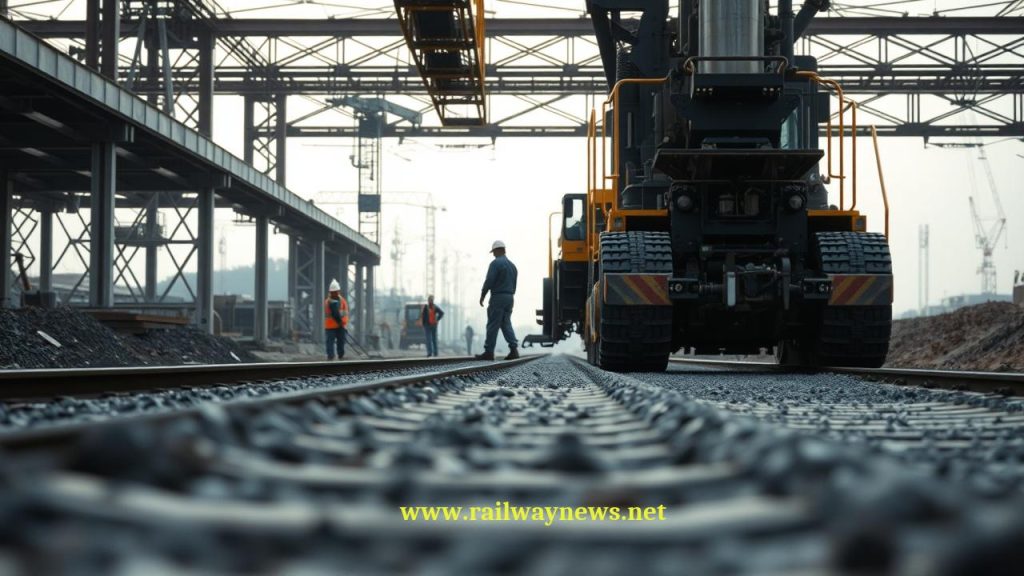
The construction of the tunnel is happening in stages, with the cutting first being excavated and then a layer of ‘blinding’ laid to form a concrete base for the structure. The steel reinforcing bars are now being delivered as a ‘roll mat’ with the parallel bars connected by mild steel tape so they can be quickly rolled out ready for the concrete pour. The next stage involves the assembly of the five concrete segments that form each of the ‘M’ shaped sections of tunnel. Continual improvements have been made to the delivery and installation process to improve the speed and accuracy of the assembly and cut unnecessary waiting time.
Once the structure has been assembled, a concrete ‘invert’ slab is poured to form the base for the track. This process has been sped up by changing the direction from which concrete is delivered and by introducing prefabricated reinforcing cages which has doubled the speed of the process. The valley in the top of the ‘M’ is now being filled with an aerated concrete mix, which is faster and more reliable to install than aggregate.
Productivity Enhancements and Collaboration
The initial construction schedule proved overly optimistic, with the team facing significant productivity challenges during the first two years on site. HS2 worked closely with its main works contractor EKFB – a team made up of Eiffage, Kier, Ferrovial Construction and Bam Nuttall – to identify and implement a series of improvements to the construction process. These improvements were tested on site at a specially built section of test tunnel, allowing the team to experiment with new approaches offline without risking further delays to construction. This testing, and a rigorous focus on improving the logistics of the complex process, which is now directly delivered by EKFB, contributed to a doubling of the install rate for tunnel segments.
As a result, the rate of installation has doubled from an average of two segments a day in 2022/23 to five-and-a-half per day this year, with 2.1km worth of segments now installed. These improvements help to reduce interfaces between separate teams working at the very restricted space at the face of the tunnel and build flexibility into the programme to help manage any unexpected delays.
Programmatic Oversight
While significant progress is being made on many parts of the project, some of the civil engineering, like the Chipping Warden tunnel, are further behind. As a result, Mark Wild, HS2 Ltd’s Chief Executive, is now leading a comprehensive reset of the programme to deliver the railway in the most efficient way possible and for the lowest reasonable cost. Lessons learnt from Chipping Warden are also being applied to the tunnels at Wendover and Greatworth, which both use a similar pre-cast approach.
Last June 2025, we published an article about Renfe’s cutting-edge Aranjuez maintenance hub. Click here to read – Future of Rail: Renfe’s Railway Technology Hub, Aranjuez: Essential Guide
Conclusion
The A361 road realignment marks a significant milestone in the construction of the Chipping Warden green tunnel. The HS2 project is implementing improvements to construction processes, increasing productivity, and applying lessons learned to other tunnel projects. Despite progress, a comprehensive program review is underway to optimize project delivery.
Company Summary
EKFB: A team made up of Eiffage, Kier, Ferrovial Construction and Bam Nuttall.
Eiffage: Main works contractor.
Kier: Main works contractor.
Ferrovial Construction: Main works contractor.
Bam Nuttall: Main works contractor.
HS2 Ltd: Responsible for the HS2 project.
Technology
No technology is mentioned in the provided text.
RELATED POSTS
April 1, 2026 12:10 pm
Alstom secured a €410 million contract from CFR SA to...

April 1, 2026 4:31 pm
Network Rail upgraded Berrylands station platforms for £6 million, replacing...
April 1, 2026 6:21 pm
Federal Transit Administration awarded $20.6 billion in formula-based apportionments to...

April 1, 2026 8:40 pm
BNSF Railway expands Galesburg, Illinois, yard capacity, with second hump...