
Cambridge South Station: A Green Blueprint for Rail
Cambridge South station: a groundbreaking project built with sustainability in mind. It’s restoring habitats, minimizing its carbon footprint, and setting a new standard for green railway development.
Cambridge, UK – June 5, 2024
As the UK railway network continues its evolution, the forthcoming Cambridge South station, slated to open in early 2026, exemplifies a commitment to sustainability and environmental stewardship. This ambitious project, a collaborative effort between Network Rail and contractor Murphy, extends beyond mere infrastructure development. It represents a comprehensive strategy to mitigate the environmental impact of construction, enhance biodiversity, and create a lasting positive legacy for the community. This article delves into the various facets of this green initiative, exploring the innovative approaches to habitat restoration, sustainable construction practices, and the integration of the station with the local environment. The project’s dedication to achieving a 10% net gain in biodiversity and reducing its carbon footprint demonstrates a proactive approach to environmental responsibility, setting a precedent for future railway projects.
The focus of this article is on the strategies employed to deliver a greener railway that benefits both the local community and the environment. We will examine the restoration of Hobson’s Park, the station’s design and construction, and the integration with the local transport network.
Restoring Hobson’s Park and Enhancing Biodiversity
A cornerstone of the Cambridge South project is the restoration and enhancement of the neighboring Hobson’s Park nature reserve. To offset the temporary disruption caused by construction activities, extensive work has been undertaken to restore the affected areas. This includes the replanting of native trees and shrubs, reseeding of meadow areas, and the creation of habitats designed to encourage wildlife to return and thrive. A crucial aspect of the project involved the careful preservation of existing habitats. By fencing off large areas of established vegetation, including newly planted broadleaf woodland, the project team minimized disturbance to nesting birds and other wildlife. Furthermore, the utilization of grassland areas for temporary worksites, which are easier and faster to restore than woodland, reflects a strategic approach to minimizing environmental impact during construction.
The project aims to achieve a 10% net gain in biodiversity. To this end, a significant 22,000 square meter area of arable land adjacent to Addenbrooke’s Way has been acquired to extend Hobson’s Park to the south. This expansion serves a dual purpose: it provides a new location for relocating vital habitats that would have been lost due to construction and creates an expanded natural space for the community. The new area incorporates a diverse range of habitats, including native trees, shrubs, hedgerows, and wet grassland. A stormwater attenuation basin has also been integrated to encourage species such as the native water vole, thus promoting biodiversity.
Sustainable Station Design and Construction
The design and construction of the Cambridge South station itself prioritize environmental sustainability. The station’s footprint has been deliberately minimized to reduce land take, particularly on green belt land. This compact design helps to preserve the existing nature area of Hobson’s Park, ensuring the project contributes to the net gain in biodiversity, as per its objectives. The construction process has been meticulously managed to minimize the carbon footprint. By focusing on design and construction efficiencies, the overall carbon footprint of the new station’s construction has been reduced by 22.5%. This approach helps to deliver a new, sustainable transport rail hub for Cambridge.
Furthermore, the station is designed to integrate with the local transport network, in line with the Cambridge Local Plan 2018, which promotes sustainable transport options. The new station is seamlessly connected to the local cycle network, with cycleways and footpaths integrated through Hobson’s Park. A dedicated facility will provide storage for 1,000 bicycles. The nearby guided busway system complements these sustainable transport options, providing access to the station via park-and-ride facilities and the existing bus network, improving access to the station and the Cambridge Biomedical Campus.
Green Infrastructure: A Key Component
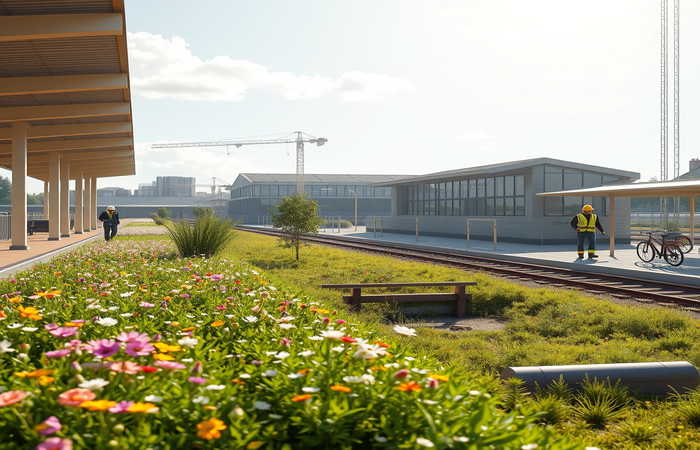
The incorporation of green infrastructure is a defining feature of the Cambridge South station. The station’s design includes a ‘green roof’ which features a wildflower meadow, which is designed to attract pollinators. In addition, a rainwater catchment system, consisting of an underground attenuation tank with a capacity equivalent to a tennis court, has been implemented to store rainwater. This water will be released slowly back into the environment and the nearby brook. The green roof will be complemented by solar panels, which will generate green electricity to reduce the station’s reliance on the national grid.
The station forecourt is designed to provide a pleasant environment for users. Broadleaf tree walkways and a rain garden will enhance the aesthetics. A living fence along the station’s boundary line will add to the overall green environment. These features collectively contribute to the station’s sustainable profile and enhance the user experience.
Conclusion: A Blueprint for Sustainable Rail Development
The Cambridge South station project represents a significant step forward in sustainable rail development, demonstrating that infrastructure projects can be designed and delivered with a deep commitment to environmental stewardship. The meticulous restoration of Hobson’s Park, the proactive measures to enhance biodiversity, and the focus on minimizing the carbon footprint throughout construction showcase an integrated approach to sustainable development. The station’s green design features, its integration with the local transport network, and its commitment to minimizing environmental impact offer a blueprint for future rail projects.
The project exemplifies how the rail industry can contribute to local sustainability goals and provide tangible benefits to the community. By prioritizing environmental considerations, Network Rail, Murphy, and their partners have created a railway station that is not only fit for the future, but also enhances the local environment, provides sustainable transport solutions, and enriches the quality of life for local residents. This collaborative model, with the dedication to innovative design and sustainable practices, sets a high standard for future rail projects in the UK and beyond.
In short, the Cambridge South station is more than just a transport hub. It’s a commitment to a greener, more sustainable future for Cambridge, a legacy that will benefit both the community and the environment for generations to come.
About the Companies:
- Network Rail: The owner and infrastructure manager of most of the railway network in Great Britain.
- Murphy: A global, family-owned, specialist engineering and construction company.