
MTA & Real Estate Giants Partner: Grand Central Shed Rebuild Confirmed
MTA partners with JPMorgan Chase and Vornado to rebuild the Grand Central Train Shed. This public-private partnership tackles critical infrastructure decay, ensuring future Metro-North operations.
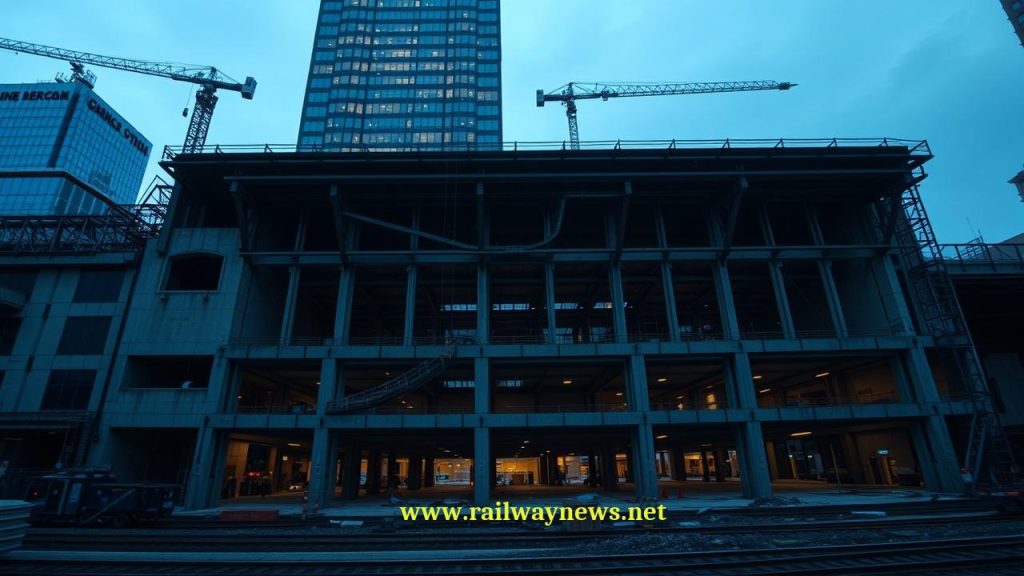
New York, NY – New York’s Metropolitan Transportation Authority (MTA) is advancing a critical infrastructure overhaul of the Grand Central Train Shed through innovative public-private partnerships with real estate giants JPMorgan Chase & Co. and Vornado Realty Trust. This strategic collaboration, part of the MTA’s 2025-2029 capital plan, aims to rebuild the century-old subterranean structure that is vital to Metro-North Railroad operations, leveraging private development to fund public transit renewal.
| Category | Details |
|---|---|
| Project Name | Grand Central Train Shed Reconstruction |
| Location | Below Park Avenue, from 42nd St to 57th St, New York City |
| Lead Agency | Metropolitan Transportation Authority (MTA) |
| Private Partners | JPMorgan Chase & Co. (JPMC), Vornado Realty Trust |
| Project Timeline | Part of the MTA 2025-2029 Capital Plan |
| Primary Justification | Severe deterioration of concrete and steel from decades of water and de-icing salt infiltration. |
Main Body:
The MTA has formally announced its partnership with JPMorgan Chase and Vornado Realty Trust to undertake the comprehensive reconstruction of the Grand Central Train Shed. This vast underground structure serves as the critical approach for nearly all Metro-North trains entering Grand Central Terminal, sorting them onto the correct passenger platforms. The project is a key component of the agency’s upcoming 2025-2029 capital plan, addressing decades of structural decay that threatens the integrity of both the railway and the Park Avenue roadway above.
The primary technical challenge stems from the severe degradation of the shed’s foundational elements. For decades, corrosive elements such as road salt, water, and various chemicals have seeped down from Park Avenue, relentlessly eroding the structure’s concrete encasements and steel support beams. The reconstruction will involve complex, phased work to replace these compromised components while maintaining the continuous operation of one of the world’s busiest commuter rail networks. This effort builds on a successful pilot phase where work on a segment of the train shed was integrated with the construction of JPMC’s new headquarters at 270 Park Avenue, a synergy that brought the initial project in under the MTA’s budget and is on track for completion by late 2026.
This public-private partnership (P3) model is becoming a hallmark of the MTA’s strategy for tackling large-scale infrastructure needs in a fiscally constrained environment. By aligning the rebuild with major private real estate developments overhead, the MTA can share costs and logistical burdens. The collaboration with JPMC on their headquarters set a powerful precedent, demonstrating that private construction can be leveraged to execute complex public works efficiently. This new, expanded partnership with both JPMC and Vornado signals a scalable approach to modernizing critical, yet unseen, transit infrastructure across New York City.
Key Takeaways
- The project addresses critical structural decay in the train shed beneath Park Avenue, which is essential for Metro-North operations.
- The MTA is utilizing a P3 model, partnering with JPMC and Vornado Realty Trust to integrate public works with private real estate development.
- A previous, smaller-scale project with JPMC proved the model’s financial and logistical viability, coming in under budget.
Editor’s Analysis
This move by the MTA is a masterclass in urban infrastructure renewal for the 21st century. In an era where public funding for massive “state of good repair” projects is increasingly scarce, leveraging the value of overlying real estate is not just innovative; it’s essential. This P3 model creates a symbiotic relationship: private developers gain streamlined approvals and integrated construction, while the public transit agency gets its critical infrastructure rebuilt at a reduced direct cost. For the global rail market, the Grand Central Train Shed project serves as a powerful case study on how to unlock private capital to modernize legacy systems in dense, high-value urban corridors. This is a replicable strategy for cities like London, Tokyo, and Paris that face similar challenges with aging, vital subterranean rail networks.
Frequently Asked Questions
- What is the Grand Central Train Shed?
- It is the large underground structure beneath Park Avenue in Manhattan, spanning from 42nd to 57th Street. It contains the tracks and switches that sort MTA Metro-North Railroad trains to their designated passenger platforms inside Grand Central Terminal.
- Why does the train shed need to be rebuilt?
- Over many decades, the structure’s concrete and steel beams have been severely deteriorated by salt, water, and chemicals seeping down from the street level, compromising its structural integrity.
- Who is funding the reconstruction?
- The project is part of the MTA’s 2025-2029 capital plan and is being advanced through a public-private partnership (P3) with JPMorgan Chase & Co. and Vornado Realty Trust, which helps share the financial and logistical load.
RELATED POSTS

July 27, 2022 3:56 am
This article explores Stadler’s commitment to sustainable railway solutions, focusing...
August 15, 2018 11:27 am
Amtrak's $370 million Northeast Corridor upgrade means faster track maintenance,...
October 3, 2022 11:56 am
This article examines the recent agreement between Alstom and Polo...

August 12, 2025 10:33 pm
Frauscher opens new railway sensor manufacturing hub in Mysore, India,...
June 21, 2025 3:49 am
Amtrak plans Northeast Regional expansion to Ronkonkoma, Long Island, connecting...
May 23, 2017 6:40 am
The Port of Long Beach is piloting Adaptable Carriage technology,...