
TRU Christmas Bridge Works: Quad-Tracking Advances in UK
Deighton’s quad-tracking project advances with Christmas bridge works, enabling four tracks and electrification, boosting capacity and future rail services.
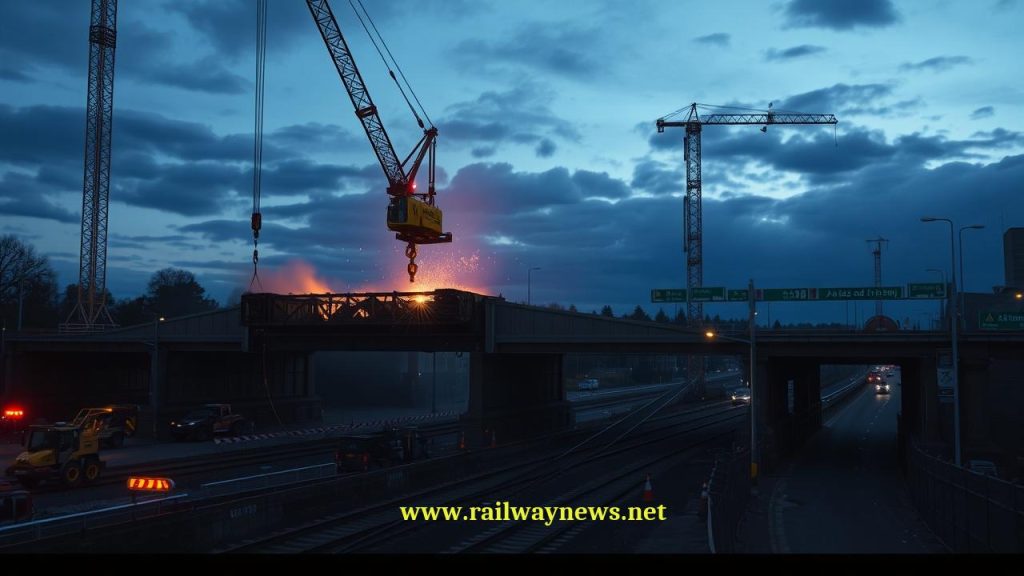
Major bridge demolition and upgrade works are scheduled for the Christmas period at Deighton as part of the multi-billion-pound Transpennine Route Upgrade (TRU). These works are a critical enabler for the future four-tracking and electrification of the line, a project that will see Deighton station remain closed until its complete transformation in 2027.
| Category | Details |
|---|---|
| Project | Deighton Station Modernisation (Part of Transpennine Route Upgrade) |
| Lead Organisation | Transpennine Route Upgrade (TRU) |
| Key Works | Demolition of Whitacre Street overbridge; Parapet installation on A62 Leeds Road bridge |
| Construction Materials | Pre-cast concrete parapets, aligning with industry trends towards advanced materials for efficiency. |
| Primary Goal | Enable track realignment from two to four tracks and future OLE installation. |
| Station Status | Deighton Station closed until 2027 for complete rebuild. |
The Transpennine Route Upgrade (TRU) programme will leverage the reduced passenger service over the Christmas holiday period to advance a crucial phase of its Deighton station modernisation project. The works involve the complete demolition of the Whitacre Street overbridge and the installation of new, pre-cast concrete parapets on the A62 Leeds Road bridge using a crane. According to TRU sponsor Sophie Leishman, this period is a key opportunity to complete disruptive work with minimal impact on services. “We’d like to thank the local community for their understanding as we work to deliver major upgrades for Deighton station,” she stated. “The work on both bridges during this time will take us a step closer to a much-improved Deighton station and improved rail services through the area and beyond.”
These structural interventions are foundational for the project’s primary engineering goal: doubling the number of tracks through the area from two to four. This track realignment, scheduled for next year, is a game-changer for the route’s capacity, allowing faster, direct services to overtake local stopping services, which will significantly reduce journey times. Additionally, the revised bridge clearances and track layout will facilitate the subsequent installation of Overhead Line Equipment (OLE), paving the way for a fully electrified fleet of quieter, greener trains. The use of pre-cast concrete components for the A62 bridge is indicative of a wider industry trend towards off-site manufacturing and advanced materials, such as self-compacting concrete, which are increasingly specified in major infrastructure projects to accelerate construction and improve quality control within tight operational windows.
The work at Deighton is a microcosm of the wider TRU ambition to transform one of the UK’s most vital rail arteries. This multi-billion-pound, multi-year programme is upgrading the entire line between Manchester, Huddersfield, Leeds, and York to deliver a more frequent, reliable, and higher-capacity service. The complete transformation of Deighton station, set for a 2027 reopening, will feature a host of passenger improvements that are currently unspecified but are expected to align with the modern accessibility and facility standards being rolled out across the upgraded route. While local road diversions will remain in place, the long-term benefits of this intensive engineering blockade are central to unlocking the economic and environmental potential of the railway across the North of England.
Key Takeaways
- Major Infrastructure Milestone: The demolition of one bridge and upgrading of another are critical enabling works for the main track expansion project at Deighton.
- Quad-Tracking and Electrification: The ultimate goal is to increase track capacity from two to four lines and install overhead power lines, allowing for faster, more frequent, and greener electric train services.
- Long-Term Station Closure: Deighton station will remain fully closed to passengers until 2027 to allow for its complete reconstruction as a modern, accessible facility.
Editor’s Analysis
While the focus is on a local station, the engineering works at Deighton represent the granular, complex reality of modernising a 19th-century railway for 21st-century demands. Major network-wide upgrades like the TRU are not just about new trains and signalling; they depend on a cascade of civil engineering interventions on legacy infrastructure. The demolition and modification of these two bridges highlight the foundational work required to create the physical clearance and footprint for additional tracks and electrification masts. This project underscores a key challenge for the global rail industry: successfully integrating modern standards of speed, capacity, and sustainability onto historic alignments, a task that requires long-term closures and significant capital investment but is essential for future-proofing critical economic corridors.
Frequently Asked Questions
- Why is Deighton station closed until 2027?
- Deighton station is closed for a complete transformation as part of the Transpennine Route Upgrade. The closure facilitates major engineering works, including track realignment to expand from two to four tracks and the complete rebuilding of the station itself.
- What specific bridge work is being carried out?
- The Whitacre Street overbridge is being completely demolished. Concurrently, the A62 Leeds Road bridge is being upgraded with the installation of new pre-cast concrete parapets to accommodate the future railway layout.
- What are the main benefits of this project?
- The primary benefits will be increased capacity and reduced journey times. Doubling the tracks allows fast trains to overtake stopping services, while electrification will enable the use of greener, more efficient electric trains, improving the overall service on the Transpennine route.

Railway infrastructure, rolling stock and transport technologies specialist focused on global rail industry developments, high-speed rail systems, signaling technologies and freight transportation. Covering railway investments, public transport modernization, rail operations and international mobility projects across Europe, Asia and North America.
RELATED POSTS

September 6, 2026 5:19 am
Hitachi delivered Taiwan's first N700ST high-speed train from Japan in...

September 5, 2026 4:19 pm
CPK launched formal tender talks with four consortia to design...

September 5, 2026 7:14 pm
HS2 Ltd signed renegotiated civils contracts with EKFB and Align...

September 6, 2026 4:12 am
Alstom delivered the first of 100 new G Class trams...

September 6, 2026 1:17 am
Hitachi Toshiba Supreme Consortium confirmed the first of 12 N700ST...
September 6, 2026 8:17 am
DB InfraGO reopened the Nuremberg-Regensburg line in Bavaria on 31...