
IBX Light-Rail: NYC’s Transit Boost – Rail Infrastructure Advances
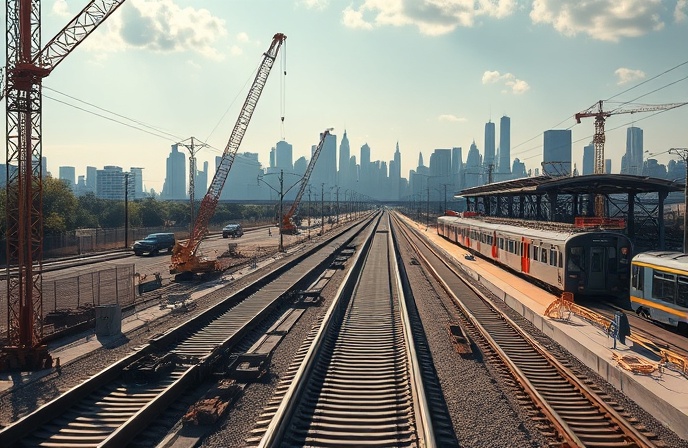
New York City’s IBX light-rail project, a 14-mile line along existing tracks, advances. MTA, with Hochul’s backing, aims to connect underserved areas.
“`html
IBX Light-Rail Project Advances, Connecting Underserved Communities in New York City
New York City’s transportation landscape is poised for a significant transformation as the Interborough Express (IBX) light-rail project enters its crucial engineering and design phase. What is the IBX? It’s a new 14-mile transit line. Where will it be built? Along an existing freight rail line in Brooklyn and Queens. When is this happening? The project is currently in the design phase, following funding approval earlier this year. Who is behind this initiative? The Metropolitan Transportation Authority (MTA), with the support of Governor Kathy Hochul. Why is the project important? The IBX aims to connect historically underserved communities to existing public transit options, enhancing accessibility and improving regional connectivity. This article will delve into the project’s key elements, highlighting its potential impact and the technical considerations involved in its execution.
Project Design and Engineering Phase
The MTA Board’s confirmation of the Jacobs/HDR joint venture marks a critical milestone in the IBX’s development. This joint venture is now tasked with leading the design and engineering phase, a process that encompasses detailed track layouts, station designs, and the integration of advanced signaling systems. The project will leverage the existing 14-mile freight-rail line, jointly owned by the Long Island Rail Road (LIRR) and CSX, minimizing the need for new right-of-way acquisitions and potentially reducing construction time. This existing infrastructure presents unique engineering challenges, including the need to integrate light-rail infrastructure with existing freight operations and addressing varying track geometries. The design phase must also address potential noise mitigation strategies and environmental impact assessments, critical considerations for operating in densely populated urban areas. Successful design necessitates meticulous planning to ensure efficient operations while also ensuring the safety of both passengers and freight train services.
Funding and Financial Framework
The financial underpinning of the IBX is substantial, with Governor Hochul approving $2.75 billion in funding earlier this year as part of the MTA’s capital plan. The project’s total estimated cost is $5.5 billion. The MTA’s financial commitment represents a strong vote of confidence in the project’s viability and its potential to alleviate traffic congestion. Securing remaining funding, likely through a combination of state and federal grants, is crucial. The financial structure includes allocation of the remaining $2.75 billion within the MTA’s 2025-2029 capital plan. The project’s financial management will be a key focus as it progresses into the construction and implementation phases. Maintaining strict adherence to budget targets and securing any necessary future funding will be critical for project success.
Connectivity and Transit Integration
A primary goal of the IBX is to enhance connectivity for nearly 900,000 residents along its route. The new line will provide a significant transit alternative in areas with limited public transport options. The project proposes 19 stations strategically located to serve diverse communities. The design incorporates seamless connections to 17 subway lines, 50 bus routes, and two LIRR stations. This level of integration will vastly improve access to employment centers, educational institutions, and recreational facilities for many residents of Brooklyn and Queens. This integrated approach ensures that the IBX is not just a standalone transit line, but an integral component of the broader New York City public transportation network.
Construction and Operational Considerations
The 14-mile route, stretching from Sunset Park, Brooklyn, to Jackson Heights, Queens, along the existing freight-rail line, presents unique construction challenges. The engineering and design phase will need to carefully address the integration of the light-rail tracks, signaling systems, and stations within the existing infrastructure. Careful consideration must be paid to phasing the construction to minimize disruption to existing freight services and residential areas. The selection of rolling stock (the trains themselves) will also be crucial, with considerations for passenger capacity, acceleration and deceleration performance, and energy efficiency. Once operational, the IBX will require a robust maintenance program, including scheduled track maintenance, fleet management, and signaling system upkeep, to ensure its long-term reliability and operational efficiency.
Conclusion
The advancement of the Interborough Express light-rail project represents a significant step towards a more interconnected and equitable transportation system for New York City. The project’s focus on serving underserved communities and its integration with existing transit networks have the potential to significantly improve mobility and reduce reliance on private vehicles. The successful completion of the engineering and design phase will be critical, with implications for other cities and regions considering similar transit projects. The use of existing rail infrastructure offers both benefits and challenges, while careful planning, robust funding, and efficient project management will be essential for delivering the IBX on time and within budget. The project underscores the importance of investment in public transportation to foster economic development, improve quality of life, and reduce carbon emissions. The IBX represents a forward-thinking approach to public transit, emphasizing accessibility, connectivity, and sustainable urban development.
“`
RELATED POSTS

November 19, 2021 5:59 pm
Europe's rail future is ERTMS. Leading infrastructure managers are...

November 6, 2014 6:07 pm
The newest tram produced by the Škoda Pilsen plant has...
October 28, 2025 9:54 pm
A colossal crane joins the BART Silicon Valley expansion project,...

U.S. **rail traffic** experienced a 3.8% decline in the week...

May 19, 2025 7:09 am
Princeton TMX and Telegraph Forge Alliance to Revolutionize Rail Logistics...
March 30, 2018 9:18 pm
The West Coast Partnership franchise: Modernizing the UK rail...