
WCML Open Access Rejected: UK Rail Capacity & Future Investment
ORR rejects WCML open access bids due to capacity issues, impacting Virgin, FirstGroup, and WSMR. The congested southern section lacks space for new services.
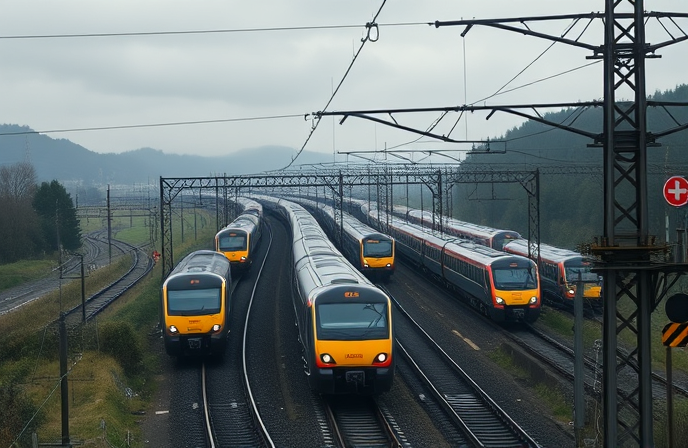
Open Access Dreams Dashed: ORR Rejects WCML Applications Due to Capacity Constraints
The Office of Rail and Road (ORR), the UK’s independent safety and economic regulator for railways, has rejected three open access applications for services on the West Coast Main Line (WCML), delivering a significant blow to potential new entrants. This decision, announced recently, centers around the lack of available capacity on the southern section of the WCML, already operating at maximum throughput. The rejected applications came from Virgin, FirstGroup (Lumo brand), and Wrexham, Shropshire & Midlands Railway (WSMR). This ruling, effective immediately, will significantly impact the ambitions of these operators and fuels debate about the future of open access rail services. The core issue revolves around the ORR’s assessment of the WCML’s capacity and its impact on network reliability. The question arises: Can the WCML, a vital artery of the UK rail network, accommodate more passenger services without compromising its operational efficiency?
Capacity Constraints and Operational Concerns
The ORR’s primary justification for the rejections is the congested nature of the southern WCML. The regulator’s assessment found that adding new open access services would significantly harm the performance and timetabling resilience of existing services. The WCML, a critical railway line connecting London to major cities like Liverpool, Manchester, Birmingham, and Glasgow, is already struggling to manage the current volume of traffic. Stephanie Tobyn, ORR’s director of strategy, policy and reform, explicitly stated, “The evidence showed that new services would harm the performance of existing services on this congested section of the network.” The ORR’s decision emphasizes the delicate balance between promoting competition and ensuring operational efficiency within a complex rail network. The implication is clear: further services on the southern WCML are currently unfeasible due to infrastructure limitations.
Specific Application Details and Stakeholder Reactions
Virgin’s proposal, aiming for a return to the UK rail market with services linking London to various cities, faced the most significant setback. FirstGroup’s Lumo brand had proposed a “Lumo North West” service, and WSMR, backed by Alstom, sought to revive a London–Wrexham connection. All these were rejected after a detailed ORR review focused on performance, timetabling, and capacity. Virgin Trains, formerly a significant player on the WCML before its exit in 2019, expressed disappointment, characterizing the decision as “a blow for consumer choice and competition.” Campaigners also voiced their concerns. Neale Coleman, chair of the Campaign for Better Transport, stated that “It’s disappointing to see new open access services turned down, especially as these can offer passengers better value and more choice.” The rejection particularly impacted Virgin, who had been keen to re-enter the UK rail market. These stakeholder responses underscore the potential benefits of open access services – enhanced competition, increased choice for passengers, and potentially lower fares – that are now deferred due to infrastructural limitations.
Political Considerations and Regulatory Independence
The ORR has been keen to emphasize its impartiality and technical focus in this decision. The regulator’s director, Stephanie Tobyn, explicitly addressed concerns regarding political or financial influence, stating: “There is no evidence to support claims that this decision was made to protect franchised revenue. Our decisions are based on the data, not political or financial pressure.” This statement is crucial, as it maintains the integrity of the regulatory process and refutes any suggestions of bias. The rejection of the applications is, therefore, framed as a purely technical assessment of the WCML’s capacity limitations, rather than any politically motivated decision. This statement emphasizes the significance of technical expertise and data-driven analysis in maintaining the impartiality of the ORR and preventing any form of external pressure.
The Open Access Landscape: Contrasts and Future Outlook
The ORR’s decision sheds light on the uneven playing field of open access rail services in the UK. While the WCML, particularly its southern portion, presents significant capacity constraints, other lines, like the East Coast Main Line (ECML), offer more favorable conditions. The ECML continues to support open access operators such as Hull Trains, Grand Central, and Lumo, with five additional open access bids under ORR review. The differing situations on the WCML and ECML underscore the importance of localized infrastructure investment to facilitate expanded service and encourage new open access services. A recent approval granted to FirstGroup to operate a new open access route between London and Stirling demonstrates the potential for open access services where capacity allows.
Conclusion
The ORR’s decision to reject the open access applications on the WCML highlights the critical need for increased infrastructure investment to unlock further capacity and support competition within the UK rail sector. The rejection will be seen as a significant setback for Virgin and other operators seeking to expand their reach in the UK. The situation underscores the need for strategic capacity upgrades on the congested sections of the WCML to enable the introduction of new services. This will require long-term investment and careful planning. The rejection also brings the importance of open access and its ability to offer better value and increase consumer choice back into discussion. The contrasting dynamics between the WCML and ECML, illustrate the geographically specific challenges and opportunities. Looking ahead, the future of open access depends on strategic infrastructure investment and efficient network management. This is essential to accommodate further service and encourage new entrants into the market. It also is the only way to maintain an accessible, functional railway network capable of serving the evolving needs of passengers across the UK.
Company Summary
Virgin: Virgin Rail Group previously operated long-distance passenger rail services in the UK, including the WCML. Its operations are currently under review, and it’s been unsuccessful in its recent bid to return to the UK rail market. The company’s history and brand recognition position it as a potentially strong competitor in the open access market, provided capacity constraints are addressed.
FirstGroup (Lumo): FirstGroup is a major transport operator in the UK, running several train operating companies. The Lumo brand is specifically focused on open access services.
Wrexham, Shropshire & Midlands Railway (WSMR): WSMR is a company backed by Alstom. It shows the interest in passenger rail services.
RELATED POSTS

April 1, 2022 10:41 am
Network Rail’s £83m Investment in UK Rail Upgrades: Enhancing Capacity...

At the XV International investment forum "Sochi - 2016", a...
March 30, 2025 2:02 am
Introduction The railway industry is undergoing a significant digital transformation,...

August 2, 2016 12:22 pm
French rail transport company Alstom has secured a €800m contract...
June 14, 2025 10:21 am
Foundation Laid for Delice–Çorum High-Speed Rail Line: Travel Time Between...

October 15, 2023 4:10 am
EN 14033 – Part 2: Technical Requirements for Travelling and...