
Mashhad Metro: 2026 Construction Update & Route Map
Mashhad Metro expands, showcasing advanced railway technology in Iran. Lines 1 & 2 utilize TBMs and international partnerships, boosting urban mobility.

Project Profile: Mashhad Metro, Iran
The Mashhad Metro system is a landmark urban rail development in Iran, engineered to serve the country’s second-most populous city. This project profile details the technical specifications and execution of its operational lines, which feature advanced tunneling methods through challenging geologies and a combination of international and domestic rolling stock procurement. The system stands as a key case study in regional transportation infrastructure development.
| Attribute | Details |
|---|---|
| Project Name | Mashhad Metro Development |
| Location | Mashhad, Khorasan Razavi Province, Iran |
| Operational Length | ~39.3 km (Line 1: 25 km; Line 2: 14.3 km) |
| Max Speed | 70 km/h (Line 1 LRVs) |
| Status | Lines 1 & 2 Operational; Future lines proposed |
| Key Contractors | CNR Changchun (Rolling Stock), Tehran Wagon Manufacturing (Rolling Stock), Arthe Civil & Structure (Engineering), PARSIAN Rail Power (PRP) (Electrification) |
Technical Specifications
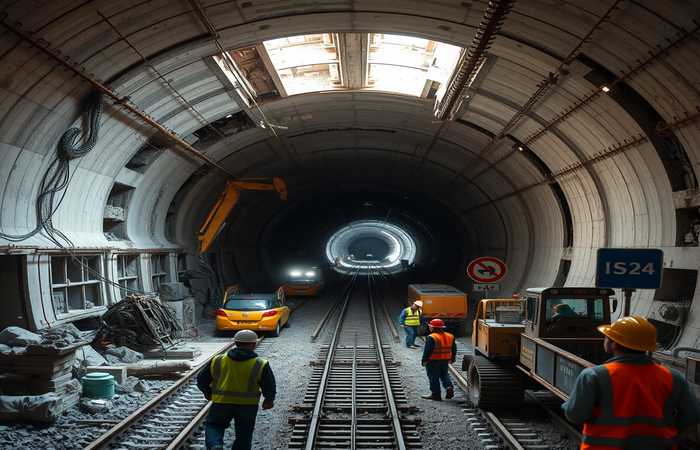
Tunneling and Civil Works: The Mashhad Metro project is notable for its extensive underground sections designed to navigate a dense urban environment. Line 2, a 14.3 km heavy metro route, is almost entirely subterranean (~14 km) and was constructed using advanced tunneling techniques. A key 10.8 km segment was excavated using a Tunnel Boring Machine (TBM) equipped with an Earth Pressure Balance (EPB) shield. This technology was critical for navigating the region’s challenging geological profile, which consists of stiff-to-hard clay intermixed with sand, coarse gravel, and boulders at depths of 16m to 25m. Line 1 contrasts this with a mixed-profile design, integrating a 9.5 km underground segment with surface-level track, demonstrating versatile engineering tailored to different urban zones.
Rolling Stock and Systems: The system’s rolling stock was sourced through international and domestic partnerships. Line 1 operates with a fleet of 60 three-car Light Rail Vehicles (LRVs) manufactured by China’s CNR Changchun Railway Vehicles. These low-floor units are designed for high-capacity service, accommodating 270 passengers and achieving a commercial speed of 34.5 km/h. A subsequent contract for 100 wagons involved a joint production venture between CNR, Farab, and Tehran Wagon Manufacturing, facilitating technology transfer. The project’s electrical systems for Line 2 were managed by PARSIAN Rail Power (PRP) under an EPC contract, ensuring robust power delivery for the heavy metro line’s operational demands.
Key Takeaways
- Advanced TBM Application: The project successfully deployed sophisticated TBM technology with an EPB shield to overcome difficult ground conditions, setting a benchmark for underground metro construction in the region.
- Effective Technology Transfer: Collaboration between international suppliers like CNR and domestic firms such as Tehran Wagon Manufacturing facilitated the local production of rolling stock, enhancing Iran’s domestic railway manufacturing capabilities.
- Strategic Network Integration: The metro system was designed for maximum connectivity, with Line 1 linking directly to Mashhad International Airport and Line 2 providing interchange points with the national railway network and future metro lines.
Frequently Asked Questions (FAQ)
What lines of the Mashhad Metro are currently open?
Lines 1 and 2 of the Mashhad Metro are fully operational. Line 1, a light rail service, commenced operations in 2011 and was extended to the Mashhad International Airport in 2016. Line 2, a heavy metro line, is also in service, connecting key districts from Koohsangi to Tabarsi.
Who built the Mashhad Metro tunnels?
The tunnels for the Mashhad Metro, particularly the complex 14km underground section of Line 2, were constructed using advanced Tunnel Boring Machines (TBMs). Specialist firm Arthe Civil & Structure provided detailed engineering for Line 2’s bored tunnel, while a consortium of contractors managed the excavation and construction, showcasing a multi-faceted approach to the project’s civil works.
RELATED POSTS
June 3, 2020 4:12 pm
Melbourne's Port Rail Transformation Project boosts rail capacity, easing road...

Asia, Bahrain, Future Projects, Infrastructure, Kuwait, News, Projects, Qatar, Saudi Arabia, UAE, Yemen
October 27, 2009 10:43 pm
The six members of the Gulf Cooperation Council (GCC) are...
May 29, 2025 12:00 pm
## East River Tunnel Rehabilitation: A Vital Step Towards Enhanced...

January 24, 2025 10:57 am
The total investment for the modernization project exceeds €830 million,...

December 27, 2016 3:22 am
The railroad construction project, China-Laos, was officially launched today in...
July 8, 2022 4:49 am
San Francisco's Muni Metro N Judah line Sunset Tunnel received...