
Scotland’s Railway: New Cross-Border Team Boosts Anglo-Scottish Rail
Scotland’s Railway launches a cross-border operations team in Glasgow to boost Anglo-Scottish services, improving resilience amid industry financial challenges.
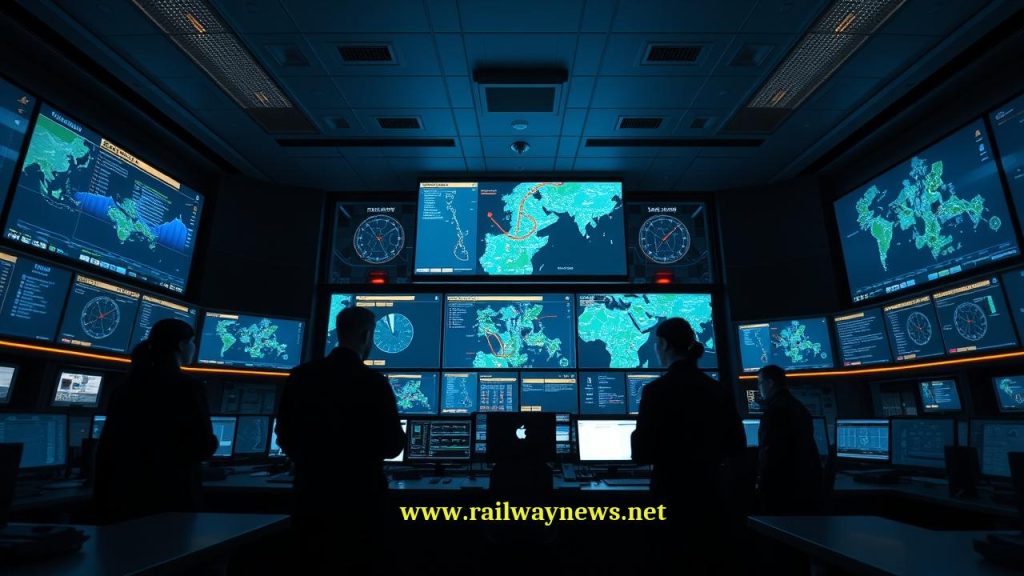
Scotland’s Railway has launched a pioneering Cross-Border Operations Team, embedding train operator staff directly into Network Rail’s Glasgow control centre to streamline services on key Anglo-Scottish routes. This strategic move to boost performance and resilience comes as the UK rail supply chain faces a challenging economic landscape, highlighted by Babcock Rail’s recent £5.2m loss.
| Category | Details |
|---|---|
| Initiative | Launch of First Cross-Border Operations Team |
| Location | Network Rail Scotland’s Rail Operating Centre, Glasgow |
| Team Composition | 8 dedicated Train Service Managers |
| Operational Scope | 24/7 management of 2,000+ daily trains on East & West Coast Main Lines |
| Effective Date | December 12, 2025 (Ahead of Dec 14 timetable launch) |
In a significant step towards integrated network management, Scotland’s Railway has established its first dedicated Cross-Border Operations Team. The initiative, effective December 12, 2025, sees eight train service managers co-located 24/7 within Network Rail Scotland’s state-of-the-art rail operating centre in Glasgow. This move builds on the existing collaborative environment where Network Rail, ScotRail, Caledonian Sleeper, and the British Transport Police already work side-by-side. The primary goal is to enhance performance and service reliability on the vital East and West Coast Main Lines connecting Scotland and England.
The new structure is designed to radically improve real-time communication and decision-making during operational challenges. By embedding a dedicated cross-border team in Glasgow, the industry aims to create a seamless link between the control rooms in Glasgow, York, Birmingham, and Manchester. Simon Constable, Network Rail Scotland’s operations director, stated that having dedicated Anglo-Scot managers in the control room will enable “faster decision-making during times of disruption.” This operational integration is championed by Transport Scotland, with Head of Rail Delivery Damian Briody calling it a “step change in how we manage the network” that will help maintain service continuity.
This push for operational efficiency and resilience is set against a backdrop of diverging fortunes within the wider UK rail industry. While this collaborative initiative aims to optimize existing infrastructure, key suppliers are navigating financial headwinds. Contractor Babcock Rail recently reported a £5.2m pre-tax loss for the year to March 2025, attributing the downturn to a slowdown in framework projects and budget reductions during the transition to a new control period. This contrasts sharply with the success of operators like FirstGroup, which recently secured a major £3 billion contract to run London’s Overground network, demonstrating that significant opportunities exist for companies that can prove their operational prowess.
Key Takeaways
- Enhanced Resilience: A centralized cross-border team enables faster, more coordinated responses to disruptions on the critical West and East Coast Main Lines.
- Improved Communication: Direct integration of train operators into the Glasgow ROC breaks down communication silos between key regional control rooms across Great Britain.
- Industry Collaboration Model: The initiative serves as a blueprint for the “Scotland’s Railway” ethos of a ‘one team’ approach, merging the efforts of Network Rail, train operators, and government bodies for passenger benefit.
Editor’s Analysis
The launch of the Cross-Border Operations Team in Glasgow is more than a regional operational tweak; it represents a strategic response to the inherent fragmentation of the UK’s privatised railway. In an industry where delays in one region can cascade across multiple operators and hundreds of miles, creating a single point of truth for cross-border services is a crucial, low-cost method of boosting network resilience. While capital-intensive projects face scrutiny amid financial pressures on suppliers like Babcock Rail, this type of operational integration offers a blueprint for delivering tangible passenger improvements through collaboration and smarter use of existing resources. Global rail markets with mixed public-private models will be watching to see if this “deep alliance” in the control room can deliver the performance gains that expensive infrastructure upgrades often promise but struggle to achieve.
Frequently Asked Questions
- What is the purpose of the new Cross-Border Operations Team?
- The team’s primary purpose is to improve performance, communication, and resilience on the East and West Coast Main Lines between Scotland and England by enabling faster, more coordinated decision-making, especially during service disruptions.
- Where is the new team based and who is involved?
- The team of eight train service managers is based at Network Rail Scotland’s rail operating centre in Glasgow. It is a collaborative effort involving Network Rail and cross-border train operators, enhancing coordination with control rooms in York, Birmingham, and Manchester.
- Why is this initiative significant for the UK rail industry?
- It demonstrates a shift towards deeper operational integration between infrastructure managers and train operators. In a financially constrained environment, it serves as a model for improving service reliability through collaboration and process enhancement rather than solely relying on large-scale capital investment.

Railway infrastructure, rolling stock and transport technologies specialist focused on global rail industry developments, high-speed rail systems, signaling technologies and freight transportation. Covering railway investments, public transport modernization, rail operations and international mobility projects across Europe, Asia and North America.
RELATED POSTS

August 4, 2026 1:11 pm
Hitachi Rail Canada secured a $407.7M contract to install CBTC...
August 11, 2026 11:13 am
Hungary confirmed the €2.5B Hungarian rail upgrade will not see...

August 4, 2026 11:12 am
MBTA confirmed a $150.8 million overhaul of the 85-year-old Green...

August 1, 2026 7:14 pm
€205 billion funding shortfall threatens the TEN-T rail network's completion...
August 1, 2026 7:56 am
BMZ delivered two new TEM18DM diesel shunting locos to RZD...

August 5, 2026 7:11 pm
JR Central secured Shizuoka governor approval July 7, 2026 for...