
Alstom’s Battery EMU: Revolutionizing Rail

The following article delves into the significant advancements in railway technology showcased by Alstom’s battery-powered electric multiple unit (EMU) train. This innovative technology addresses the persistent challenge of providing sustainable and efficient rail transport on non-electrified lines. The development, testing, and projected deployment of this EMU represents a pivotal moment for the rail industry, signifying a potential paradigm shift away from diesel-powered trains towards cleaner, more environmentally friendly alternatives. This discussion will explore the technical specifications of the train, the collaborative research efforts behind its creation, the economic viability of battery-powered rail transport, and the broader implications for the future of railway operations. The article will also analyze the potential impact on regional transportation networks and the challenges involved in integrating this technology into existing infrastructure.
Alstom’s Battery-Powered EMU: A Technological Leap
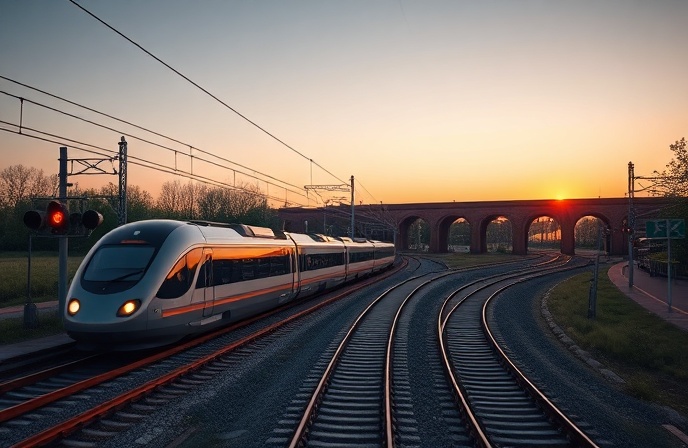
Alstom’s prototype battery-powered EMU, developed at its Hennigsdorf site in collaboration with the Technical University of Berlin and funded in part by the German Federal Ministry of Transport and Digital Infrastructure (BMVI), represents a substantial technological advancement. The train’s key innovation lies in its ability to seamlessly switch between catenary (overhead power line) operation and battery power, enabling operation on both electrified and non-electrified routes. This dual-mode capability significantly enhances its operational flexibility and expands its potential deployment scenarios. The traction battery, developed and tested in Mannheim, is a crucial component, its performance and longevity directly impacting the train’s overall efficiency and economic viability.
Collaborative Research and Development
The success of this project highlights the importance of collaborative research and development within the rail industry. The partnership between Alstom, the Technical University of Berlin, DB Regio (German national railway company), and the German National Innovation Programme for Hydrogen and Fuel Cell Technology has leveraged diverse expertise in engineering, operational analysis, and energy systems. Extensive simulations and real-world testing have ensured the train’s performance and reliability meet stringent standards. The involvement of the Technical University of Berlin, specifically its Department of Railway Operations and Infrastructure and Department of Product Development Methods and Mechatronics, contributed vital insights into operational efficiency, infrastructure integration, and overall system optimization.
Economic Feasibility and Operational Considerations
A key focus of the project has been on establishing the economic feasibility of battery-powered mainline rail operations. Detailed cost analyses, encompassing battery lifecycle, maintenance, charging infrastructure, and operational efficiency, were conducted to determine the overall cost-effectiveness compared to diesel alternatives. This analysis also involved considerations regarding the optimal deployment strategies, including the identification of suitable routes and the integration of the train into existing timetables and operational procedures. The results of this research are crucial for guiding future investment decisions and promoting the wider adoption of battery-powered trains.
Impact on Regional Transportation and Infrastructure
The successful implementation of Alstom’s battery-powered EMU has the potential to significantly impact regional transportation networks. It provides a viable solution for extending rail services to areas currently lacking electrification, improving connectivity and reducing reliance on environmentally damaging diesel trains. This could lead to increased passenger numbers, reduced travel times, and improved overall accessibility in underserved regions. However, the integration of this technology into existing infrastructure requires careful planning and potentially significant investment in charging infrastructure at strategic locations along the chosen routes. This necessitates close collaboration between railway operators, infrastructure providers, and regulatory bodies.
Conclusion
Alstom’s battery-powered EMU represents a significant step towards a more sustainable and efficient future for railway transportation. The successful demonstration of the train’s capabilities, coupled with the comprehensive research undertaken by Alstom and its partners, has clearly demonstrated the technical feasibility and economic viability of this technology. The project’s success highlights the power of collaborative research and development in driving innovation within the rail industry. The seamless transition between catenary and battery power offers unprecedented operational flexibility, opening up possibilities for expanding rail services to non-electrified lines. While challenges remain concerning infrastructure investment and integration into existing systems, the potential benefits for regional transportation networks and the environment are considerable. The projected deployment of the train in Baden-Württemberg and Bavaria marks a pivotal moment, signaling a potential paradigm shift in railway technology and paving the way for wider adoption of battery-powered trains globally. This technology holds immense promise for creating more sustainable, efficient, and accessible rail networks worldwide, reducing reliance on fossil fuels and contributing to a cleaner, greener future for transportation.
RELATED POSTS
November 26, 2025 1:42 pm
First ARGOS **digital interlocking** commissioned in France, boosting **railway** modernization....
September 11, 2016 1:06 pm
Here's a voiceover-friendly excerpt:"The Ceneri Base Tunnel, a critical piece...
April 2, 2025 9:25 am
Introduction This article delves into the significant contract awarded to...
May 1, 2017 10:41 pm
**In September 2020, the Heart of Georgia Railroad completed its...

July 9, 2025 4:33 am
Brisbane's Southside train stations now feature Indigenous art, enriching the...
November 5, 2022 7:24 am
This article explores the significant Bloor-Yonge Capacity Improvements (BYCI) project...