
ZSSK Orders 36 Škoda Battery Trains for EUR 332M, Boosting Slovakia Rail
ZSSK invests EUR 332 million in 36 Škoda **battery trains**, a significant step toward zero-emission regional **rail transport** in Slovakia, modernizing the fleet.
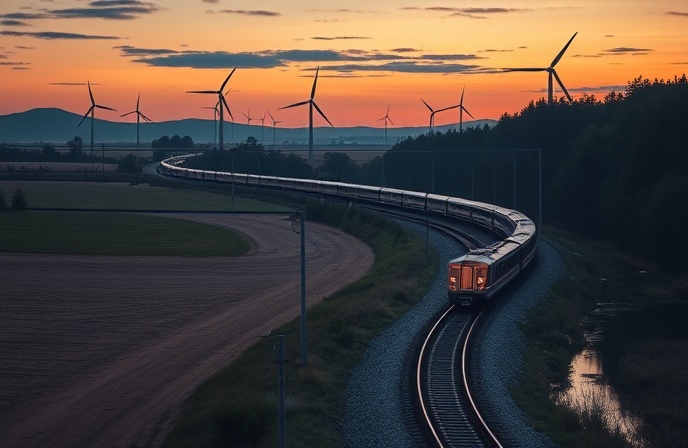
The Slovak national passenger rail operator, ZSSK, has finalized a significant EUR 332 million contract with the ŽOS Trnava consortium, a leading Central European railcar repair firm, for the procurement of 36 Škoda battery trains. This landmark agreement signals a major step towards zero-emission regional rail transport in Slovakia, with initial deliveries slated for next year and an option for an additional 20 units.
| Key Entity | Critical Detail |
|---|---|
| Company | ZSSK (Slovak Passenger Rail) |
| Supplier Consortium | ŽOS Trnava (part of Škoda Group) |
| Contract Value | EUR 332 million |
| Fleet Size | 36 Škoda battery trains (initial order) |
| Timeline | First 16 trains next year; option for 20 more. |
| Technology | Battery-powered electric trains; Zero-emission |
| Key Benefit | Modernization of regional rail, replacement of diesel trains, enhanced passenger comfort. |
The acquisition of these state-of-the-art, zero-emission battery trains represents a pivotal moment for Slovakia’s rail network. The contract, valued at EUR 332 million, will see the introduction of 36 Škoda-manufactured battery trains, with part of the production to be handled by consortium partner ŽOS Trnava, the largest railcar repair company in Central Europe. ZSSK plans to take delivery of the first 16 battery trains in the upcoming year, with a contractual option for an additional 20 vehicles, underscoring a strong commitment to fleet modernization.
Strategic Impact on Regional Transport
These new battery-powered trains are poised to revolutionize regional rail transport across Slovakia. They will directly address the need to replace aging diesel trains operating on non-electrified lines, a critical challenge for many European rail operators. A key advantage highlighted in the contract is the trains’ ability to seamlessly transition between electrified and non-electrified sections without requiring passengers to change trains, significantly enhancing passenger convenience and journey times. This modernization effort is projected to yield substantial environmental benefits, with an anticipated reduction in annual CO₂ emissions by hundreds of millions of kilograms.
Technological Advancement and Operational Benefits
Tomáš Ignačák, Executive Vice President of the Škoda Group, emphasized the strategic importance of battery trains as a viable path to zero-emission regional transport, noting their ability to combine the efficiency of electric trains with the flexibility of operating on non-electrified lines without extensive infrastructure investment. Ivana Piňosová, CEO of ZSSK, reiterated these points, stating that the new Škoda battery trains will not only enhance the operator’s rolling stock but also improve working conditions for train operators, marking the introduction of the first zero-emission trains in Slovakia. The initial order of 16 trains is specifically intended to replace worn-out diesel units, leveraging their dual-mode capability for both electrified and non-electrified routes, aligning perfectly with ZSSK’s vision for a modern, sustainable, and passenger-centric railway.
Last June 2025, we published an article about Renfe’s cutting-edge Aranjuez maintenance hub. Click here to read – Future of Rail: Renfe’s Railway Technology Hub, Aranjuez: Essential Guide
The financial backing for this transformative project, facilitated by European funding, is a testament to its alignment with broader sustainability goals. Denisa Žiláková, State Secretary at the Slovak Ministry of Transport, highlighted this European investment as a crucial step in modernizing rail transport and efficiently utilizing available resources. “The financing of battery-powered electric units from European funds is an important milestone on the road to modern and environmentally friendly rail transport in Slovakia,” Žiláková stated. She further expressed confidence that the new units will offer enhanced passenger comfort, contribute to emission reductions, and foster the development of public transport in regions lacking electrified infrastructure.
Technical Specifications
- Base Platform: Škoda Panter electric train platform with integrated traction battery system.
- Maximum Speed: Up to 160 km/h (powered by contact line); Up to 120 km/h (battery-only operation).
- Battery Range: Minimum 80 kilometers on non-electrified sections, sufficient for most current diesel-operated regional services.
- Battery Recharging: Via contact line during operation and at dedicated charging points.
- Energy Recovery: Recuperation of braking energy into batteries on non-electrified sections.
- Configuration: Integrated two-car units.
- Seating Capacity: 157 seats.
- Signaling: Equipped with ETCS Level 2.
- On-board Amenities: Air conditioning (passenger compartment and driver’s cab), on-board Wi-Fi, 230 V sockets with USB ports, low floors for accessibility, modern information systems.
- Environmental Impact: Significantly more environmentally friendly and less disruptive due to quiet and smooth operation.
Industry Context
This substantial investment by ZSSK signifies a strong industry trend towards decarbonization and the adoption of innovative rail technologies. The successful deployment of battery trains not only addresses immediate operational needs but also positions Slovakia as a forward-thinking player in the European rail market. For rail operators globally, this contract serves as a compelling case study for the feasibility and benefits of transitioning to zero-emission rolling stock, particularly in regions where full electrification infrastructure is a long-term prospect. The combination of European funding, technological partnership with Škoda Group, and a clear strategic vision from ZSSK highlights a blueprint for sustainable rail development that other national operators can look to emulate.
RELATED POSTS

February 7, 2017 8:51 am
The first Coradia Liner V160 trains entered commercial service today,...

March 29, 2025 4:01 pm
This article examines the acquisition of Condor Signals and Communications,...

June 13, 2017 12:56 pm
Bombardier Transportation is showcasing its advanced mobility solutions and local...

Alstom has received the Top Employers Spain 2017 certification, which...

October 8, 2025 6:54 pm
Here are a few options for your 18-22 word news...

April 4, 2025 2:50 pm
Introduction This article delves into the significant completion of the...