
Zetwerk: Building India’s Bullet Train

This article delves into the significant contribution of Zetwerk Manufacturing Businesses to India’s ambitious Mumbai-Ahmedabad High-Speed Rail (MAHSR) project, also known as the bullet train project. The project, a monumental undertaking in Indian railway infrastructure, aims to drastically reduce travel time between Mumbai and Ahmedabad. This analysis will explore the scope of Zetwerk’s involvement, the logistical challenges inherent in supplying such a large quantity of fabricated girders, and the broader implications of this contract within the context of India’s burgeoning high-speed rail network. We will also examine the technological advancements and infrastructural demands necessary for the successful implementation of such a high-speed rail system and consider the economic and societal impacts of this transformative project. The focus will be on the critical role of steel bridge fabrication in high-speed rail projects and the industrial capabilities required to meet the demanding specifications.
Zetwerk’s Role in the MAHSR Project
Zetwerk Manufacturing Businesses secured a substantial INR 1.26 billion ($16.6 million) contract from Larsen & Toubro (L&T), the primary contractor responsible for steel bridge fabrication for the MAHSR project. This contract entails the delivery of 10,000 metric tons (MT) of fabricated girders. These girders are crucial load-bearing components for the steel bridges supporting the high-speed rail line. The scale of this order underscores the significant logistical challenges involved in procuring, fabricating, and delivering such a large volume of specialized steel components within a constrained timeframe. The successful execution of this contract is vital for the timely completion of the project’s steel bridge infrastructure. This highlights Zetwerk’s capabilities in handling large-scale manufacturing and logistics.
The Importance of Steel Bridges in High-Speed Rail
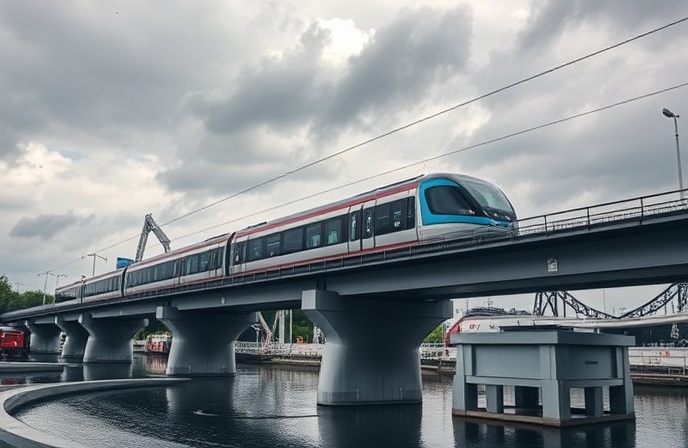
High-speed rail (HSR) projects demand robust and precisely engineered infrastructure. Steel bridges, owing to their strength-to-weight ratio and adaptability, are frequently employed in HSR construction. The design and fabrication of these bridges require stringent quality control and adherence to exacting specifications. Factors such as wind loads, seismic activity, and the dynamic stresses imposed by high-speed trains must be carefully considered during the design and fabrication phases. The use of advanced materials and fabrication techniques are often employed to ensure optimal performance and longevity. Zetwerk’s contribution to the fabrication of these critical components is therefore crucial to the overall success of the MAHSR project.
Logistical Challenges and Project Management
The delivery of 10,000 MT of fabricated girders presents substantial logistical hurdles. These include efficient material sourcing, precise fabrication processes, rigorous quality control, and timely delivery to the construction sites along the 508km MAHSR route. Effective project management, involving sophisticated scheduling and coordination among various stakeholders, is paramount to overcome these challenges. This includes managing the transportation of the girders across potentially challenging terrains and integrating the delivery schedule with the overall construction timeline of the project. The project necessitates meticulous planning and execution to avoid delays and ensure the smooth progression of the MAHSR construction.
Economic and Societal Impact of the MAHSR Project
The MAHSR project is not merely a transportation initiative; it’s a significant catalyst for economic growth and societal development. The creation of high-skilled jobs in manufacturing, construction, and engineering contributes directly to economic activity. Moreover, the reduced travel time between Mumbai and Ahmedabad is expected to boost connectivity, enhance trade, and stimulate regional development. This improved connectivity facilitates economic integration, attracting investment and enhancing the quality of life for residents along the corridor. The project exemplifies India’s commitment to modernizing its infrastructure and bolstering its economic competitiveness on a global scale. The successful completion of this endeavor will serve as a benchmark for future high-speed rail projects in India and other developing nations.
Conclusions
The Mumbai-Ahmedabad High-Speed Rail (MAHSR) project represents a significant leap forward in India’s infrastructure development. Zetwerk’s involvement, supplying 10,000 metric tons of fabricated girders for the project’s steel bridges, highlights the scale and complexity of this undertaking. The successful execution of this contract underscores Zetwerk’s capabilities in large-scale manufacturing and logistics within the demanding context of high-speed rail construction. The project’s success hinges on several factors, including precise engineering, stringent quality control, efficient logistics, and effective project management. The use of steel bridges, crucial load-bearing components in high-speed rail infrastructure, necessitates advanced fabrication techniques and adherence to rigorous specifications to ensure safety and durability. Beyond the engineering and logistical aspects, the MAHSR project carries considerable economic and societal implications, promising increased connectivity, economic growth, and enhanced quality of life. The project’s completion will not only serve as a milestone in Indian railway infrastructure but also serve as a model for future high-speed rail development worldwide, demonstrating the capacity for developing nations to undertake such ambitious infrastructure projects successfully. The successful completion of this project will showcase India’s capacity for technological advancement and large-scale project management, positioning it as a leader in high-speed rail technology and infrastructure development. The broader impact on the economy and society, through job creation, improved connectivity, and enhanced regional development, emphasizes the far-reaching implications of this transformative project.
RELATED POSTS
February 25, 2020 9:33 pm
This article examines the significant contract awarded to Hitachi Rail...
March 30, 2017 6:02 pm
"The Port of Long Beach saw a 5.6% increase in...
August 31, 2023 8:01 pm
Introduction The safety of passengers and railway workers is paramount...

October 16, 2025 10:54 am
Sensonic & Skylark partner to enhance **railway infrastructure monitoring**. Integrating...
October 7, 2025 12:54 pm
**Option 1 (Focus on new trains):**> London's DLR unveils new...
October 20, 2017 6:43 am
Optimize railway infrastructure for unmatched safety and efficiency. Discover...