
UK Rail: AI to Combat Aging Infra & Boost Resilience
The UK railway sector is deploying AI to combat aging infrastructure and rising demand. This will create safer, more resilient and efficient **rail infrastructure**.
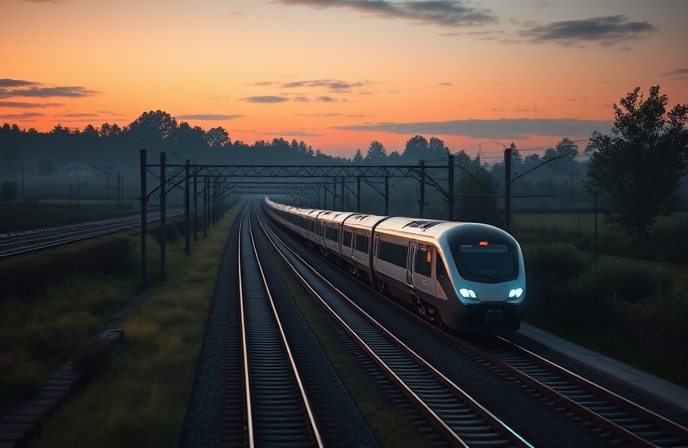
The UK rail network is embracing Artificial Intelligence (AI) as a critical solution to address its pressing challenges of aging infrastructure, surging demand, and a significant engineering talent deficit. This strategic adoption of AI, focused on context-rich intelligence, promises to unlock a future of safer, more resilient, and perpetually ready rail infrastructure across the nation.
| Key Entity | Critical Detail |
|---|---|
| UK Rail Network | Facing ageing assets, rising demand, and engineering talent shortage. |
| Core Action | Adoption of AI for enhanced infrastructure management and operational optimisation. |
| Key Initiatives | HS2, East West Rail, co-innovation partnership for AI workflow development. |
| Date | 1 December 2025 |
Main Body:
The UK’s railway sector is currently navigating a period of substantial investment and transformation, exemplified by ambitious projects such as HS2 and East West Rail. However, this forward momentum is juxtaposed with the strains on the existing network, which is grappling with aging infrastructure, persistent funding gaps, and a concerningly high rate of project cancellations. The central challenge lies in the dual imperative to deliver vital new infrastructure while simultaneously fortifying the resilience and efficiency of the current system, all against a backdrop of a critical shortage of skilled engineering professionals.
Strategic Impact of AI in UK Rail
Artificial Intelligence presents a transformative pathway to bridge the widening gap between escalating demand and the finite capacity of rail infrastructure. Achieving this requires a precision-driven approach, leveraging AI that possesses a profound understanding of fundamental engineering principles. This is not merely about automating tasks; it’s about enabling optimised decision-making and unlocking operational outcomes that were previously unattainable.
Beyond Automation: AI for Optimised Outcomes
The true power of AI in the rail industry extends far beyond basic automation. AI-powered solutions are poised to revolutionise maintenance and operations by analysing vast streams of data from sensors to accurately predict potential failures. This proactive approach to maintenance is paramount for enhancing safety, improving reliability, and significantly reducing operational costs. Additionally, AI can optimise traffic flows in real-time, simulate the complex impacts of climate events on infrastructure, and dramatically accelerate the design iterations for new projects, thereby equipping engineers with the advanced tools necessary to meet the UK’s ambitious infrastructure goals.
The Trust Imperative: AI Built on Real-World Context
For AI to be truly effective and gain widespread industry adoption, it must be built upon a foundation of trust. This necessitates AI solutions that are deeply integrated with and informed by project-specific, environmental, institutional, and core engineering context. To foster this, a co-innovation initiative is being launched, designed to collaborate closely with users. This partnership will focus on shaping the next generation of AI-enhanced workflows, prioritizing interoperable APIs and exploring novel commercial models that accurately reflect the evolving symbiosis between AI-driven and human-led work.
A Foundation of Trust: Commitment to Data Stewardship
Innovation within the rail sector must be unequivocally grounded in trust, with an unwavering commitment to protecting user data. Strict governance protocols are being implemented around the training of AI models, ensuring that only data explicitly licensed or purchased for this purpose is utilised. Users will also have the capability to fine-tune AI models with their proprietary data for exclusive application. A detailed Data Agreement Registry will offer transparency into the precise manner in which data has been employed to train specific AI models, reinforcing user confidence and control. By synergistically combining the invaluable experience of seasoned engineers with the power of trustworthy AI, the industry is set to deliver a railway system that is demonstrably safer, more resilient, and substantially more efficient.
Last June 2025, we published an article about Renfe’s cutting-edge Aranjuez maintenance hub. Click here to read –
Future of Rail: Renfe’s Railway Technology Hub, Aranjuez: Essential Guide
Future of Rail: Renfe’s Railway Technology Hub, Aranjuez: Essential Guide
About the Author: Andrew Smith is the Industry Solutions Manager responsible for Rail and Transit solutions. Andrew has over 35 years of civil engineering software experience, with 30 years focused directly on rail and transit solutions globally. Andrew is regarded as an industry expert in the management, integration and analysis of railway related linear data, and acts as a subject matter expert for the Linear Analytics application. Prior to joining the Solutions team, Andrew led the Professional Services team for Rail for over six years, successfully delivering key consulting and services projects around the world. Andrew holds a Degree in Artificial Intelligence from the University of Sussex (UK).

Railway infrastructure, rolling stock and transport technologies specialist focused on global rail industry developments, high-speed rail systems, signaling technologies and freight transportation. Covering railway investments, public transport modernization, rail operations and international mobility projects across Europe, Asia and North America.
RELATED POSTS

October 1, 2026 7:09 am
United States regulators confirmed a September 30 deadline for the...

October 4, 2026 5:14 pm
Alstom secured a CA$4.7 billion order from VIA Rail Canada...

October 6, 2026 2:14 am
Union Pacific launched export rail shipments with Ferromex to deliver...

October 1, 2026 12:13 am
Illinois approved $1.5 billion annually for the Northern Illinois Transit...

October 1, 2026 6:10 am
Amtrak approved a System Expansion Committee on July 30 to...

October 1, 2026 3:12 am
Greenbrier confirmed Brian Comstock as new president and CEO effective...