
Uijeongbu LRT Project: South Korea’s Automated Light Rail Transit
South Korea’s Uijeongbu LRT, a successful railway project, boosts urban transport with its innovative automated system and Public-Private Partnership.
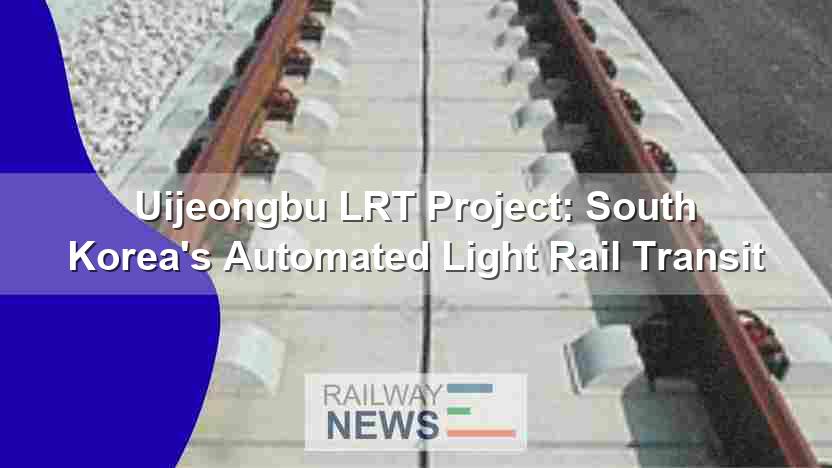
This article explores the Uijeongbu Light Rail Transit (LRT) project in South Korea, a significant undertaking demonstrating innovative approaches to urban rail development. The project aims to address the increasing transportation demands of Uijeongbu city, a rapidly growing suburb of Seoul, while showcasing the capabilities of automated light rail systems and successful Public-Private Partnerships (PPPs). We will examine the project’s technical specifications, its financial structure, the logistical challenges overcome during construction, and finally, its projected impact on the community. The analysis will also consider the Uijeongbu LRT within the broader context of South Korea’s expanding railway network and its implications for future urban transport planning. This detailed study aims to provide a detailed overview of the project’s success and to highlight valuable lessons applicable to similar light rail projects worldwide.
Project Overview and Planning
Faced with inadequate transportation infrastructure to manage its growing population, Uijeongbu city opted for the construction of its own light metro system rather than relying on the delayed extension of Seoul Metro Line 1. The Uijeongbu LRT, also known as the U-Line, is an 11.2km elevated line featuring 15 stations. It connects the eastern part of the city (Balgok) with its commercial and civic centers (Tapseok), significantly reducing travel times compared to existing bus services. A crucial aspect of the project was the establishment of Uijeongbu Light Rail Ltd (URLL) in 2005, a special purpose vehicle (SPV) with a 45% stake held by the city and the remaining by a consortium led by GS Engineering & Construction. This PPP model facilitated the project’s financing and implementation.
Construction and Technology
The Uijeongbu LRT project was executed on a turnkey basis, with GS Engineering & Construction leading the consortium responsible for both construction and 30-year operation. Civil works were undertaken by a consortium of Korean companies, while Siemens Transportation Systems provided the electrical and mechanical systems, including the automatic train control (ATC) system, depot equipment, and the rolling stock (15 VAL 208 NG trainsets). Systra, a global engineering and consulting firm specializing in transportation, provided project management and construction supervision services. The line’s construction, from commencement in 2007 to completion in 2011, involved strategically utilizing existing river courses and flood channels to minimize environmental impact and optimize the elevated track layout.
Operational Characteristics and Performance
The Uijeongbu LRT is a fully automated system, utilizing 15 two-car trainsets, each capable of carrying up to 236 passengers. These rubber-tired VAL 208 NG trains, supplied by Siemens, offer a maximum speed of 80 kmph, short braking distances, and quiet operation, ideal for the line’s inclines and curves. The system operates for 20 hours daily, with trains running every 205 seconds during peak hours, achieving a high-frequency service. A sophisticated Automatic Operations Control (AOC) system, monitored at a central control center via CCTV, manages train movements and dynamically adjusts train deployment to meet fluctuating passenger demand. This system ensures efficient and safe operations.
Financial Aspects and Ridership Projections
The total project cost amounted to $475 million, with $258.4 million contributed by the consortium and the remainder through tax revenue. The initial ridership projections are impressive, with an anticipated 32 million annual passengers and a peak-hour capacity of 3,400 passengers per direction. Further projections anticipate growth to 55 million annual passengers within 20 years, and a peak-hour capacity of 6,400 passengers per direction by 2040, requiring the addition of rolling stock to meet this increased demand.
| Project Parameter | Value |
|---|---|
| Project Length | 11.2 km |
| Number of Stations | 15 |
| Connection | Balgok to Tapseok; Interchange with Seoul Metro Line 1 at Hoeiryong |
| Total Project Cost | $475 million |
| Consortium Contribution | $258.4 million |
| Rolling Stock | 15 VAL 208 NG two-car trainsets (Siemens) |
| Peak Hour Capacity (projected) | 3,400 passengers/hour/direction (initial); 6,400 passengers/hour/direction (2040) |
| Annual Ridership (projected) | 32 million (initial); 55 million (within 20 years) |
Conclusions
The Uijeongbu LRT project stands as a compelling example of successful urban rail development. It has not only addressed a critical transportation need for a growing city but has also demonstrated the effectiveness of a PPP model in financing and implementing complex infrastructure projects. The choice of a fully automated system utilizing advanced technology has ensured high operational efficiency, passenger comfort, and reduced environmental impact. The project’s success hinges on several key factors: the strategic partnership between the city government and a capable private consortium, the careful planning and execution of construction, and the selection of reliable and efficient technology. The initial success, exceeding ridership projections and enhancing public transportation significantly, provides a strong foundation for future expansion. Continued monitoring of ridership patterns and proactive adjustments to meet evolving passenger needs, as demonstrated by the planned increase in rolling stock, are crucial for the long-term sustainability and effectiveness of the system. The project serves as a valuable case study for cities worldwide facing similar challenges in managing urban growth and transportation demands. The meticulous planning, technologically advanced solutions, and the well-structured PPP are elements that contribute to the project’s overall positive outcome, potentially influencing future light rail initiatives globally.
Company Information:
GS Engineering & Construction: A major South Korean construction company involved in various infrastructure projects globally.
Siemens Transportation Systems: A global leader in rail technology, providing signaling, rolling stock, and other rail systems globally.
Systra: An international engineering and consulting firm specializing in transportation infrastructure projects worldwide.

Railway infrastructure, rolling stock and transport technologies specialist focused on global rail industry developments, high-speed rail systems, signaling technologies and freight transportation. Covering railway investments, public transport modernization, rail operations and international mobility projects across Europe, Asia and North America.