
Thailand High-Speed Rail: 2026 Construction Update
Thailand’s new high-speed rail network connects three major airports, boosting tourism and economic growth in the Eastern Economic Corridor. Railway sector news.

Thailand High-Speed Rail Linked 3 Airport Project Profile
The High-Speed Rail Linked 3 Airport Project is a landmark infrastructure development creating a 220 km high-speed transportation corridor connecting Don Mueang, Suvarnabhumi, and U-Tapao international airports. This project serves as the primary mobility backbone for Thailand’s Eastern Economic Corridor (EEC), integrating advanced rail technology to dramatically reduce travel times and serve as a catalyst for regional economic and urban development.
| Attribute | Details |
|---|---|
| Project Name | High-Speed Rail Linked 3 Airport Project |
| Location | Bangkok & Eastern Economic Corridor (EEC), Thailand |
| Route | Don Mueang Airport – Suvarnabhumi Airport – U-Tapao Airport |
| Total Length | 220 km |
| Maximum Speed | 250 km/h (High-Speed Sections); 160 km/h (Urban Sections) |
| Estimated Cost | THB 225 billion (approx. $6.8 billion) |
| Status | Under Construction (Projected Opening 2027) |
| Project Owner | State Railway of Thailand (SRT) |
| Key Contractors | CP Group-led Consortium (including China Railway Construction Corp., CITIC Group, Siemens, Hyundai, Italian-Thai Development, CH. Karnchang, CRRC-Sifang) |
Technical Specifications
The project’s alignment consists of three primary segments: a 21 km extension from Don Mueang Airport to Phaya Thai, a 29 km segment utilizing the existing Airport Rail Link structure to Suvarnabhumi Airport, and a new 170 km high-speed line from Suvarnabhumi to U-Tapao Airport. The infrastructure comprises approximately 181 km of elevated track, 8 km of underground tunneling, and 2 km of surface-level track. The entire line is engineered to a standard gauge of 1,435mm, ensuring interoperability and high-speed stability. The system incorporates advanced European Train Control System (ETCS) signaling, a fully integrated communications network, automated fare collection (AFC), and platform screen doors (PSDs) at all 9 high-speed and 10 city line stations. Rolling stock is supplied by CRRC-Sifang, designed for a maximum operational speed of 250 km/h.
Strategic Importance & Key Takeaways
- Economic Catalyst for the EEC: The railway is the central pillar of the Eastern Economic Corridor’s development plan, designed to attract foreign investment, boost tourism, and facilitate logistics and trade by seamlessly connecting industrial zones with international air gateways.
- Integrated Multi-Modal Transport Hub: By linking three of Southeast Asia’s busiest airports, the project creates a unified aviation and rail hub. This integration will significantly enhance passenger convenience, reducing the travel time between U-Tapao and Bangkok to under 45 minutes.
- Public-Private Partnership (PPP) Benchmark: As one of Thailand’s largest PPP infrastructure projects, its execution serves as a model for future large-scale developments in the region, leveraging international expertise in finance, construction, and railway technology.
Project FAQ
When will the Thailand 3 Airports High-Speed Rail open?
The High-Speed Rail Linked 3 Airport Project is projected to commence full commercial operations in 2027, subject to the final construction and system commissioning timeline.
Who is building the high-speed rail connecting Don Mueang, Suvarnabhumi, and U-Tapao?
The project is being developed under a Public-Private Partnership agreement. The State Railway of Thailand (SRT) is the project owner, and the construction and operation are managed by a consortium led by Thailand’s Charoen Pokphand (CP) Group, which includes major international partners like China Railway Construction Corporation, Siemens, and Hyundai.
RELATED POSTS
January 14, 2016 1:42 pm
Bangkok's Orange Line MRT project, finally completed, will transport...
February 25, 2018 12:23 am
Arlanda Express high-speed rail link, a successful public-private partnership, connects...
March 7, 2008 10:20 am
Oslo's metro and tram network undergoes modernization with new MX3000...
November 23, 2018 12:28 pm
Japan's Chuo Shinkansen Maglev Line, a high-speed railway project by...
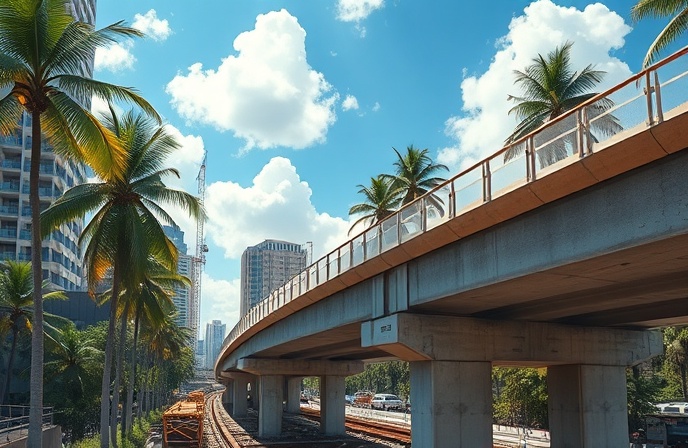
September 6, 2025 4:49 am
Honolulu's Skyline rail project breaks ground, commencing construction of the...
December 27, 2009 1:47 am
Istanbul's metro expansion integrates cutting-edge railway technology, boosting efficiency and...