
SWR & Network Rail Trial Thermal Imaging Train to Cut Rail Delays
South Western Railway and Network Rail launch a trial using thermal imaging on a ‘Hotshot’ train. The aim: reduce **railway** delays by detecting infrastructure faults.
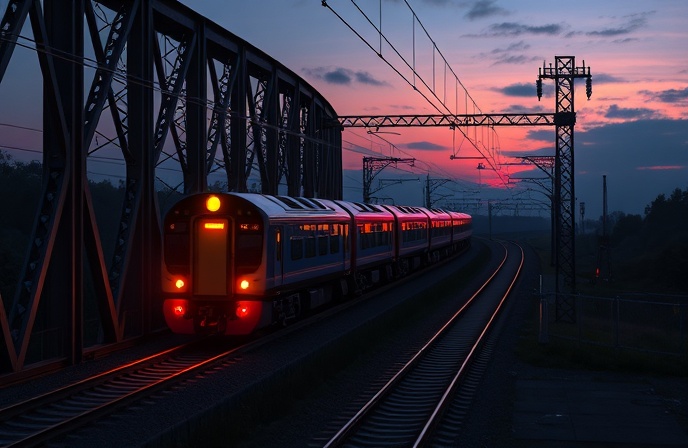
South Western Railway (SWR) and Network Rail have initiated a groundbreaking year-long trial, deploying thermal imaging technology on a Class 450 train, dubbed ‘Hotshot’, to proactively detect infrastructure faults and significantly reduce network delays. This advanced system, equipped with specialized cameras, promises to identify potential electrical and power supply issues in real-time, enabling preemptive maintenance and enhancing service reliability for passengers.
| Lead Entity | South Western Railway (SWR) & Network Rail |
| Core Action | Trialing thermal imaging technology (‘Hotshot’ train) for infrastructure fault detection |
| Key Technology | Thermal imaging cameras (front for electrical, undercarriage for shoe gear/third rail) |
| Timeline | Year-long trial beginning now |
| Potential Impact | Reduction in average delays (up to 200 mins) and severe delays (over 2,000 mins) |
| Key Partners | Angel Trains, One Big Circle, Siemens, dg8 Design |
The ‘Hotshot’ train is fitted with two sophisticated cameras: a forward-facing thermal imaging camera designed to pinpoint electrical anomalies along the track and an undercarriage-mounted camera monitoring the critical shoe gear and third rail power supply system. Captured imagery is transmitted to engineers, providing immediate alerts regarding overheating components or faulty connections. This proactive approach empowers maintenance teams to address potential failures before they escalate into significant service disruptions.
UK Rail Minister Lord Hendy lauded the initiative, stating, “This Government is fundamentally reforming how our railways are run – creating a network that works better for the people and freight using it. The cutting-edge technology that the integrated South Western Railway is trialling is key to achieving this and will serve as an example of the kinds of smart investments publicly owned rail companies can implement to improve services for passengers.”
According to SWR, faults identifiable by the ‘Hotshot’ train can currently cause average delays of approximately 200 minutes, with more severe conductor rail failures historically resulting in delays exceeding 2,000 minutes. This trial represents the first instance of such continuous, integrated monitoring across a substantial portion of the SWR network, which services routes connecting Central London with areas in Surrey, Hampshire, Berkshire, and Dorset.
Strategic Impact
The implementation of ‘Hotshot’ aligns with broader government objectives to modernize and optimize the UK’s rail infrastructure. By leveraging advanced diagnostic technology, SWR and Network Rail aim to deliver a more resilient and efficient railway, directly benefiting passengers through reduced journey times and fewer unexpected cancellations. The proactive detection of faults minimizes the need for reactive repairs, which are often more costly and disruptive. This initiative underscores the potential for innovation within publicly owned rail entities to drive significant service improvements and cost efficiencies.
Operational Details
The Class 450 trains selected for this trial are integral to SWR’s operations, covering key commuter and regional routes. The dual-camera system is designed for detailed coverage, detecting issues that might otherwise go unnoticed until they manifest as service failures. A preceding, smaller-scale trial on the SWR network proved the efficacy of this technology, enabling engineers to resolve a fault near Ashtead, Surrey, within 48 hours without impacting passenger services – a stark contrast to a similar past incident that caused 2,500 minutes of delays.
Neil Drury, SWR’s Engineering and Infrastructure Director, commented, “Much like our famous ‘Flying Banana’ train which helps monitor the tracks, you can now look out for Hotshot. We hope this innovative collaboration between SWR, Network Rail, Angel Trains and our other partners will identify potential infrastructure issues before they escalate, helping to reduce disruption on the network and keep our customers moving.”
Industry Context
Last June 2025, we published an article about Renfe’s cutting-edge Aranjuez maintenance hub. Click here to read – Future of Rail: Renfe’s Railway Technology Hub, Aranjuez: Essential Guide
This development is part of a wider trend in the rail industry towards embracing digital transformation and predictive maintenance. The collaboration, involving SWR, Network Rail, Angel Trains, One Big Circle, Siemens, and dg8 Design, with Angel Trains leading design, management, and funding, highlights the growing importance of cross-industry partnerships in driving innovation. The successful deployment of ‘Hotshot’ could pave the way for its expansion to other SWR fleet trains and serve as a model for other railway operators globally seeking to enhance asset management and operational performance through advanced sensing and data analytics. This trial follows SWR’s prior implementation of thermal imaging monitoring in South East London, Kent, and East Sussex, demonstrating a sustained commitment to technological advancement. Additionally, it echoes Network Rail’s recent ‘Project Reach’, a partnership aimed at eliminating mobile signal blackspots, showcasing a broader industry push towards leveraging technology for improved connectivity and service delivery through blended public-private investment models.

Railway infrastructure, rolling stock and transport technologies specialist focused on global rail industry developments, high-speed rail systems, signaling technologies and freight transportation. Covering railway investments, public transport modernization, rail operations and international mobility projects across Europe, Asia and North America.
RELATED POSTS

October 1, 2026 7:09 am
United States regulators confirmed a September 30 deadline for the...

October 8, 2026 1:15 pm
Alstom secured a €1bn contract to build 13 automated trains,...

October 4, 2026 5:14 pm
Alstom secured a CA$4.7 billion order from VIA Rail Canada...

October 1, 2026 12:13 am
Illinois approved $1.5 billion annually for the Northern Illinois Transit...
October 6, 2026 2:14 am
Union Pacific launched export rail shipments with Ferromex to deliver...

October 1, 2026 6:10 am
Amtrak approved a System Expansion Committee on July 30 to...