
Stadler to Supply MBC with Hybrid Locomotives, Boosting Swiss Freight
Stadler to deliver two new hybrid locomotives to MBC, bolstering Swiss freight capacity and environmental goals. This supports crucial railway modal shift efforts.
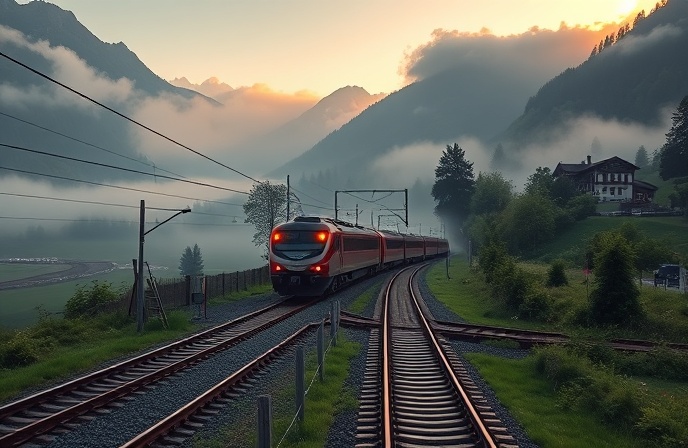
Stadler to Deliver Two Advanced Hybrid Locomotives to MBC, Bolstering Swiss Freight and Environmental Goals
Stadler has secured a significant order to construct two additional hybrid metre-gauge locomotives for Transports de la région Morges–Bière–Cossonay (MBC), enhancing the operator’s freight capacity and supporting the canton of Vaud’s environmental objectives. These new locomotives, set to operate on the Bière–Apples–Morges line from the end of 2028, are poised to advance the region’s long-term strategy for shifting freight from road to rail.
| Key Entity | Critical Detail |
|---|---|
| Supplier | Stadler |
| Operator | Transports de la région Morges–Bière–Cossonay (MBC) |
| Order | Two additional hybrid metre-gauge locomotives |
| Total Fleet | Three (following this order and late 2024 purchase) |
| Operational Deployment | Bière–Apples–Morges line, from end of 2028 |
| Key Technology | Hybrid (overhead line and diesel) |
| Strategic Impact | Strengthening freight capabilities, supporting modal shift, reducing CO₂ emissions |
The sophisticated hybrid vehicles are engineered for operational versatility, capable of drawing power from overhead lines on the main rail network and seamlessly transitioning to diesel engines for operations within gravel pits. This dual-mode capability ensures flexible and efficient freight transport across MBC’s extensive network. This latest procurement follows MBC’s initial order of a single locomotive in late 2024, bringing the total fleet of these advanced units to three by the end of 2028.
Strategic Impact and Environmental Commitment
The acquisition of these two Stadler hybrid locomotives represents a crucial step for MBC and the canton of Vaud in their ongoing efforts to decarbonise freight transport. Frédéric Evequoz, Tailormade Sales Manager at Stadler, expressed satisfaction with the order, stating, “The order underlines our expertise in the field of tailor-made vehicles. I would like to thank MBC for their trust and excellent cooperation.” He further highlighted that “The new locomotives are an important step towards climate-friendly freight transport in the canton of Vaud.”
MBC will strategically deploy these new locomotives to replace aging units and significantly expand its freight operations. This initiative is a cornerstone of a broader cantonal strategy aimed at transitioning a substantial volume of goods from road haulage to rail. The primary objective is to alleviate traffic congestion caused by heavy vehicles and dramatically reduce CO₂ emissions within the Morges district by promoting sustainable logistics solutions.
Last June 2025, we published an article about Renfe’s cutting-edge Aranjuez maintenance hub. Click here to read – Future of Rail: Renfe’s Railway Technology Hub, Aranjuez: Essential Guide
Pierre-Alain Perren, Managing Director of MBC, underscored the environmental benefits, emphasizing, “The shift from road to rail freight transport is a significant step forward for the environment and will reduce traffic on the roads in the Morges district by some 20,000 lorries per year.” This quantifiable impact demonstrates the tangible environmental and societal advantages of investing in modern, sustainable rail infrastructure.
Technical Specifications
- Weight: 64 tonnes
- Length: 17 metres
- Maximum Speed: 80 km/h
- Starting Tractive Effort: 220 kN
- Power Output: Up to 3 MW
- Design Features: Purpose-built for narrow-gauge freight, efficient on challenging gradients and tight geometries, designed for roll-on/roll-off movements of standard-gauge wagons on special transporter rollers.
Industry Context
The MBC locomotives are part of a standardized narrow-gauge locomotive family, a testament to collaborative development between Stadler and several prominent Swiss railways. This family of locomotives has also been ordered by Montreux–Berner Oberland-Bahn (MOB), Rhaetian Railway (RhB), and Matterhorn Gotthard Bahn (MGBahn). This coordinated development approach fosters economies of scale in research, production, and maintenance, while still allowing for crucial customization to meet the unique operational demands of individual regional railway networks. For railway operators and their stakeholders, this signifies a strategic direction towards more efficient, environmentally conscious, and cost-effective rolling stock solutions, vital for navigating evolving regulatory landscapes and increasing consumer demand for sustainable supply chains.

Railway infrastructure, rolling stock and transport technologies specialist focused on global rail industry developments, high-speed rail systems, signaling technologies and freight transportation. Covering railway investments, public transport modernization, rail operations and international mobility projects across Europe, Asia and North America.
RELATED POSTS
September 6, 2026 5:19 am
Hitachi delivered Taiwan's first N700ST high-speed train from Japan in...
September 6, 2026 1:17 am
Hitachi Toshiba Supreme Consortium confirmed the first of 12 N700ST...

September 5, 2026 4:19 pm
CPK launched formal tender talks with four consortia to design...
September 6, 2026 4:12 am
Alstom delivered the first of 100 new G Class trams...

September 5, 2026 7:14 pm
HS2 Ltd signed renegotiated civils contracts with EKFB and Align...
September 5, 2026 6:17 pm
Universal Signalling won a deal to install its U-Cross system...