
Rome Metro Line C Extension Opens: History Meets Modern Rail
Rome Metro Line C’s 4km extension connects the historic heart with suburbs, featuring “museum stations” showcasing archaeological finds. Enhancing connectivity and blending history with modern transport.
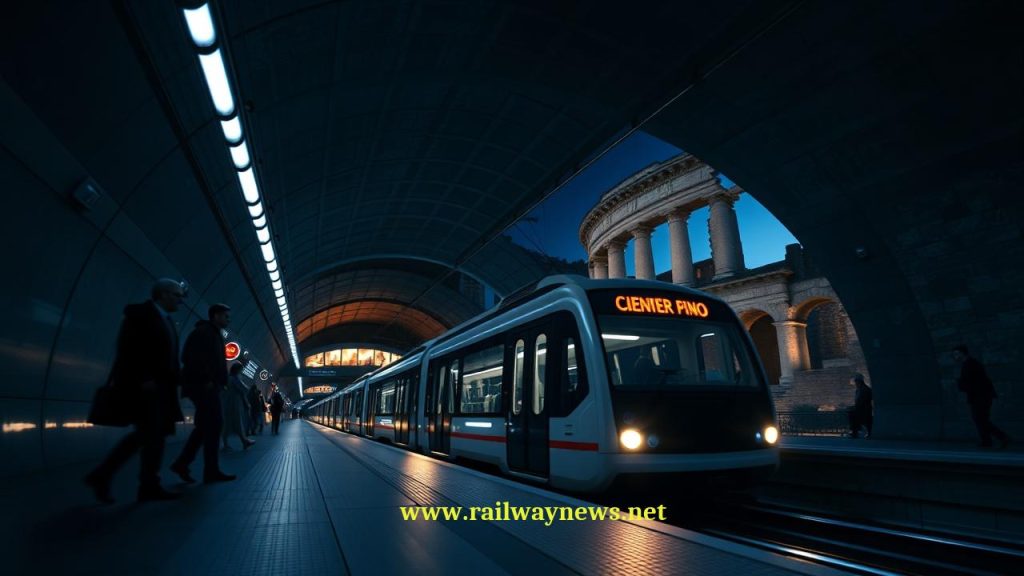
Rome has officially inaugurated a landmark 4 km extension of its Metro Line C, culminating an 11-year construction effort to connect the city’s historic heart with its sprawling suburbs. The new section, featuring two “museum stations” that showcase priceless archaeological discoveries, establishes a vital transport link directly to the Colosseum and the Imperial Fora.
| Category | Details |
|---|---|
| Project | Rome Metro Line C Extension (San Giovanni to Colosseo/Fori Imperiali) |
| Length & Stations | 4 km; 2 new stations: Colosseo–Fori Imperiali and Porta Metronia |
| Construction Timeline | 11 years |
| General Contractor Consortium | Webuild, Vianini Lavori, Hitachi Rail, CMB, and CCC (Metro C S.c.p.A.) |
| Key Engineering Technique | “Top-down archaeological” method for excavation and preservation |
The inauguration ceremony saw the participation of high-level officials, including Minister of Infrastructure and Transport Matteo Salvini and Rome’s Mayor Roberto Gualtieri, alongside executives from the Metro C consortium led by Webuild. Mayor Gualtieri celebrated the achievement, stating, “With this extension, we are connecting essential parts of Rome, from its outskirts to its historic center, while also offering the public remarkable cultural sites. These stations demonstrate the craftsmanship and design skills of Italians, successfully combining complex engineering works with the city’s valuable historical heritage.” The extension stretches Line C’s operational length to 22 km across 24 stations, creating a crucial public transport spine between the capital’s south-east and north-west sectors.
The project’s primary challenge was excavating beneath one of the world’s most archaeologically dense urban landscapes. To overcome this, engineers employed an innovative “top-down archaeological” technique, allowing for the concurrent progress of construction and archaeological investigation. This method was crucial for the two new stations, both built at a depth of over 30 meters. The Porta Metronia station, near the Aurelian Walls, was redesigned mid-construction to preserve and display a 2nd-century AD Roman military barracks complete with frescoes and mosaics. Similarly, the Colosseo–Fori Imperiali station, which provides a key interchange with Line B, integrates the remains of ancient Roman structures, including thermal baths damaged in the great fire of 64 A.D., into its design, creating a narrative journey for passengers.
This extension is a significant milestone in a much larger strategic vision for Rome’s mobility. The San Giovanni station, which opened in 2017, was the first to pioneer the “museum station” concept. With the Colosseo and Porta Metronia stations now operational, the city is looking ahead to the next phases of Line C. Future plans include a central station at Piazza Venezia, projected for completion in 2033, followed by further extensions towards Chiesa Nuova, San Pietro, and eventually Farnesina. When fully completed, Line C will span 29 km and 31 stations, fundamentally reshaping how residents and tourists navigate the Eternal City.
Key Takeaways
- Enhanced Connectivity: The extension forges a direct, high-speed link between Rome’s eastern suburbs and the monumental core, significantly reducing travel times and improving access to major tourist and cultural sites.
- Engineering Innovation: The project serves as a global benchmark for using the “top-down archaeological” construction method, proving that modern infrastructure development can coexist with the meticulous preservation of subterranean historical heritage.
- Cultural Integration: By transforming stations into curated museum spaces, Rome’s metro system redefines public transport, offering passengers a unique cultural experience and turning a daily commute into a journey through history.
Editor’s Analysis
The completion of Rome’s Line C extension is more than a local infrastructure upgrade; it is a powerful case study for the global railway industry. It directly addresses the paramount challenge facing urban rail projects in historic cities: how to build for the future without erasing the past. The “museum station” concept, executed with sophisticated engineering and in close collaboration with archaeological authorities, sets a new standard for heritage-sensitive development. For other cities grappling with similar constraints, from Athens to Istanbul to Mexico City, Rome’s approach offers a viable and inspiring blueprint. It demonstrates that investment in innovative construction techniques and interdisciplinary planning can yield projects that are not only functionally efficient but also culturally enriching, turning potential obstacles into unique public assets.
Frequently Asked Questions
What is the new extension of Rome’s Metro Line C?
It is a 4-kilometer extension connecting San Giovanni station to the Colosseo/Fori Imperiali station in the historic center of Rome. It includes two new stations: Colosseo–Fori Imperiali and Porta Metronia.
What makes the new stations on Line C unique?
They are designed as “museum stations” that integrate and display major archaeological finds discovered during their construction. Passengers can view authentic Roman artifacts, including the remains of a 2nd-century military barracks at Porta Metronia and ancient thermal baths at the Colosseo station, blending public transport with a cultural experience.
What engineering challenges did the project face?
The primary challenge was excavating in Rome’s complex and archaeologically rich subsoil. To manage this, the project utilized the “top-down archaeological” technique, which allows for the construction of station levels from the surface downwards while enabling archaeological work to proceed safely and concurrently.

Railway infrastructure, rolling stock and transport technologies specialist focused on global rail industry developments, high-speed rail systems, signaling technologies and freight transportation. Covering railway investments, public transport modernization, rail operations and international mobility projects across Europe, Asia and North America.
RELATED POSTS
September 6, 2026 5:19 am
Hitachi delivered Taiwan's first N700ST high-speed train from Japan in...
September 6, 2026 1:17 am
Hitachi Toshiba Supreme Consortium confirmed the first of 12 N700ST...
September 6, 2026 6:17 am
Hungary ordered a national ban on most freight trains from...

September 5, 2026 4:19 pm
CPK launched formal tender talks with four consortia to design...

September 6, 2026 4:12 am
Alstom delivered the first of 100 new G Class trams...

September 5, 2026 7:14 pm
HS2 Ltd signed renegotiated civils contracts with EKFB and Align...