
Rome Metro Line C Expansion: Urban Mobility & Rail Infrastructure
Rome’s Metro Line C expands, adding 4 km to its network, connecting to northwest Rome. The EUR 2 billion project, led by Webuild, aims to alleviate city center congestion.
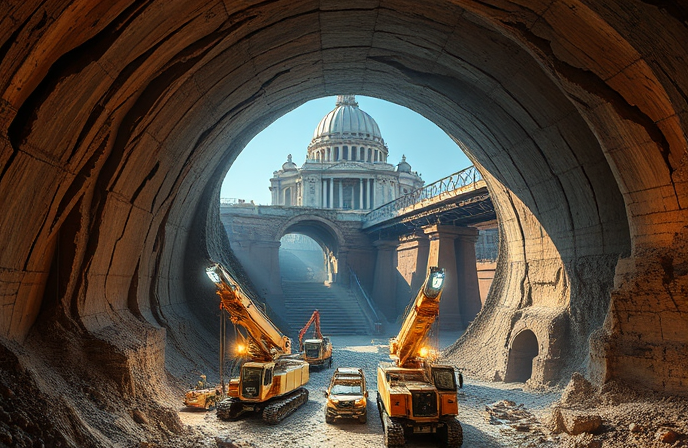
Rome’s Metro Line C Expansion: A New Chapter in Urban Mobility
Rome is set to embark on a significant expansion of its Metro Line C, promising to transform urban mobility and alleviate congestion within the historic city center. Under a EUR 2 billion contract awarded to a consortium spearheaded by Webuild and Vianini Lavori, the project will extend Line C further into the heart of Rome. The project, commissioned by Roma Metropolitane on behalf of Roma Capitale, is slated to begin in January 2026 following executive design approval. This article explores the key elements of this ambitious project: its geographical scope, technical intricacies, historical significance, and its impact on the city’s transportation infrastructure. The aim is to understand how this latest phase, the T2 section, will improve the travel experience and connect the sprawling city, ultimately changing how Romans navigate their ancient capital.
The Scope of Expansion: Reaching the Northwest
The project’s T2 section constitutes a 4-kilometer extension of Metro Line C, running from Venezia Station to Clodio/Mazzini. This new stretch will introduce four new stations: Chiesa Nuova, San Pietro, Ottaviano (which will provide a critical connection to Line A), and Clodio/Mazzini. Webuild, with a share valued at EUR 673 million, will lead the construction efforts. This expansion is a crucial component of the larger plan for Line C, which, upon full completion, will encompass 26 kilometers and feature a total of 29 stations. Currently, 22 stations are operational. This project focuses on connecting the southeastern suburbs with the northwestern areas of Rome, creating a comprehensive network and addressing the city’s need for efficient public transport.
Engineering Challenges: Navigating Beneath the Eternal City
The T2 section presents complex engineering hurdles, requiring innovative solutions to address the specific challenges of building within Rome’s historic and geological environment. The route’s most significant obstacle is its passage under the Tiber River, requiring the line to run approximately 25 meters below the riverbed. Furthermore, the alignment traverses areas of significant archaeological sensitivity, mandating careful planning and execution to protect historical artifacts. This demands the use of advanced construction techniques and materials. One of the key approaches will be the use of diaphragm walls, which will extend to depths of approximately 90 meters, a method that has been proven successful during the construction of the existing Venezia Station.
Archaeological Stations: Integrating History and Modernity
Two of the four new stations, Chiesa Nuova and San Pietro, will be “archaeological stations,” designed with an emphasis on seamlessly integrating Roman heritage with modern urban features. San Pietro Station, located within the gardens of Castel Sant’Angelo, will reach a depth of 48 meters, making it the deepest station in the entire network and a significant visual landmark. Its design will be carefully curated to complement the surrounding historical landmarks. Chiesa Nuova Station will be situated beneath the square that shares its name, and in close proximity to the Church of Santa Maria in Vallicella and the Oratorio dei Filippini, structures celebrated for their architectural and cultural importance. These architectural integrations will not only enhance the stations themselves but also transform them into accessible museums.
Looking Ahead: The Impact on Urban Mobility
Webuild is currently in the final testing phase of the San Giovanni–Colosseo/Fori Imperiali section, including the archaeological stations of Porta Metronia and Colosseo/Fori Imperiali, which are expected to be delivered in September 2025. This provides a glimpse into the anticipated improvements in mobility that the full expansion of Line C will eventually deliver. When the extension is completely finished, the line will connect the southeastern suburbs of Rome with the northwest, significantly improving urban mobility and reducing congestion in the historic center. The project’s ultimate aim is to offer the citizens and tourists of Rome a more reliable, efficient, and sustainable mode of public transportation, while simultaneously preserving and celebrating the city’s rich historical legacy.
Conclusion
The expansion of Rome’s Metro Line C, particularly the T2 section, represents a substantial investment in the city’s future, promising to enhance urban mobility and reduce reliance on private vehicles. The project’s ambitious scope, intricate engineering challenges, and the integration of archaeological elements underscore its significance. The consortium led by Webuild and Vianini Lavori is poised to navigate these challenges, leveraging its expertise to deliver a state-of-the-art transportation infrastructure while preserving Rome’s rich cultural heritage. The upcoming opening of the San Giovanni–Colosseo/Fori Imperiali section underscores the project’s forward momentum, offering a preview of the transformative impact Line C will have on the city. The completion of Line C will not only improve the travel experience for Romans and visitors but also set a new standard for integrating modern infrastructure with historical preservation. This project’s success will serve as a significant example of how cities can balance the need for enhanced public transportation with the imperative to preserve the past.
RELATED POSTS
March 5, 2026 4:23 am
Renfe suspends Spain rail services on Madrid-Andalusia corridor until February...
March 4, 2026 2:06 pm
Alstom commissioned 76 Flexity LRVs and CBTC signaling for Toronto,...
Ukraliznytsia launched its first dual-gauge semi-trailer intermodal service, linking Ukraine's...

March 6, 2026 8:16 am
€247 billion rail sector strategy signed by CER and UNIFE...
March 3, 2026 8:10 pm
Ayesa-Egis JV secures HS2 track systems design for 140 miles...
March 6, 2026 3:37 am
Czech Environment Ministry approved €7.3B Prague rail tunnel EIA for...