
Romania HSR: Bucharest-Constanta & EU Corridor Railway Plan
Romania’s **high-speed rail** development is feasible! EIB study reveals potential for lines reaching 200-250 km/h, boosting the national economy with **railway** modernization.
Introduction
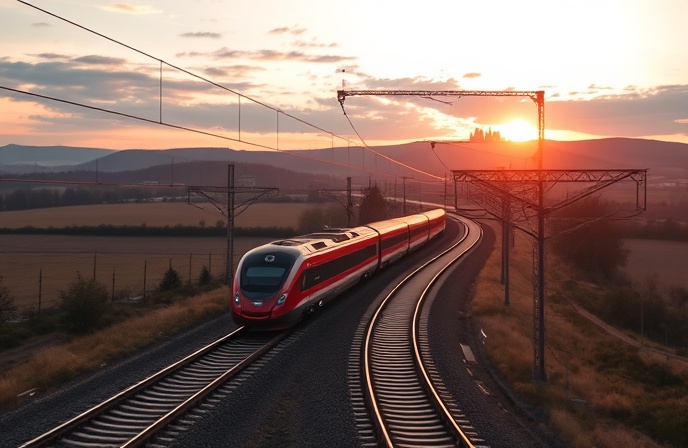
During Railway Days 2025, held in Bucharest on October 14–15, Mihai Frumosu, Senior Transport Expert at the European Investment Bank (EIB), stated that high-speed rail (HSR) development in Romania is feasible, with potential lines supporting speeds of 200–250 km/h.
Feasibility and Economic Impact
Mihai Frumosu highlighted the potential of HSR to shift passenger traffic from air and road to rail, thereby significantly boosting Romania’s economy. The study, presented at the event organized by Club Feroviar, examined the construction of lines capable of supporting speeds between 200 and 250 km/h, concluding that such development is viable within the country.
Project Scope and European Masterplan
The study is based on the European Masterplan for high-speed rail development, which includes the creation of an HSR corridor between Constanța – Bucharest – the Hungarian border. The analysis considered technical, financial, and economic perspectives.
Modernization and Speed Enhancement
The report explored options for achieving speeds of 250–300 km/h on already modernised lines without constructing entirely new ones. Upgraded railway sections along European corridors in Romania could be improved to reach 200 km/h through upgrades to signalling systems, tracks, and the implementation of ERTMS. Modernized sections currently allow speeds of up to 160 km/h, with the reconstruction and modernization of engineering structures already enabling speeds of up to 200 km/h.
Cost Analysis and Route Options
Four options were pre-selected for the Constanța – Bucharest – Hungarian border corridor. Case studies showed a cost range of EUR 8.9 million/km to EUR 25.5 million/km (based on 2018 prices), varying based on line speed, terrain, and the extent of complex structures. For the Bucharest – Constanța route (Option 3), the study recommended modernizing the line to allow speeds of up to 200 km/h between Bucharest and Fetești (147 km), and building a new line between Fetești and Constanța, enabling speeds of up to 250 km/h. The full route is 217.2 km, with 140 km requiring modernization and 68 km representing newly built track. The estimated cost is EUR 2.6 billion (at 2024 prices), reducing journey time to 1 hour and 20 minutes.
The recommended corridor would run from Constanța, via Bucharest, Braşov, Sighişoara, Cluj-Napoca, and Oradea, towards the Hungarian border. The total length of this corridor is 782 km, designed for mixed speeds of up to 200 km/h and up to 250 km/h, with an estimated CAPEX of EUR 15 billion.
Last June 2025, we published an article about Renfe’s cutting-edge Aranjuez maintenance hub. Click here to read – Future of Rail: Renfe’s Railway Technology Hub, Aranjuez: Essential Guide
Conclusion
The study, presented at Railway Days 2025, concluded that HSR development in Romania is feasible, focusing on lines supporting speeds of 200–250 km/h. The analysis included cost assessments, route options, and the potential for enhancing existing infrastructure to achieve higher speeds. The primary focus of the study was the Constanța – Bucharest – Hungarian border corridor.
Company Summary
European Investment Bank (EIB): The EIB is a financial institution that supports projects in the European Union and beyond. Mihai Frumosu, a Senior Transport Expert at the EIB, presented the findings at the Railway Days 2025.
Club Feroviar: Club Feroviar organized Railway Days 2025, which took place in Bucharest.
CFR SA: Mihai Frumosu commended CFR SA for the reconstruction and modernization of engineering structures.
Technology
ERTMS: The study mentions the implementation of ERTMS (European Rail Traffic Management System) as part of the upgrades to signaling systems.

Railway infrastructure, rolling stock and transport technologies specialist focused on global rail industry developments, high-speed rail systems, signaling technologies and freight transportation. Covering railway investments, public transport modernization, rail operations and international mobility projects across Europe, Asia and North America.
RELATED POSTS

September 6, 2026 5:19 am
Hitachi delivered Taiwan's first N700ST high-speed train from Japan in...
September 6, 2026 6:17 am
Hungary ordered a national ban on most freight trains from...

September 6, 2026 1:17 am
Hitachi Toshiba Supreme Consortium confirmed the first of 12 N700ST...

September 5, 2026 4:19 pm
CPK launched formal tender talks with four consortia to design...
September 7, 2026 8:16 am
Midea, Gree and TCL shipped air conditioners via China Railway...
September 19, 2026 11:19 am
China launched an experimental 1.11-tonne maglev test sled to 800...