
Rail’s Digital Shift: Connectivity Drives Passenger Experience
Rail’s on-board experience is key as passenger traffic surges. Operators must invest in connectivity to compete with airlines and unlock new revenue.
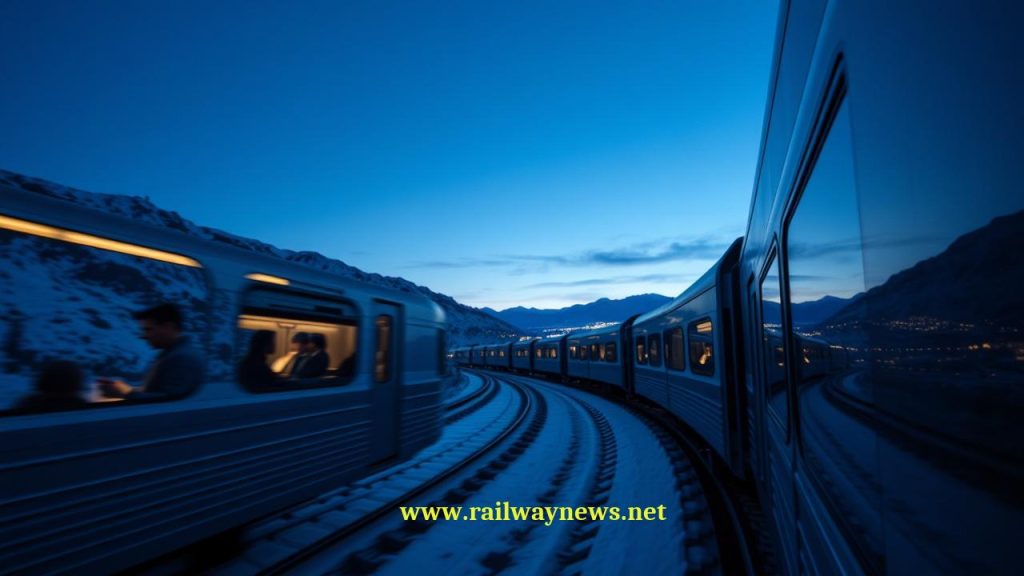
As global rail traffic surges towards a projected 3.7 trillion passenger-kilometers by 2025, a new study reveals a fundamental shift in passenger behavior, redefining the train journey as a digitally-driven “living space” where connectivity and on-board experience have become critical competitive differentiators against a resurgent airline industry. This transformation is forcing operators to move beyond transport provision and become integrated experience providers, with significant implications for investment priorities and revenue models.
| Category | Details |
|---|---|
| Global Rail Traffic Forecast | Increase from 2.6 trillion (2022) to 3.7 trillion passenger-km (2025) |
| Key Passenger Expectation | 78% of passengers consider on-board Wi-Fi essential |
| Connectivity Performance Gap | 70% of passengers report frequent interruptions or unstable connections |
| On-Board Device Usage | 71% of travelers use smartphones; 29% use laptops/tablets |
| Night Train Investment | European Sleeper announces a $4 million expansion for new routes and fleet upgrades |
| Competitor Benchmark (Air) | Global air travel projected to reach a record 5.2 billion passengers in 2025 |
Main Body:
A landmark study on passenger behavior highlights a paradigm shift in rail travel, where time on board is no longer idle transit but an active part of the journey. With the global rail market recovering robustly post-pandemic, the study indicates that passengers now spend an average of 48 minutes on digital platforms during a typical four-hour trip. This engagement is dominated by mobile devices, with 71% of passengers using smartphones for work or entertainment. Content consumption is diverse, ranging from video-on-demand and anime for Gen Z travelers to news and documentaries for older demographics, signaling that a one-size-fits-all digital offering is no longer viable for operators aiming to capture a diverse market.
The core of this new experience is connectivity, which the study identifies as the industry’s most significant challenge. A stark discrepancy exists between expectation and reality: while 78% of passengers deem Wi-Fi essential, a staggering 70% report experiencing poor or unstable service. This gap presents a major technical and financial hurdle for operators, as maintaining consistent, high-speed internet across varied terrains is complex and costly. However, the data also frames this challenge as a strategic opportunity. Reliable connectivity is the gateway to developing on-board digital platforms that can generate crucial ancillary revenue through premium content, food and beverage ordering, and destination service bookings, helping to offset rising operational costs.
This focus on the on-board experience is materializing in tangible market trends, particularly the revival of long-distance and overnight services. The strategic rationale is clear: if the journey itself is valuable, its duration becomes an asset. This is evidenced by the recent announcement from night train operator European Sleeper, which has launched a $4 million crowdfunding campaign to expand its network with new routes like Paris-Berlin and Brussels-Milan. This investment in “slow travel” directly competes with a booming air transport sector, which the International Air Transport Association (IATA) projects will carry a record 5.2 billion passengers in 2025. In this competitive landscape, rail’s ability to offer a comfortable, productive, and seamless journey is its most powerful value proposition.
Key Takeaways
- The Digital Mandate: The on-board experience, driven by reliable digital connectivity, has evolved from a passenger amenity to a core business requirement essential for customer retention and revenue generation.
- Ancillary Revenue is Critical: As operating costs rise, leveraging digital platforms for ancillary sales—from premium content to at-seat dining—is becoming a strategic necessity for financial sustainability.
- Experience as a Competitive Edge: The resurgence of night trains, backed by significant investment, shows that rail can effectively compete with air travel by transforming travel time into productive or leisure time, a key differentiator on medium and long-distance routes.
Editor’s Analysis
The findings confirm that the future battle for passengers will be fought not on speed alone, but on the quality of the time spent in transit. The train is evolving into a mobile environment where passengers expect the same seamless digital life they have at home or in the office. For rail operators, this means investment in robust, multi-gigabit connectivity is no longer a line item under “passenger comfort” but a foundational element of commercial strategy, as critical as the tracks themselves. Those who successfully bridge the connectivity gap and build engaging digital ecosystems will not only enhance customer loyalty but also unlock significant new revenue streams, positioning themselves to win market share from both rival operators and the airline industry.
Frequently Asked Questions
What is the primary challenge facing rail operators in improving passenger experience?
The primary challenge is the “connectivity gap.” While 78% of passengers see Wi-Fi as essential, 70% experience unreliable service, creating a major discrepancy between customer expectations and the reality of on-board digital infrastructure.
How are passenger activities on trains changing?
Passengers are increasingly treating train journeys as an active time for work, entertainment, and communication, rather than passive transit. Data shows heavy reliance on personal devices, with an average of 48 minutes of digital engagement on a four-hour trip, focused on video streaming, social media, and browsing.
Why is there a renewed interest in long-distance and night trains?
As the on-board experience improves, longer journeys are becoming more attractive. Passengers are willing to accept extended travel times, such as on overnight services from operators like European Sleeper, provided the journey is comfortable, connected, and allows them to use their time productively or restfully.

Railway infrastructure, rolling stock and transport technologies specialist focused on global rail industry developments, high-speed rail systems, signaling technologies and freight transportation. Covering railway investments, public transport modernization, rail operations and international mobility projects across Europe, Asia and North America.
RELATED POSTS

October 8, 2026 1:15 pm
Alstom secured a €1bn contract to build 13 automated trains,...

October 1, 2026 7:09 am
United States regulators confirmed a September 30 deadline for the...

October 8, 2026 12:18 pm
Siemens Mobility signed an agreement with VinSpeed to supply 350...

October 4, 2026 5:14 pm
Alstom secured a CA$4.7 billion order from VIA Rail Canada...

October 5, 2026 6:12 pm
AECOM and Jacobs secured a contract in September 2026 to...

October 1, 2026 12:13 am
Illinois approved $1.5 billion annually for the Northern Illinois Transit...