
Rail Baltica’s Soodevahe: Estonia’s Rail Infrastructure Milestone
Rail Baltica’s Soodevahe junction, a €38.8M project, boosts Estonian freight capacity. Connecting to Europe’s high-speed rail network.
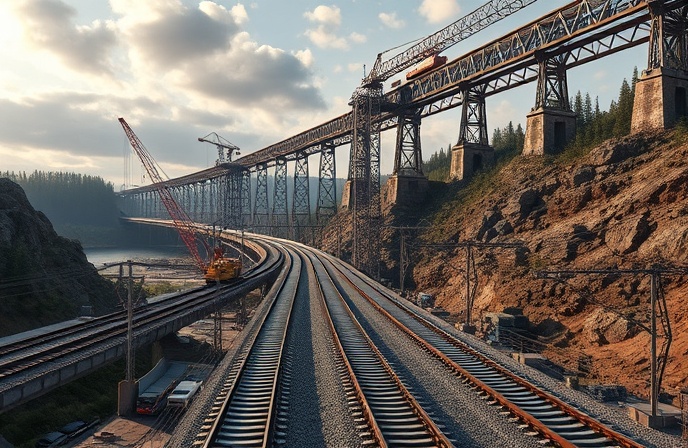
Rail Baltica’s Soodevahe Junction: A Milestone in Estonian Infrastructure
Estonia’s Rail Baltica project, a crucial link in the European high-speed rail network, has reached a significant development stage with the awarding of a construction contract for the Soodevahe traffic junction. Awarded on July 31st to AS TREF Nord, an Estonian infrastructure company, this EUR 38.8 million project is slated to be one of the most technically demanding infrastructure undertakings in Estonia to date. This project represents a vital step in integrating Estonia’s freight network with the broader European transport system. The Soodevahe junction, located near Tallinn, will connect the new 1435 mm standard gauge Rail Baltica line with the existing 1520 mm broad gauge railway, significantly boosting freight transport capacity, especially from the strategically important Port of Muuga. The complex project aims to enable efficient transit of goods from the Baltic Sea to the heart of Europe. This article explores the multifaceted challenges and strategic importance of the Soodevahe junction.
Connecting Gauges and Boosting Capacity
The Soodevahe junction is designed to serve as a critical interface between two distinct railway systems. Its primary function is to facilitate the seamless transfer of freight from the 1520 mm broad gauge lines, which currently handle significant freight traffic, onto the new European standard gauge (1435 mm) Rail Baltica line. This connection will enable direct freight transportation from the Port of Muuga to European markets, bypassing the need for transshipment and thereby significantly reducing transit times and costs. The strategic importance of this junction is highlighted by Anvar Salomets, Chairman of the Management Board of Rail Baltic Estonia, who emphasizes that this junction will host “the connection between the Rail Baltica main line and the Muuga route, enabling the direct flow of international freight from the port to the heart of Europe.” This focus on seamless integration and increased capacity underlines the project’s pivotal role in Estonia’s economic development and its integration into the larger European transport network.
Engineering Challenges and Innovative Solutions
The Soodevahe junction presents a multitude of complex engineering challenges. The construction site is located in an area characterized by high groundwater levels and challenging geological conditions, demanding innovative construction techniques. One of the most significant undertakings involves constructing a tunnel beneath the operational broad gauge railway line while ensuring uninterrupted rail services. Furthermore, the project incorporates a viaduct structure designed using a frame structure approach, a first for transport infrastructure in Estonia. This design is intended to ensure safe and uninterrupted traffic flow on multiple levels. Jaanus Taro, Chairman of the Management Board of TREF Nord, highlights the complexity, stating, “In this three-level junction, we must cross two railway corridors of different gauges, build a tunnel underneath them, and at the same time maintain uninterrupted traffic.” The construction period, estimated at 38 months, necessitates exceptional precision in both planning and execution to adhere to the project timeline and coordinate with other Rail Baltica construction phases.
Funding and Collaboration
The EUR 38.8 million contract for the Soodevahe junction is jointly financed by the European Union’s Connecting Europe Facility (CEF) 10 program and revenues from the sale of CO₂ quotas. This funding structure underscores the project’s significance within the broader European transport infrastructure strategy and its contribution to a more sustainable transport ecosystem. The joint funding mechanism, operating under a cooperation agreement between Rail Baltic Estonia and the Ministry of Climate, reflects a commitment to international collaboration and environmental sustainability. The emphasis on sustainable transport solutions, coupled with the CEF’s support, highlights the project’s alignment with European Union policy goals to foster environmentally conscious and efficient transportation networks.
Project Timeline and Coordination
The construction of the Soodevahe junction, a complex undertaking, is expected to span 38 months, demanding meticulous planning and execution. TREF Nord has emphasized the need for tight coordination with other Rail Baltica construction phases, emphasizing the requirement for exceptionally accurate execution. As a critical part of the broader Rail Baltica corridor, the project requires seamless integration with other ongoing and future works. The construction company’s readiness to coordinate with all stages showcases the commitment to ensure the project’s success within a strict timeframe. Successfully executing this project within schedule will necessitate the adoption of advanced project management methods, strong cooperation between stakeholders, and diligent monitoring throughout the process.
Conclusion
The Soodevahe traffic junction project marks a vital step forward in the realization of the Rail Baltica corridor, and is poised to reshape Estonia’s railway landscape. This project highlights the complexities of modern railway infrastructure projects, including the need for advanced engineering solutions, rigorous planning, and close collaboration across multiple stakeholders. The innovative design of the Soodevahe junction, coupled with its strategic location, is set to dramatically improve the efficiency of freight transport, offering better access to European markets for businesses. The utilization of European Union funding reinforces the commitment to sustainability and the promotion of rail-based transport. The success of this project will not only enhance Estonia’s economic connectivity but also contribute significantly to the broader European vision for a high-speed, integrated rail network. The long-term implications are substantial, especially for the Port of Muuga, which is set to become an even more crucial hub in Baltic Sea logistics and freight trade with the continent.
RELATED POSTS

September 23, 2022 4:39 pm
This article explores the recent commissioning of the automated metro...
December 10, 2018 11:09 pm
Alstom has been awarded a contract to equip Israel Railways'...
April 25, 2020 1:22 pm
This article examines the significant contribution of the Saipem-led Cepav...
September 8, 2022 4:14 am
Expansion of VLS Environmental Solutions Through Acquisition of Safety Railway...
January 16, 2026 3:39 am
Spain launches a EUR 400 million Madrid-Jaén rail project, cutting...
October 22, 2025 9:54 pm
Nokia and ST Engineering will deploy an IP/MPLS backbone for...