
Rail Baltica: High-Speed Rail Progress & Future in Baltic States
Rail Baltica’s track-laying is underway, with a focus on vibration mitigation for high-speed rail. Learn more about the project’s innovative approach!

“`html
Introduction
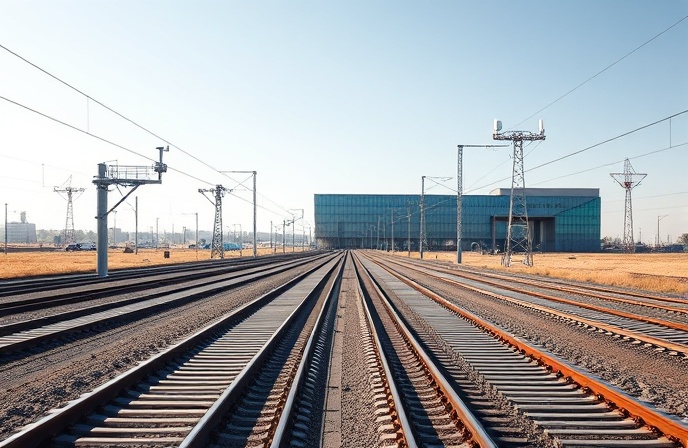
In December 2023, the Rail Baltica project achieved a significant milestone with the installation of the first 1,500 meters of railway track in the vicinity of the future passenger terminal at Riga International Airport. This marks the commencement of track-laying activities within the central section of the Rail Baltica line in Latvia.
Track Laying and Infrastructure
The track-laying process involves the use of a specialized machine that assembles and lays the track. The initial 1,500-meter segment consists of tracks, sleepers, and fasteners. The project utilizes 1,660 mm gauge track and incorporates a slab track construction method. This method involves the use of concrete slabs instead of traditional ballast, which offers enhanced stability and reduced maintenance requirements. The specific track-laying activities are being carried out by a consortium of companies, including BESIX, RERE Būve, and SIA “RBBL”, contracted by Eiropas Dzelzceļa līnijas.
Project Scope and Timeline
The Rail Baltica project aims to integrate the Baltic States into the European rail network. The complete railway line will span 870 km, connecting Tallinn, Riga, and Vilnius with a connection to Warsaw. In Latvia, the total length of the railway line will be 265 km. The entire Rail Baltica project is anticipated to be completed by 2030, with an estimated total cost of €5.8 billion.
Vibration Mitigation and Technical Specifications
The Rail Baltica project is designed to meet the technical specifications for high-speed rail, including a maximum speed of 249 km/h for passenger trains and 120 km/h for freight trains. A key consideration in the design and construction is the implementation of vibration mitigation measures to reduce the impact of railway operations on the surrounding environment.
You might be interested in:
Last March 2018, we published an article about VTG’s acquisition of Nacco reshaping European rail freight. Click here to read – VTG-Nacco Merger: Reshaping European Rail Freight
Financial and Operational Details
The project is co-financed by the European Union and the governments of the Baltic States. Eiropas Dzelzceļa līnijas is responsible for the implementation of the Rail Baltica project in Latvia. The ongoing track-laying activities represent a critical phase in the development of the high-speed railway line.
Conclusion
The installation of the initial track segment near Riga International Airport signifies a significant step forward for the Rail Baltica project. The project is scheduled for completion by 2030 and is anticipated to cost €5.8 billion. The project involves 870 km of railway connecting the Baltic States and Poland. The construction includes several technical specifications, including vibration mitigation, and is co-financed by the European Union and the Baltic States’ governments.
Company Summary
BESIX: A construction company involved in the Rail Baltica project.
RERE Būve: A company that is part of the consortium carrying out the track-laying activities for the Rail Baltica project.
SIA “RBBL”: A company that is part of the consortium carrying out the track-laying activities for the Rail Baltica project.
Eiropas Dzelzceļa līnijas: The company responsible for the implementation of the Rail Baltica project in Latvia.
“`
RELATED POSTS
March 10, 2021 12:19 am
This article explores the successful restoration of Hanwell station, a...

May 25, 2025 7:08 am
Derby, United Kingdom – May 2024 – In a momentous...

September 6, 2025 3:13 am
TTC secures Alstom contract for 70 new subway train sets,...
August 3, 2016 3:02 pm
In June 2018, SMRT Corporation's SMRT acquisition of Strides Transportation...
December 7, 2014 3:31 pm
Queensland's Darra to Springfield railway line is complete, improving transport...
August 8, 2025 9:33 pm
Alstom's new Kazakh signalling center boosts railway digitalization, modernizing Kazakhstan...