
Network Rail: Future of Rail, Solar Power Deal & Sustainability
Network Rail secures landmark clean energy deal, purchasing 64GWh annually from EDF Renewables’ solar farm. The first of its kind in UK rail, this agreement promises significant carbon emission reductions.
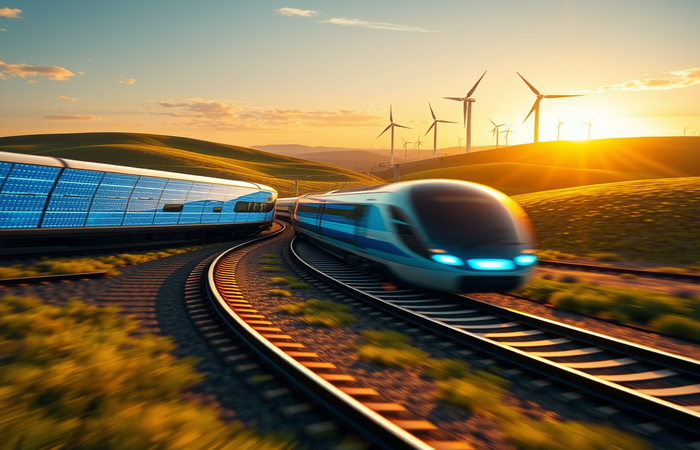
Network Rail Drives Sustainability with Groundbreaking Clean Energy Deal
In a landmark move for the UK rail industry, Network Rail has secured a Corporate Power Purchase Agreement (CPPA), the first of its kind in Britain’s railway sector. This 14-year agreement will provide 64GWh of clean energy annually at a fixed cost, supplying approximately 15% of the electricity needed for Network Rail’s non-traction energy requirements (offices, depots, and managed stations). The project, situated near Swainsthorpe in Norfolk, will see EDF Renewables commence construction of a new solar facility. This strategic partnership underscores Network Rail’s commitment to its Green Strategy, aiming for a more sustainable future for the railway. This deal promises significant reductions in carbon emissions while also highlighting the potential for the rail sector to lead the way in renewable energy adoption.
Powering the Future: The Corporate Power Purchase Agreement (CPPA)
The core of this initiative is the innovative CPPA, a financial mechanism where a corporate entity (Network Rail) directly purchases electricity from a renewable energy generator (EDF Renewables). This bypasses traditional energy markets, providing price stability and supporting the development of new renewable energy infrastructure. For Network Rail, the fixed-cost nature of the agreement offers long-term budget certainty, shielding them from volatile energy market fluctuations. The CPPA also guarantees that a significant portion of Network Rail’s electricity consumption comes from renewable sources, substantially reducing their carbon footprint. The initiative will produce enough energy to power every one of the 20 Network Rail-managed stations for eight years, and the equivalent of powering London Liverpool Street station for nine years.
Solar Facility in Norfolk: A Strategic Location
The solar facility, to be built near Swainsthorpe in Norfolk, is strategically located and will be owned and operated by EDF Renewables UK. The facility’s proximity to the Great Eastern Main Line symbolises a tangible link between renewable energy generation and the railway network. This project alone is estimated to prevent the release of around 60,000 tonnes of carbon dioxide emissions over its lifetime, an environmental impact equivalent to planting approximately 2.2 million trees. The selection of Norfolk, as a location for the project, not only supports the government’s plan for change, but also promises the creation of local jobs and economic growth through investment in clean energy infrastructure.
Industry Implications and Future Outlook
This pioneering agreement has far-reaching implications for the rail sector. It demonstrates the potential for railway organizations to leverage their purchasing power to drive investment in renewable energy, contributing to the UK’s net-zero targets. The deal is also a key component of Network Rail’s wider sustainability agenda, with the long-term objective of transitioning all non-traction electrical requirements to solar power. With the upcoming consolidation of the rail industry under Great British Railways, this agreement provides a framework for the sector to adopt similar clean energy models, leading to increased efficiency and a smaller carbon footprint. The project also includes a community fund of £20,000 annually, which will be paid for the 35-year lifetime of the project.
Conclusion
Network Rail’s CPPA with EDF Renewables is a crucial step towards decarbonizing the railway and achieving its ambitious sustainability goals. By securing a long-term supply of renewable energy, Network Rail is not only reducing its carbon footprint but also providing a model for the wider rail industry to follow. This initiative demonstrates the importance of strategic partnerships and innovative financial mechanisms in accelerating the transition to a sustainable energy future. The successful implementation of this project will likely pave the way for further investment in renewable energy across the rail sector, contributing to a greener, more resilient, and efficient railway network for the future. The alignment with government objectives of transitioning to sustainable energy makes it a win-win scenario for both Network Rail and the UK’s environmental goals.
RELATED POSTS
Union Pacific earned an 80% top Class I railroad intermodal...

March 6, 2026 12:10 pm
Consortium Announces Digital Services Platform for UK Rail Sector A...
March 5, 2026 7:57 pm
Banedanmark launched battery train operations on Denmark's 67 km Skjern–Holstebro...
March 4, 2026 10:12 am
Amtrak and Siemens deploy 8 Airo trains for the U.S....
March 5, 2026 4:23 am
Renfe suspends Spain rail services on Madrid-Andalusia corridor until February...
March 6, 2026 4:07 pm
Digital Subscription Market Analysis Q1 2026 Analytics firm Antenna confirmed...