
MTA Opens Brooklyn Railcar Facility, Boosting NYC Subway Fleet
New York’s MTA opens a cutting-edge Railcar Facility in Brooklyn. This facility will speed up the commissioning of new subway cars, modernizing the rail fleet.
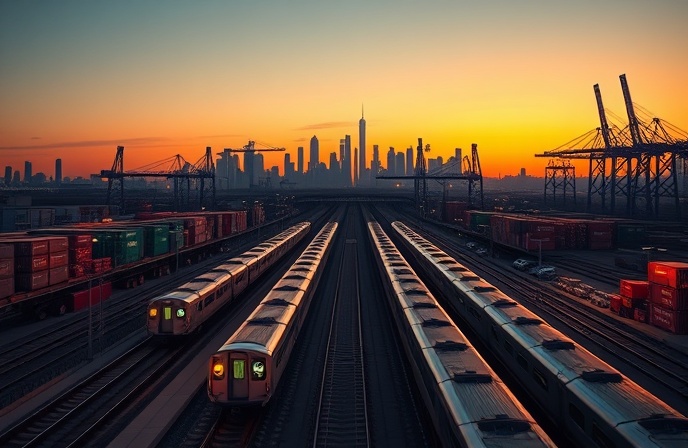
New York Governor Kathy Hochul and the Metropolitan Transportation Authority (MTA) have officially opened New York’s inaugural purpose-built Railcar Acceptance and Testing Facility in Sunset Park, Brooklyn. This state-of-the-art complex, delivered on time and under budget, is poised to significantly expedite the commissioning of new subway cars, enhancing workflow efficiency and underpinning the MTA’s most substantial fleet modernization program in decades.
| Key Entity | Critical Detail |
|---|---|
| Organization | Metropolitan Transportation Authority (MTA) |
| New Facility | Railcar Acceptance and Testing Facility |
| Location | Sunset Park, Brooklyn (near South Brooklyn Marine Terminal) |
| Completion | On time and USD 5.5 million under budget |
| Timeline | Delivered within three-year timeline |
| Fleet Modernization | Supports procurement of R211 and R268 cars, largest rolling stock investment since 1980s |
| Investment (Capital Plan) | USD 68 billion 2025-29 Capital Plan |
| New Cars in Capital Plan | 1,500 new subway cars |
Strategic Impact
Governor Kathy Hochul emphasized the facility’s role in realizing “generational upgrades” for the subway fleet, made possible by funding from congestion pricing and the MTA’s 2025-29 Capital Plan. This strategic investment aims to bring thousands of new, modern railcars into passenger service more rapidly, promising an improved riding experience for millions of New Yorkers. The streamlined testing process at the new facility is designed to ensure that riders benefit from enhanced subway services sooner than ever before.
Operational Integration
The new facility, the first brand-new, full-scale railcar facility built on new property by the MTA since the Pitkin Yard in 1948, offers unparalleled logistical flexibility. It is equipped to receive new rolling stock via truck, rail, or boat. Once on-site, individual cars are assembled into train formations for detailed inspection, testing, and commissioning on dedicated tracks. Following these initial stages, the newly formed trains are directly integrated into the operational subway network for final testing before their official clearance for revenue service.
MTA Chair and CEO Janno Lieber highlighted the facility’s alignment with the MTA’s historic USD 11 billion investment in rolling stock. “Now we’re ready to start processing the 1,500+ rail cars included in the Capital Plan, no matter how they’re delivered — by land or by water,” Lieber stated. MTA Construction and Development President Jamie Torres-Springer further underscored the project’s success, noting that it consolidates previously dispersed operations under one roof, a key factor in improving subway reliability for decades.
Fleet Modernization and Technology Integration
The opening coincides with the MTA’s accelerated procurement of modern R211 and R268 subway cars. The 2025-29 Capital Plan allocates for 1,500 new subway cars, representing the largest rolling stock investment since the 1980s. The R211 fleet, already partially in service, features enhanced security, wider doors, improved accessibility, and advanced digital displays. The R268 cars, sharing many R211 features, are slated for B Division lines from 2028. Both fleets are designed for seamless integration with Communications-based Train Control (CBTC), the international standard for modern train signalling, which will enable faster network upgrades and improved service frequency.
Last June 2025, we published an article about Renfe’s Aranjuez maintenance hub. Click here to read – Future of Rail: Renfe’s Railway Technology Hub, Aranjuez: Essential Guide
Industry Context
The successful, on-budget completion of the Railcar Acceptance and Testing Facility, recognized with a silver medal at the 2026 Engineering Excellence Awards, sets a new benchmark for large-scale transit infrastructure projects. Its design-build approach, utilizing prefabricated components and precast concrete track pits, demonstrates a commitment to innovation and cost-efficiency. For railway operators and rolling stock manufacturers globally, this facility exemplifies a forward-thinking strategy to accelerate fleet modernization, enhance operational reliability, and ultimately improve the passenger experience—critical considerations in an era demanding greater efficiency and service quality from public transportation systems.

Railway infrastructure, rolling stock and transport technologies specialist focused on global rail industry developments, high-speed rail systems, signaling technologies and freight transportation. Covering railway investments, public transport modernization, rail operations and international mobility projects across Europe, Asia and North America.
RELATED POSTS
September 6, 2026 5:19 am
Hitachi delivered Taiwan's first N700ST high-speed train from Japan in...

September 5, 2026 4:19 pm
CPK launched formal tender talks with four consortia to design...
September 5, 2026 7:14 pm
HS2 Ltd signed renegotiated civils contracts with EKFB and Align...

September 6, 2026 4:12 am
Alstom delivered the first of 100 new G Class trams...
September 6, 2026 1:17 am
Hitachi Toshiba Supreme Consortium confirmed the first of 12 N700ST...
September 6, 2026 6:17 am
Hungary ordered a national ban on most freight trains from...