
Milan Metro Modernisation: 2026 Construction Update
Milan’s metro system undergoes massive modernization, boasting new lines, rolling stock, and tech upgrades for enhanced passenger experience. Railway sector news highlights this impressive transformation.
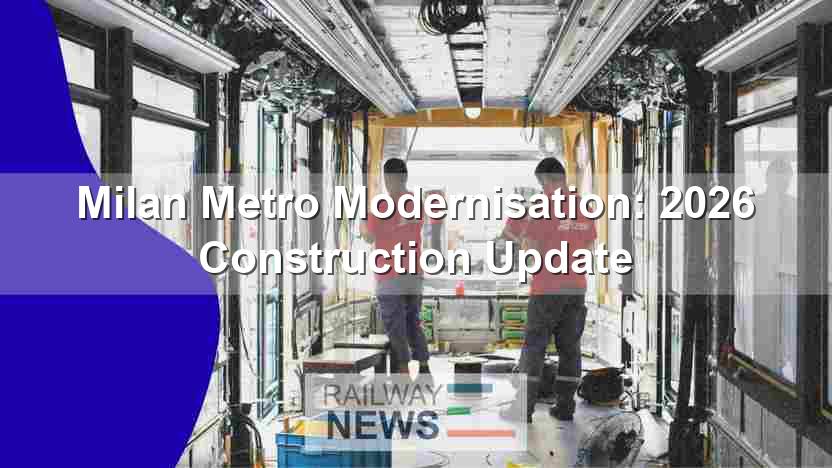
The Milano Metro Modernisation project is a multi-phase infrastructure program enhancing capacity, safety, and operational efficiency across Milan’s urban rail network. This profile details the technical specifications of key upgrades, including the construction of the new M4 line and the deployment of advanced Communications-Based Train Control (CBTC) and Automatic Train Operation (ATO) systems to create an internationally competitive transit system.
| Attribute | Details |
|---|---|
| Project Name | Milano Metro Modernisation & Expansion |
| Location | Milan, Italy |
| Network Length | Approx. 115 km (post-M4 completion) |
| Maximum Speed | Up to 80 km/h |
| Estimated Cost | Exceeding €1.8 billion (M4 construction) plus significant investment in existing line upgrades |
| Status | Multi-phase: M1, M2, M3, M5 operational with ongoing upgrades. M4 under construction (phased opening). |
| Key Contractors/Stakeholders | Metropolitana Milanese (Owner), ATM (Operator), Hitachi Rail Italy (Rolling Stock), Webuild Group (M4 Construction) |
Technical Specifications
A core component of the modernisation is the implementation of advanced signalling and automation. The new M4 and existing M5 lines operate on a driverless, unattended GoA4 Automatic Train Operation (ATO) system, managed by a state-of-the-art Communications-Based Train Control (CBTC) system. This technology enables higher frequency services, reduced headways, and enhanced safety through real-time train monitoring and automatic speed control. Older lines are undergoing progressive signalling overhauls to improve service regularity and prepare for future automation upgrades. Data processing systems are integrated to monitor track conditions predictively, enabling a shift to proactive maintenance schedules.
The project includes a significant renewal of rolling stock. For the heavy metro M2 line, new ‘Leonardo’ trains supplied by Hitachi Rail Italy are replacing aging vehicles, offering increased capacity and improved accessibility with low-floor designs. On the light rail network, Adtranz Eurotrams provide air-conditioned travel for up to 270 passengers. Infrastructure upgrades are extensive, with the new 15.2km M4 line connecting Linate Airport directly to the city’s west. To mitigate environmental impact in dense urban areas, track systems have been upgraded with resilient fastenings and floating slab track, which significantly reduce noise and vibration transmitted to adjacent buildings.
Key Takeaways
- Automation as a Core Strategy: The deployment of fully automated GoA4 ATO systems on lines M4 and M5 is central to boosting network capacity, operational efficiency, and safety, setting a benchmark for future line developments.
- Enhanced Passenger Experience: Modernisation extends beyond engineering to passenger-facing technology, with the system-wide integration of EMV contactless payments and enhanced real-time information systems improving convenience and accessibility.
- Strategic Network Expansion: The construction of new lines and extension of existing ones, particularly the M4 airport link, is crucial for connecting previously underserved areas and integrating the metro with national rail and air travel hubs, reinforcing Milan’s position as a major European city.
FAQ
When will Milan Metro Line M4 be fully open?
Milan’s M4 ‘Blue Line’ is opening in phases. While sections are already operational, the full 15.2 km route connecting Linate Airport to San Cristoforo station is scheduled for full completion and operation by late 2024, with final system integration continuing into the following years.
Who is building the new Milan Metro lines?
The infrastructure for Milan’s metro is owned by Metropolitana Milanese (MM). The construction of new lines like the M4 involves a consortium of civil engineering firms, with Webuild Group leading the project, while the system is operated by Azienda Trasporti Milanesi (ATM).

Railway infrastructure, rolling stock and transport technologies specialist focused on global rail industry developments, high-speed rail systems, signaling technologies and freight transportation. Covering railway investments, public transport modernization, rail operations and international mobility projects across Europe, Asia and North America.