
Madrid High-Speed Rail: Infrastructure Upgrade & Bypass Benefits
Madrid’s high-speed rail network gets vital upgrade, connecting key corridors. New bypass link boosts efficiency, cutting travel times.
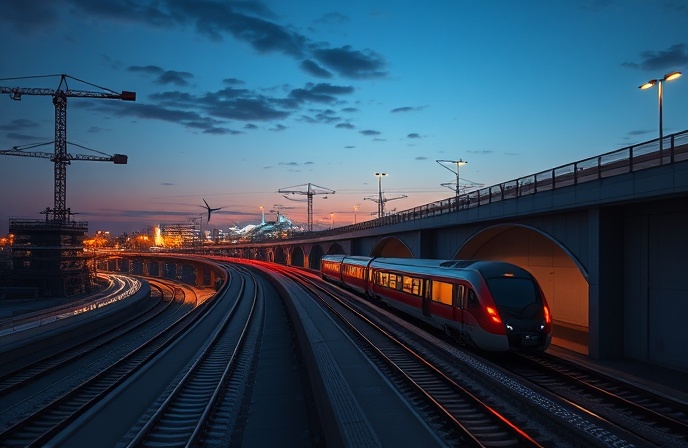
Madrid’s High-Speed Rail Network Receives a Critical Upgrade: Connecting the Corridors
Adif Alta Velocidad (Adif AV), Spain’s high-speed rail infrastructure manager, has reached a significant milestone in the construction of a vital new railway link in Madrid. This project aims to seamlessly connect the high-speed lines (LAV) from Madrid to Barcelona and Madrid to Levante, creating a critical “baipás” (bypass). This initiative, which began construction at an undisclosed date, is set to drastically reshape rail travel for passengers in the northeast and north-northwest regions of Spain. The primary objective is to enable direct rail connections, eliminating the need for train changes and significantly reducing travel times. The new link, costing over EUR 110 million, will greatly improve the efficiency of the Spanish high-speed network and make train travel even more accessible. This article explores the key aspects of this major infrastructure investment.
The Heart of the Project: The Baipás Bypass
At the core of the project is the construction of a dedicated rail platform designed to create a direct bypass between the Madrid-Barcelona and Madrid-Levante LAVs. Currently, trains from the Madrid-Barcelona line either originate or terminate at Puerta de Atocha station. The new connection will reroute these services to Madrid Chamartín-Clara Campoamor station, utilising a standard-gauge tunnel that links the two primary Madrid stations, and will also partially utilize a section of the Madrid-Levante line. This design will allow passengers travelling from the northeast corridor (Aragon and Catalonia) to continue to destinations in the north-northwest of Spain, and vice versa, without the inconvenience of changing trains. Moreover, trains from Barcelona will gain direct access to Adolfo Suárez Madrid-Barajas Airport, further enhancing connectivity. Furthermore, the baipás will also provide northeast corridor trains direct access to the planned through station at Atocha, which is currently under construction.
Engineering Challenges and Solutions: Navigating a Complex Landscape
The construction of this critical infrastructure is taking place in a challenging environment, bounded by the M-45 and M-50 motorways and the Perales del Río neighbourhood in Getafe. The project encounters numerous technical hurdles due to the presence of existing infrastructure, and protected natural areas. Adif AV has addressed these challenges through careful planning, precise execution, and utilization of advanced engineering techniques. These approaches include extensive geotechnical surveys and archaeological excavations that have already been completed. These steps have informed the drainage, embankment, road realignment, and utility relocation, ensuring minimal disruption to the surrounding environment and existing infrastructure. These projects, while initially creating a temporary impact, lead to reduced long-term disruption.
Key Infrastructure Elements: The Mayoral Viaduct and Pergolas
Significant progress has been made on key structural elements, notably the Mayoral Viaduct. This 656-metre-long structure is the longest on the bypass. The first seven spans of the deck are complete, and the eighth is nearing completion, showcasing significant project acceleration. The abutments have been finalized, and work on the 19 piers is ongoing, with most foundations and capitals already constructed. Furthermore, construction is underway on four pergolas, essential for crossing the active high-speed lines without interrupting operations. Two will span the Madrid-Sevilla line, one the Madrid-Levante line, and one the Madrid-Barcelona line. Foundations and abutments for these critical crossings are currently being built.
The Track Layout: Connecting the Network
The two new connecting tracks, one heading towards Barcelona (VSB) and the other towards Madrid (VSM), originate near the Villaverde substation. They then pass beneath the M-45 motorway viaduct before turning east. The VSB track will cross the Madrid-Levante and Madrid-Sevilla lines via pergolas, while the VSM track will similarly cross the Madrid-Sevilla line. The two tracks will then converge into a double-track platform near kilometre points 2/140 (VSB) and 1/989 (VSM). Continuing east, the line will cross the Madrid-Barcelona LAV on the Mayoral Viaduct. Subsequently, it will pass over the M-31 motorway using two overpasses. The tracks will split again near kilometre points 4/020 (VSB) and 3/870 (VSM) before connecting with the Madrid-Barcelona line. The VSM track ends at kilometre 5/332, while the VSB ends at 5/193 after crossing the Madrid-Barcelona line on a pergola. This detailed layout ensures the seamless integration of the new bypass with the existing high-speed network, maximizing operational efficiency.
Conclusion
The new railway link in Madrid, spearheaded by Adif AV, represents a critical investment in Spain’s high-speed rail network. The project’s strategic placement, creating a bypass between two key high-speed lines, will streamline rail travel across the country. The elimination of train changes, coupled with improved access to airport services, will significantly enhance the passenger experience and increase the appeal of rail travel. The completion of the Mayoral Viaduct and the ongoing construction of the pergolas demonstrate the tangible progress being made, overcoming complex engineering and environmental challenges. The success of this project will serve as a model for future high-speed rail infrastructure projects, demonstrating the importance of efficient, sustainable, and passenger-focused transportation solutions. This initiative has the potential to boost regional economies and promote sustainable transport and is a step forward in improving railway accessibility.
RELATED POSTS

February 10, 2025 7:46 am
Introduction This article examines the significant modernization of Thailand’s State...
June 27, 2025 6:33 am
LA's Foothill Gold Line extension, a $1.5B project, nears completion....

November 27, 2018 8:09 am
Moldova's CFM just upgraded with 12 powerful GE Transportation Evolution...

November 13, 2025 7:54 am
CSX designates Alabama's Westgate Super Site as a Platinum **CSX...

June 22, 2007 7:17 pm
The world’s fastest series-production high-speed train has been approved for...

November 28, 2025 10:42 am
Czech Railways boosts its railway network with a new night...