
Italy’s Rail Revolution: FNM & Stadler’s Green DEMUs
FNM and Stadler are revolutionizing Italy’s regional rail with cutting-edge, low-emission DEMUs. Discover how this partnership delivers superior passenger experience and significant cost savings!
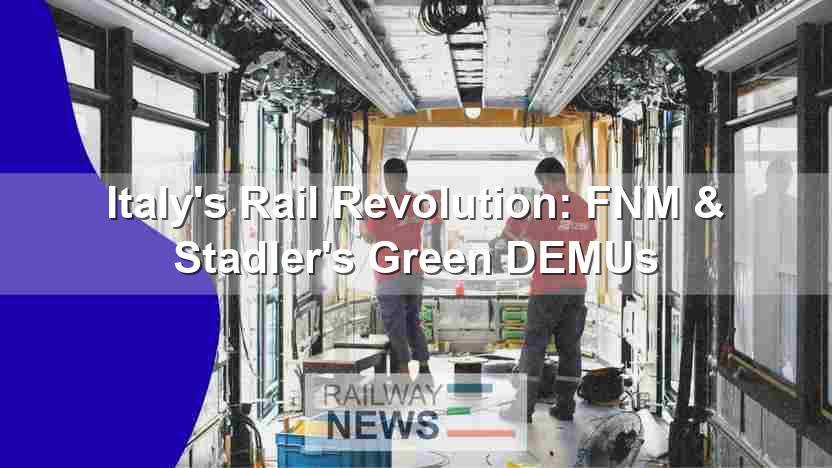
This article explores the significant framework agreement between Ferrovie Nord Milano (FNM), an Italian public transport company, and Stadler, a Swiss rolling stock manufacturer. This collaboration focuses on the procurement and deployment of a new fleet of diesel-electric multiple units (DEMUs) for regional rail services in the Lombardy region of Italy. The agreement signifies a crucial step in modernizing Italy’s regional rail infrastructure, enhancing passenger experience, and promoting environmental sustainability. The deal, spanning eight years, ensures a minimum of 30 and a maximum of 50 state-of-the-art diesel-electric trains, representing a substantial investment in improving the daily commute for the 750,000 passengers who rely on FNM’s regional services. This analysis will delve into the technical specifications of the new trains, the economic implications of the agreement, and the broader impact on the regional transportation network and its users. The environmental benefits, operational efficiencies and overall strategic goals of this partnership will also be discussed.
Technical Specifications and Innovations
The Stadler-built DEMUs represent a significant advancement in regional rail technology. The trains incorporate several key innovations designed to improve performance, passenger comfort, and environmental impact. A crucial feature is the placement of the two latest-generation, low-emission diesel engines (Stage V with Selective Catalytic Reduction (SCR) catalytic converter) in the center of the train. This central engine placement minimizes noise and vibration transmission to the passenger carriages, enhancing passenger comfort. Additionally, the engine configuration incorporates a special module powering two sets of batteries, enabling zero-emission operation within stations and reduced emissions during suburban travel. This hybrid approach significantly reduces the overall environmental footprint compared to traditional diesel trains.
Beyond the environmentally friendly propulsion system, the trains offer a range of passenger-centric amenities. These include spacious interiors with seating for 168 passengers and a total capacity of 328, modern LED lighting, Wi-Fi connectivity, 220V sockets and USB charging ports, a passenger information system, and CCTV for enhanced security. The trains are bidirectional, measuring 66.8 meters in length, and boast a maximum speed of 140 km/h (87 mph).
Economic and Operational Benefits
The agreement between FNM and Stadler presents substantial economic advantages for the operator. The new trains are projected to achieve a 30% reduction in fuel consumption compared to older models, resulting in an estimated annual saving of €3 million. The improved acceleration, a 20% increase compared to existing rolling stock, will lead to significant reductions in travel times, enhancing operational efficiency and increasing the overall attractiveness of rail travel. Additionally, the anticipated decrease in CO2 emissions by 12,400 tons annually is equivalent to removing 8,600 cars from the road, aligning with broader sustainability goals.
Environmental Impact and Sustainability
The environmental benefits of this initiative are considerable. The low-emission diesel engines and battery-assisted operation drastically reduce greenhouse gas emissions. The reduction in fuel consumption contributes to lower operational costs and decreases the region’s reliance on fossil fuels. The integration of these environmentally conscious designs into the regional rail network aligns with the broader push towards decarbonization and sustainable transportation within the European Union, and underscores FNM’s commitment to responsible environmental practices.
Strategic Implications and Conclusion
The framework agreement between FNM and Stadler represents a strategically significant investment in the future of Lombardy’s regional rail network. The procurement of these modern, efficient, and environmentally friendly trains will not only improve the quality of service for commuters, but also enhance the overall efficiency and sustainability of the rail system. The €190 million investment reflects a commitment to providing a more comfortable, reliable, and environmentally conscious public transportation option. The anticipated delivery of the first trains by 2021 marks the beginning of a substantial fleet renewal, promising significant improvements in journey times, passenger comfort, and environmental performance. The agreement sets a strong precedent for future modernization efforts across Italy’s regional rail networks, driving innovation and creating a more sustainable and user-friendly passenger experience. The projected cost savings, coupled with the reduced emissions and enhanced service, present a strong return on investment, solidifying the strategic importance of this collaboration between FNM and Stadler. The success of this partnership serves as a compelling case study for other public transportation agencies looking to modernize their fleets and adopt sustainable practices.

Railway infrastructure, rolling stock and transport technologies specialist focused on global rail industry developments, high-speed rail systems, signaling technologies and freight transportation. Covering railway investments, public transport modernization, rail operations and international mobility projects across Europe, Asia and North America.
RELATED POSTS

October 8, 2026 1:15 pm
Alstom secured a €1bn contract to build 13 automated trains,...

October 1, 2026 7:09 am
United States regulators confirmed a September 30 deadline for the...

October 8, 2026 12:18 pm
Siemens Mobility signed an agreement with VinSpeed to supply 350...

October 4, 2026 5:14 pm
Alstom secured a CA$4.7 billion order from VIA Rail Canada...

October 5, 2026 6:12 pm
AECOM and Jacobs secured a contract in September 2026 to...

October 1, 2026 12:13 am
Illinois approved $1.5 billion annually for the Northern Illinois Transit...