
Iran & Turkey to Build $1.6B Rail Line for Eurasian Trade Corridor
Iran and Turkey are building a new $1.6 billion **railway** line. This key infrastructure project aims to boost trade and enhance the **rail** corridor connecting Asia and Europe.
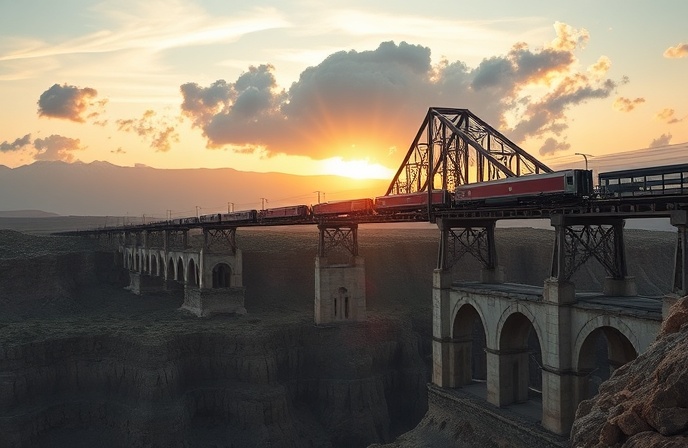
Iran and Turkey have formalized plans to construct a vital new railway line connecting Marand, Iran, to Cheshmeh Soraya at the Turkish border. This ambitious USD 1.6 billion, 200-kilometer project, slated for completion in three to four years, marks a significant strategic investment aimed at enhancing regional trade connectivity and solidifying Iran’s role as a pivotal transit hub between Asia and Europe.
| News Snapshot: Iran-Turkey Railway Expansion | |
|---|---|
| Key Entity | Iran, Turkey |
| Core Action | Agreement to build new 200 km railway line (Marand-Cheshmeh Soraya) |
| Budget/Value | Approximately USD 1.6 billion |
| Timeline | 3-4 years for completion; early 2029 or 2030 for first trains |
| Strategic Goal | Establish a complete rail corridor between China and Europe, bolster regional logistics |
The landmark agreement was announced in Tehran during a joint press conference following high-level talks between the Iranian Foreign Minister and his Turkish counterpart. The focus of these discussions centered on deepening economic cooperation, bolstering infrastructure development, and facilitating cross-border investment. Officials from both nations underscored the priority of connecting their railway networks at the border, signaling the commencement of a strategic trade corridor poised to redefine the region’s logistics landscape.
This new Marand–Cheshmeh Soraya line is an integral component of Iran’s broader strategy to transform the southern Silk Road into a fully functional rail corridor, ensuring uninterrupted freight transport between China and Europe. The Iranian Transport Minister highlighted the prospective infrastructure’s capacity for “fast and inexpensive transport of all types of goods, with minimal stops,” a development that could fundamentally alter Iran’s position within Eurasian transit networks. The initiative aligns with the renewed geopolitical emphasis on the Silk Road, amplified by China’s Belt and Road Initiative launched in 2013.
Strategic Impact on Eurasian Connectivity
In a move to counteract the limitations imposed by international sanctions, which have historically hampered Iran’s participation in major Belt and Road projects, Tehran is strategically forging stronger ties with Turkey. As an economy deeply integrated with Europe and possessing direct access to the Mediterranean and Black Seas, Turkey’s role as a Eurasian hub makes this partnership particularly pragmatic for Iran. For Ankara, the project reinforces its position as a crucial interconnection point, strengthening logistics routes linking Central Asia, the Middle East, and the European Union. The estimated USD 1.6 billion investment will address the final missing link in a continuous rail flow between the two nations, facilitating the transport of both containers from Asia and regional exports. This development aims to dismantle existing bottlenecks caused by fragmented infrastructure and cumbersome border procedures.
Last June 2025, we published an article about Renfe’s cutting-edge Aranjuez maintenance hub. Click here to read – Future of Rail: Renfe’s Railway Technology Hub, Aranjuez: Essential Guide
Industry Context
The agreement between Iran and Turkey, alongside recent developments such as the first export train carrying cement clinker to Turkey from Iran and the resumption of the Iran–Pakistan–Turkey container train service, signals a significant acceleration in rail integration across Eurasia. These initiatives are not merely about infrastructure expansion; they represent a deliberate strategy to create competitive and resilient East-West and North-South corridors. By offering viable alternatives to potentially congested or geopolitically vulnerable sea routes, these projects enhance logistical resilience and provide essential connectivity. For industry leaders, this signifies a shift towards more efficient, cost-effective, and strategically secure freight movement, potentially reshaping supply chains and reinforcing the role of rail as a critical element in global commerce. The anticipated completion by early 2029 or 2030 positions this new corridor to become a significant factor in Euro-Asian freight flows.

Railway infrastructure, rolling stock and transport technologies specialist focused on global rail industry developments, high-speed rail systems, signaling technologies and freight transportation. Covering railway investments, public transport modernization, rail operations and international mobility projects across Europe, Asia and North America.
RELATED POSTS
September 6, 2026 5:19 am
Hitachi delivered Taiwan's first N700ST high-speed train from Japan in...
September 6, 2026 6:17 am
Hungary ordered a national ban on most freight trains from...
September 6, 2026 1:17 am
Hitachi Toshiba Supreme Consortium confirmed the first of 12 N700ST...

September 5, 2026 4:19 pm
CPK launched formal tender talks with four consortia to design...
September 7, 2026 8:16 am
Midea, Gree and TCL shipped air conditioners via China Railway...
September 7, 2026 11:16 pm
China Railway Tunnel Group completed the 11.3-km underwater Yangtze tunnel...