
Inland Rail: 2026 Construction Update & Route Map
Australia’s Inland Rail project, a massive freight corridor between Melbourne and Brisbane, is revolutionizing transport. Expect significant economic growth and reduced transit times.

Inland Rail Project Profile: Australia’s 1,711km Freight Superhighway
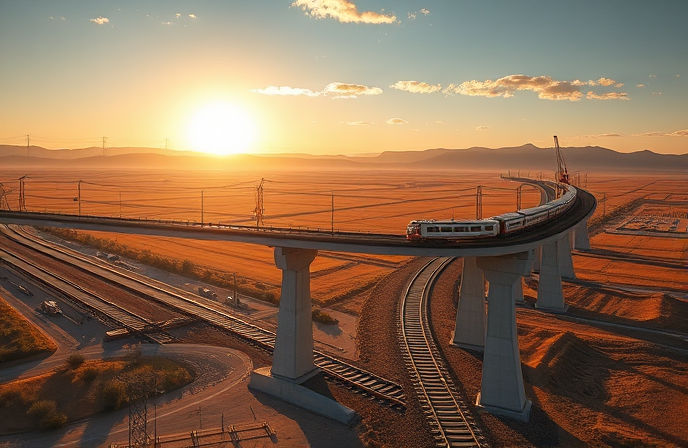
The Inland Rail is a generational upgrade to Australia’s national freight network, establishing a high-performance 1,711-kilometre rail corridor from Melbourne to Brisbane. This project is engineered to accommodate double-stacked container trains, fundamentally enhancing supply chain efficiency and providing a strategic alternative to the congested coastal route through Sydney. It represents one of the most significant transport infrastructure developments in the nation’s history.
| Attribute | Details |
|---|---|
| Project Name | Inland Rail |
| Location | Melbourne (VIC) to Brisbane (QLD), via regional Victoria & New South Wales |
| Route Length | 1,711 km (709 km new track, 992 km upgraded track) |
| Design Capability | 1,800m double-stacked container trains (up to 3,600m in some sections) |
| Estimated Cost | A$31.4 Billion (as per 2023 Independent Review) |
| Status (as of Q4 2025) | Partially Operational & Under Phased Construction |
| Key Contractors | ARTC (Client), Regionerate Rail (Gowrie-Kagaru), Trans4m Rail (Narrabri-North Star), Martinus (Narromine-Moree) |
Technical Specifications
The Inland Rail’s design adheres to mainline standard gauge (1,435 mm) specifications to ensure full interoperability with Australia’s national rail network. The project’s engineering scope involves a mix of greenfield and brownfield development, comprising approximately 709 km of new track construction and 992 km of significant upgrades to existing corridors. A core design requirement is enabling the operation of 1,800-metre-long, double-stacked container trains, which significantly increases freight volume per train path. This necessitates enhanced vertical clearances on all structures, including 22 new bridges and 18 viaducts, and substantial track and formation upgrades for higher axle loads.
Signalling and train control are managed by the Advanced Train Management System (ATMS), a digital solution designed to improve safety and network capacity. One of the project’s most formidable engineering challenges is the Gowrie to Kagaru section in Queensland, which requires the construction of over 8 km of tunnels through the steep gradients of the Toowoomba Range. This section is critical for connecting the main line to the port of Brisbane and navigating the complex terrain of the Great Dividing Range.
Key Takeaways
- Strategic Freight Diversion: The project creates a crucial north-south freight route that bypasses Sydney’s congested rail and road networks, aiming to deliver a sub-24-hour transit time between Melbourne and Brisbane and enhance national supply chain resilience.
- Economic Catalyst for Regions: By connecting key agricultural and mining regions directly to domestic and international markets, Inland Rail is projected to generate over A$18 billion in economic benefits and support thousands of jobs in regional Australia.
- Sustainable Transport Shift: The project is designed to shift significant freight volume from road to rail, with each 1,800m train equivalent to approximately 110 B-double trucks. This modal shift is expected to reduce carbon emissions by over 750,000 tonnes annually and decrease road congestion and accidents.
Frequently Asked Questions (FAQ)
When will the Inland Rail be finished?
The Inland Rail project is being delivered in distinct phases. The Parkes to Narromine section in New South Wales is already operational. While other sections are under active construction, the full 1,711 km corridor from Melbourne to Brisbane is currently projected to be completed in the early 2030s, subject to ongoing planning approvals and construction schedules.
Who is building the Inland Rail?
The Australian Rail Track Corporation (ARTC), a federal government-owned entity, is responsible for delivering and managing the Inland Rail project. ARTC has engaged multiple leading engineering and construction firms through competitive tenders to build different sections of the route. Key delivery partners include consortia like Regionerate Rail and Trans4m Rail, among many others providing specialized services.
RELATED POSTS
July 17, 2025 11:33 pm
California's high-speed rail project faces $4B funding cut, sparking political...
July 20, 2022 9:39 am
SunRail, Central Florida's commuter rail project, improves regional connectivity and...
April 28, 2025 8:12 pm
The Rail Baltica Mainline Procurement: A Key Milestone in Baltic...
February 26, 2018 6:15 pm
Italy's high-speed rail network expands, integrating advanced technology and public-private...
November 1, 2015 6:10 pm
Singapore's Downtown Line Stage 1 railway project successfully utilized advanced...
May 20, 2025 8:09 pm
Canada/USA – May 16, 2025 CN Railway Details C$3.4 Billion...