
India’s First Bullet Train: MAHSR Corridor Launches in 2027
India’s high-speed rail ambitions accelerate! The Mumbai-Ahmedabad corridor’s initial bullet train service launches August 2027, connecting Surat and Vapi. This railway milestone boosts connectivity.
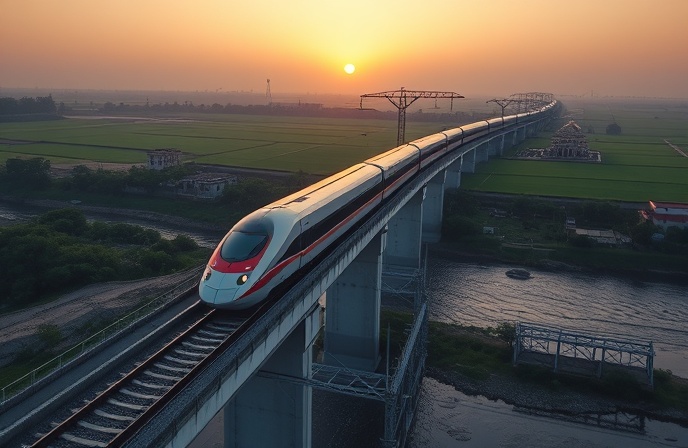
India’s highly anticipated Mumbai–Ahmedabad High-Speed Rail (MAHSR) corridor is set to commence its inaugural passenger service in August 2027, with an initial 100km operational stretch between Surat and Vapi in Gujarat. This revised timeline and operational segment mark a significant milestone for India’s high-speed rail ambitions, shifting from an earlier plan for a shorter section and paving the way for future expansion.
| Key Entity | Critical Detail |
|---|---|
| Project | Mumbai–Ahmedabad High-Speed Rail (MAHSR) Corridor |
| Core Action | Debut operational run of India’s first bullet train |
| Initial Route | Surat to Vapi, Gujarat (100km) |
| Debut Date | August 2027 |
| Original Target | December 2023 |
| Project Start | 2017 |
| Total Corridor Length | 508km |
The commencement of operations on the Surat to Vapi section signifies a crucial step forward for the MAHSR project, which has been under construction since its launch in 2017. The initial service will feature trains capable of reaching speeds of up to 320km per hour, promising a dramatic reduction in travel times between key economic hubs. The revised operational plan addresses progress on various construction fronts, including the advanced stage of completion for the Surat and Billimore section, while prioritizing the initial debut on a different, yet strategically important, segment.
Strategic Impact and Operational Vision
The MAHSR corridor, spanning approximately 508km across Gujarat, Dadra & Nagar Haveli, and Maharashtra, is designed to transform inter-city travel. The ambitious project has seen significant construction progress, with 465km, or roughly 85%, of the total route built on viaducts to minimize land acquisition and enhance safety. To date, 326km of these viaducts have been completed, alongside 17 out of 25 river bridges. The infrastructure also incorporates advanced engineering, including a unique single tunnel designed for simultaneous bidirectional high-speed train operations and the use of 40m girders for viaduct construction. These advancements highlight a commitment to robust, future-proof infrastructure.
The operational impact of the MAHSR is projected to be substantial. A journey between Mumbai and Ahmedabad is anticipated to take just one hour and 58 minutes with stops at four stations, a stark contrast to current travel times. Even with stops at all 12 stations along the route, the travel time will be an efficient two hours and 17 minutes. This significant reduction in transit duration is expected to foster greater economic connectivity, encourage business travel, and potentially boost tourism between these major metropolitan areas. The project also emphasizes safety through the implementation of advanced monitoring systems like ground settlement markers, inclinometers, piezometers, and strain gauges, along with the adoption of the New Austrian Tunnelling Method (NATM) for tunnel construction.
Technological Advancements and Future Prospects
In parallel with the MAHSR project’s development, India is exploring the integration of cutting-edge rolling stock. Discussions held in September this year focused on introducing Japan’s latest E10 Shinkansen, a next-generation bullet train system, to India, with Japan having agreed to provide this advanced technology. This move signals India’s intent to not only build world-class high-speed rail infrastructure but also to operate it with the most advanced and reliable train sets available globally. Additionally, a detailed training program, complete with simulator sessions, has commenced for operational staff, ensuring a skilled workforce is ready to manage the complexities of high-speed rail operations.
Technical Specifications
- Maximum operational speed: 320 km/h
- Corridor length: 508km
- Viaduct construction: 465km (approx. 85% of total route)
- River bridges completed: 17 out of 25
- Tunnel design: Single tunnel for simultaneous two-way high-speed train operation
- Viaduct girders: 40m
- Tunnelling method: New Austrian Tunnelling Method (NATM)
Industry Context
The impending launch of India’s first bullet train on the MAHSR corridor represents a pivotal moment for the global railway industry. It underscores the burgeoning potential of high-speed rail in emerging economies and signals a significant investment in infrastructure that will reshape transportation paradigms. For industry stakeholders, this development signifies expanding opportunities in rolling stock, signaling, infrastructure development, and operational technology. It also highlights the growing geopolitical and economic ties through technology transfer agreements, such as the potential introduction of Japanese Shinkansen technology, emphasizing the strategic importance of such mega-projects in fostering international collaboration and driving innovation within the high-speed rail sector.
Last June 2025, we published an article about Renfe’s cutting-edge Aranjuez maintenance hub. Click here to read – Future of Rail: Renfe’s Railway Technology Hub, Aranjuez: Essential Guide

Railway infrastructure, rolling stock and transport technologies specialist focused on global rail industry developments, high-speed rail systems, signaling technologies and freight transportation. Covering railway investments, public transport modernization, rail operations and international mobility projects across Europe, Asia and North America.
RELATED POSTS
August 4, 2026 1:11 pm
Hitachi Rail Canada secured a $407.7M contract to install CBTC...
August 11, 2026 11:13 am
Hungary confirmed the €2.5B Hungarian rail upgrade will not see...

August 4, 2026 11:12 am
MBTA confirmed a $150.8 million overhaul of the 85-year-old Green...
August 1, 2026 7:14 pm
€205 billion funding shortfall threatens the TEN-T rail network's completion...
August 1, 2026 7:56 am
BMZ delivered two new TEM18DM diesel shunting locos to RZD...
August 2, 2026 5:10 am
ZIM and MSC launched a weekly Asia-Jacksonville container service on...