
Indian Railways RailOne App: Passenger Services Revolution
Indian Railways launches RailOne app, a single platform for improved passenger services, July 2, 2025.
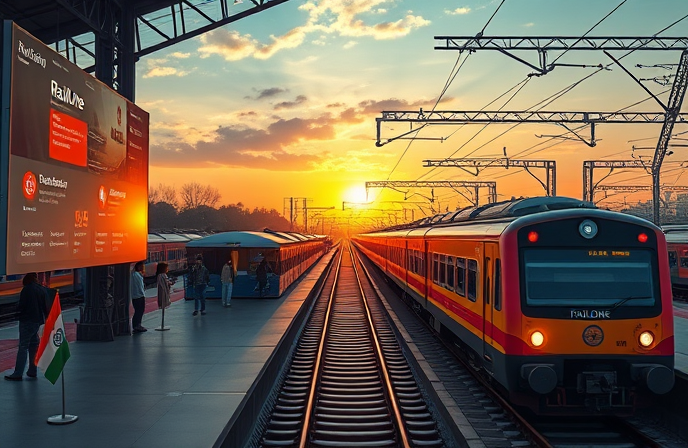
Indian Railways Launches RailOne App: A Leap Forward in Passenger Services
In a significant move to enhance passenger experience, Indian Railways unveiled the RailOne app on July 2, 2025. The launch, coinciding with the 40th Foundation Day of the Centre for Railway Information Systems (CRIS), marks a pivotal step towards streamlining passenger services. This comprehensive mobile application, announced by Union Railway Minister Shri Ashwini Vaishnaw, consolidates various passenger functionalities into a single, user-friendly platform. Developed by CRIS, the RailOne app aims to simplify access to essential services, from ticketing and real-time tracking to grievance redressal and ancillary offerings like e-catering. This article delves into the features, benefits, and future implications of the RailOne app, examining its role in modernizing the Indian Railways and improving passenger satisfaction. The “who” is Indian Railways, the “what” is the RailOne app, the “when” was July 2, 2025, the “where” is accessible nationwide via mobile platforms, the “why” is to improve passenger services and the “how” is through a single-sign-on system and consolidated features.
Single Platform, Seamless Experience
The RailOne app provides a unified interface for a wide range of passenger services, eliminating the need for multiple applications. This feature is especially appealing to passengers, improving operational efficiency through a consolidated app. The app supports single-sign-on, allowing users to log in using either a mobile personal identification number (mPIN) or biometric authentication. This simplifies access to the existing RailConnect and Unreserved Ticketing System (UTS) credentials. Passengers can download the app from both the Android Play Store and the iOS App Store, which provides greater accessibility for the user. A notable feature is the 3% discount on unreserved tickets purchased through the UTS. The integration of live train tracking, e-catering, porter booking, and last-mile taxi services further enhances the overall travel experience. While the RailOne app directs passengers to the Indian Railway Catering and Tourism Corporation (IRCTC) for reserved ticket bookings, its authorization from IRCTC ensures seamless integration with existing services.
Advanced Ticketing and Reservation System Integration
Looking ahead, Indian Railways is developing a modern Passenger Reservation System (PRS) expected to be completed by December 2025. This new PRS is designed to be agile, multilingual, and scalable, with the ability to handle ten times the current load. The system’s capacity will extend to processing 150,000 ticket bookings and four million enquiries per minute. The enhanced PRS will also feature functionalities like seat choice and a fare calendar, catering to the needs of diverse passenger groups, including students and patients. The integration of a new PRS will not only improve the efficiency of ticket booking but also enhance the user experience with options for seat selection and transparent fare display. This comprehensive approach demonstrates the commitment of Indian Railways to technological advancements.
Multilingual AI Solutions for Enhanced Passenger Interaction
In line with the government’s Digital India initiative, the Digital India Bhashini Division (DIBD) has partnered with CRIS to develop multilingual artificial intelligence (AI) solutions for Indian Railways. This collaboration, formalized through a Memorandum of Understanding (MoU), aims to support passenger interactions in 22 Indian languages. This initiative acknowledges the linguistic diversity of the Indian populace, enhancing accessibility and customer service. The implementation of multilingual AI will significantly improve communication and information dissemination, making the railway system more inclusive and user-friendly for a broader segment of the population. The goal is to create a seamless, personalized, and user-friendly experience that meets the needs of every passenger.
Conclusion
The launch of the RailOne app and the upcoming advancements in the PRS signify a strategic transformation in Indian Railways’ approach to passenger services. These initiatives represent a shift towards a more passenger-centric model, leveraging technology to enhance accessibility, convenience, and overall travel experience. The consolidation of services into a single platform, the implementation of advanced AI-powered solutions, and the development of a modern PRS are all aimed at simplifying processes and improving efficiency. The partnership between DIBD and CRIS, supporting multilingual AI, further reflects the commitment to inclusivity and serving the diverse needs of the Indian populace. Industry implications point towards a future where technology plays a pivotal role in shaping passenger-rail interaction, setting new standards in service delivery. The outlook for Indian Railways is promising, with further innovations on the horizon and continuous investment in passenger comfort and digital integration.
RELATED POSTS
August 7, 2025 6:33 pm
Amtrak and Union Pacific settle Sunset Limited OTP dispute, STB...

October 4, 2017 5:45 pm
Optimize your railway infrastructure for a superior passenger experience. ...
October 13, 2020 9:07 pm
This article examines the significant role of Parsons Corporation in...
February 28, 2021 11:25 pm
Introduction This article explores the ambitious plans of the Indian...
August 12, 2025 7:33 pm
Battery trains revolutionize rail, boosting sustainability and efficiency. Reduced...
May 29, 2025 1:00 am
DB Cargo UK Embarks on ETCS Retrofit Project at Toton...