
Iarnród Éireann Launches $10B CONNECT Rail Project: Dublin-Cork
Iarnród Éireann’s ambitious rail project, CONNECT, begins! Funded to modernize infrastructure, slash emissions, and significantly improve intercity railway services.
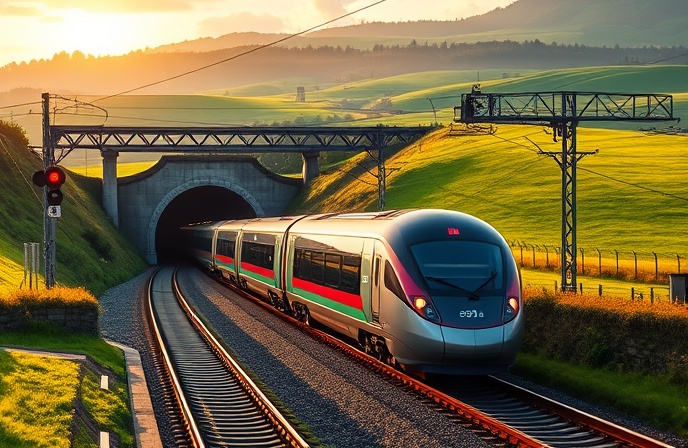
Iarnród Éireann’s ambitious CONNECT rail project, backed by significant European Union and Irish Government funding, has commenced with the goal of revolutionising intercity rail travel across Ireland. The initiative aims to modernize infrastructure, slash carbon emissions, and deliver significantly faster, more frequent, and sustainable services for passengers, particularly on the vital Dublin to Cork and Dublin to Limerick corridors.
| Key Entity | Critical Detail |
|---|---|
| Project Name | CONNECT |
| Lead Implementer | Mott MacDonald |
| Client | Iarnród Éireann |
| Funding | European Union’s Connecting Europe Facility, Ireland’s National Development Plan 2021–2030 |
| Focus Corridors | Dublin to Cork, Dublin to Limerick |
| Projected Impact | More than double annual intercity passenger numbers by 2050 |
| Potential Journey Time Reduction | Up to 30 minutes on key intercity routes |
| Target Line Speed | Up to 200km/h |
The CONNECT project is a cornerstone of Iarnród Éireann’s RAIL2050 strategy, designed to create a high-capacity, low-carbon rail network that will serve future generations. Mott MacDonald has been tasked with developing a detailed implementation strategy and a detailed decarbonisation roadmap. This will be underpinned by in-depth technical studies and extensive stakeholder engagement to ensure the project aligns with national and EU climate objectives and effectively addresses the infrastructure, service, and policy interventions required for a sustainable transport future.
Strategic Impact
Early insights from the project indicate that substantial journey time reductions, potentially up to 30 minutes on key intercity routes, are achievable through targeted infrastructure enhancements and the adoption of higher line speeds, aiming for up to 200km/h. When combined with the planned introduction of a new electric fleet, these improvements hold the promise of dramatically shortening travel times between Dublin and Cork and Dublin and Limerick, contingent on further investment. The ambitious goals extend beyond operational efficiency, with the project expected to more than double annual intercity passenger numbers by 2050, significantly contributing to regional economic balance and Ireland’s commitment to achieving net-zero greenhouse gas emissions.
Last June 2025, we published an article about Renfe’s Aranjuez maintenance hub. Click here to read – Future of Rail: Renfe’s Railway Technology Hub, Aranjuez: Essential Guide
Operational Details
The initiative is poised to play a crucial role in supporting Ireland’s Climate Action Plan and the EU Green Deal by facilitating a substantial modal shift from private car usage to rail. This transition is vital for reducing the nation’s carbon footprint and fostering sustainable urban and regional development. The focus on the Dublin to Cork and Dublin to Limerick corridors acknowledges their critical importance to Ireland’s social and economic connectivity, making them prime candidates for transformative upgrades that will benefit a large segment of the traveling public.
Industry Context
For railway operators and infrastructure developers globally, the CONNECT project exemplifies a forward-thinking approach to addressing the dual challenges of capacity expansion and decarbonisation. The project’s emphasis on a holistic strategy, encompassing infrastructure, operational speeds, fleet modernization, and policy integration, offers a blueprint for similar initiatives in other regions. As the transport sector faces increasing pressure to reduce its environmental impact while meeting growing demand, the success of CONNECT could serve as a powerful case study, influencing investment decisions and technological adoption across the international rail landscape and reaffirming rail’s position as a key enabler of sustainable mobility.

Railway infrastructure, rolling stock and transport technologies specialist focused on global rail industry developments, high-speed rail systems, signaling technologies and freight transportation. Covering railway investments, public transport modernization, rail operations and international mobility projects across Europe, Asia and North America.
RELATED POSTS

October 8, 2026 12:18 pm
Siemens Mobility signed an agreement with VinSpeed to supply 350...

October 5, 2026 6:12 pm
AECOM and Jacobs secured a contract in September 2026 to...

October 4, 2026 11:08 pm
Sound Transit confirmed the September 30 opening of Seattle Pinehurst...

October 5, 2026 1:13 pm
New York MTA confirmed a late 2026 DEIS release for...
October 6, 2026 9:17 am
Illinois approved $1.1M in state funds to upgrade two McHenry...
October 6, 2026 5:12 pm
Cleveland RTA confirmed the deferral of planned bus and rail...