
Hamilton-Auckland Rail Trial: NZ’s $78.2M Gamble
New Zealand’s Hamilton-Auckland passenger rail trial: A NZ$78.2 million investment—will it redefine commuter transport? Discover how!
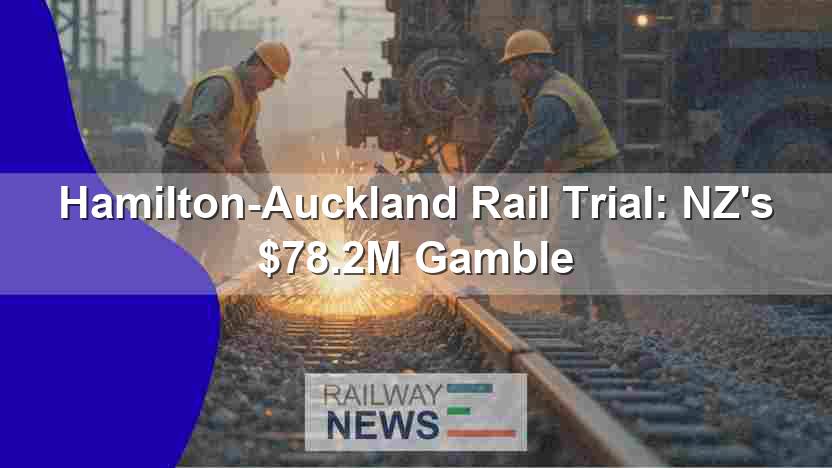
This article explores the details of the approved funding for a trial passenger rail service connecting Hamilton and Auckland, New Zealand. The initiative, a significant step towards enhancing public transportation infrastructure in the region, involves a substantial financial commitment and presents a unique opportunity to assess the feasibility and impact of expanded rail services. We will explore the financial aspects of the project, including the funding sources and cost breakdown, examine the planned operational parameters of the trial, and discuss the potential implications for urban planning and transportation policy in New Zealand. Additionally, we will consider the potential expansion of the service and the long-term viability of passenger rail as a solution for managing increasing commuter traffic between these two major cities. The analysis will consider both the immediate benefits and the potential challenges associated with implementing and sustaining such a venture.
Funding and Financial Structure
The New Zealand Transport Agency (NZTA) has approved NZ$78.2 million (approximately $53.65 million USD) for a five-year trial of a passenger rail service between Hamilton and Auckland. This funding is split between NZTA contributing NZ$68.4 million ($46.93 million USD), and local authorities covering the remaining NZ$9.8 million ($6.72 million USD). This significant investment underscores the government’s commitment to expanding public transport options and addressing growing commuter demands between these two major urban centers. The involvement of local authorities highlights the collaborative approach to this infrastructure project, indicating a shared vision for improved regional connectivity. The cost includes services provided by KiwiRail, the national railway operator, encompassing operational expenses, maintenance, and potentially infrastructure upgrades along the existing rail corridor.
Operational Plan and Service Specifications
The trial service, commencing in March 2020, is initially planned to utilize a four-carriage train with a capacity of 150 passengers. This scalable approach allows for adaptability based on actual ridership. If demand exceeds expectations, a five-carriage train, increasing capacity to 200 passengers, will be deployed. The route will include stops in Hamilton (Frankton and The Base in Rotokauri), Huntly, and terminating at Papakura in Auckland. Future expansion plans include adding stops at Te Kauwhata, Pokeno, and Tuakau, demonstrating a phased approach to service development based on the trial’s success and demand analysis. The choice of Papakura as the Auckland terminus reflects strategic considerations, potentially involving connections to other Auckland transport networks, easing integration into the wider public transport system.
Impact on Urban Planning and Transportation Policy
The Hamilton-Auckland rail trial holds significant implications for urban planning and transportation policy in New Zealand. Successful implementation could demonstrate the effectiveness of rail as a sustainable solution for managing urban sprawl and reducing reliance on private vehicles. Data collected during the trial—regarding ridership, travel times, and economic impact—will be crucial in informing future infrastructure investments and shaping national transportation strategies. This project serves as a case study for evaluating the effectiveness of investing in public transportation to alleviate traffic congestion, reduce carbon emissions, and improve the overall quality of life in urban areas. The success of this trial could influence similar initiatives in other regions of New Zealand, furthering the nation’s commitment to sustainable transportation.
Long-Term Viability and Future Expansion
The long-term viability of the Hamilton-Auckland passenger rail service hinges on several factors, including consistent ridership, efficient operational management, and ongoing government support. The success of the trial will be pivotal in determining whether the service becomes a permanent fixture. Data analysis will be crucial in evaluating cost-effectiveness, identifying areas for improvement, and informing potential expansions. Factors such as fare structures, service frequency, and integration with other transport modes will also significantly influence the project’s sustainability. Positive results from the trial could lead to a full-scale implementation, potentially extending the route further and increasing service frequency, impacting the overall commuter landscape of the Waikato and Auckland regions.
Conclusions
The NZTA’s approval of funding for the Hamilton-Auckland passenger rail trial marks a significant investment in New Zealand’s public transportation infrastructure. The NZ$78.2 million allocated for the five-year trial demonstrates a commitment to exploring sustainable transportation solutions and addressing growing commuter demands. The trial’s operational plan, with its initial four-carriage train and potential expansion to five carriages, demonstrates a flexible and scalable approach. The project’s success will depend heavily on various factors, including ridership, operational efficiency, and ongoing governmental support. The data collected throughout the trial will be crucial for evaluating the project’s cost-effectiveness and informing future transportation policy. The potential impact on urban planning is substantial, with the possibility of alleviating traffic congestion and promoting sustainable urban development. Ultimately, the long-term viability of the service rests on the successful completion of the trial and a demonstrable positive impact on the region. The project’s success could serve as a model for similar initiatives nationwide, highlighting the importance of investing in public transportation as a key strategy for managing urban growth and promoting sustainable development in New Zealand.

Railway infrastructure, rolling stock and transport technologies specialist focused on global rail industry developments, high-speed rail systems, signaling technologies and freight transportation. Covering railway investments, public transport modernization, rail operations and international mobility projects across Europe, Asia and North America.
RELATED POSTS
September 6, 2026 5:19 am
Hitachi delivered Taiwan's first N700ST high-speed train from Japan in...
September 6, 2026 6:17 am
Hungary ordered a national ban on most freight trains from...
September 6, 2026 1:17 am
Hitachi Toshiba Supreme Consortium confirmed the first of 12 N700ST...

September 5, 2026 4:19 pm
CPK launched formal tender talks with four consortia to design...

September 6, 2026 4:12 am
Alstom delivered the first of 100 new G Class trams...

September 7, 2026 8:16 am
Midea, Gree and TCL shipped air conditioners via China Railway...