
Greater Manchester Unveils £90B Rail Strategy with Bee Network
Greater Manchester unveils a transformative 30-year transport strategy, boosting the **rail** sector and aiming for a GBP 90 billion economic impact by 2050.
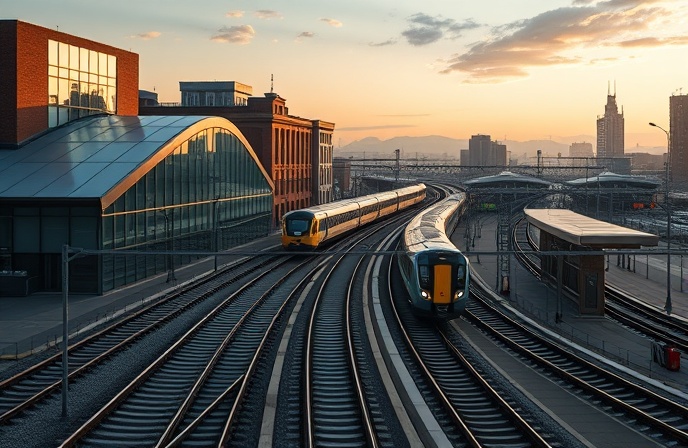
Greater Manchester has unveiled a groundbreaking 30-year transport strategy, aiming to revolutionize the region’s public transit system by 2050. The ambitious plan, presented by Mayor Andy Burnham, forecasts a doubling of passenger numbers, the creation of tens of thousands of new homes around rail hubs, and an estimated GBP 90 billion economic boost for the North West of England.
| Key Entity | Critical Detail |
|---|---|
| Greater Manchester | Launches 30-year transport transformation plan |
| Mayor Andy Burnham | Presented strategy at “Public Transport in the North of England” conference |
| Economic Impact | Estimated GBP 90 billion by 2050 |
| Timeline | Key integration into “Bee Network” starting 2026; full vision by 2050 |
| Key Projects | New stations (Golborne, Cheadle), universal accessibility by 2040, underground Piccadilly hub by 2050, 75,000 new homes near rail |
The Greater Manchester transport strategy, hailed as one of Europe’s most structured and detailed rail strategies in recent times, sets a clear roadmap for the region’s future mobility. This detailed vision is poised to significantly enhance connectivity and stimulate economic growth. A pivotal moment arrives in 2026 when the first local rail services will be integrated into the “Bee Network,” a unified metropolitan system encompassing buses, trams, regional trains, and active mobility, all operating under a single fare and operational framework. This integration is a cornerstone of making public transport intuitive, predictable, and competitive against private car usage for an expanding metropolis.
Strategic Impact
The long-term strategy is built upon several fundamental pillars, designed for gradual implementation based on funding and operational capacity. These include the expansion of the network with new stations like Golborne and Cheadle, aiming to bring approximately 30,000 additional people into the transport system. Additionally, the plan commits to universal accessibility for half of the network’s stations by 2040, a crucial step towards an inclusive transport infrastructure. A significant component is urban regeneration and transit-oriented development (TOD), with concrete plans to develop 75,000 homes in close proximity to rail infrastructure, mirroring successful models in cities such as London and Copenhagen.
Operational Details and Industry Context
Structurally, the current 318-kilometer network with 96 stations, which facilitates over 40 million annual journeys to the city’s central hubs, faces challenges common across many European regions, such as Romania. These stem from a lack of integrated frameworks and coherent long-term modernization strategies. Manchester’s approach tackles these obstacles with a gradual yet clearly planned reform. Immediate improvements include a simplified fare system to be introduced from December, featuring just two options – “anytime” and “off-peak” – valid across all operators. This move eliminates over 12 existing fare categories and effectively halves the price of single journeys compared to return tickets, paving the way for the 2026 Bee Network integration.
The strategy’s centerpiece is the ambitious construction of a new underground hub at Manchester Piccadilly by 2050, a project comparable in scale to underground developments in Madrid or Stockholm. This transformative investment is expected to redefine connectivity and passenger experience.
Last June 2025, we published an article about Renfe’s Aranjuez maintenance hub. Click here to read – Future of Rail: Renfe’s Railway Technology Hub, Aranjuez: Essential Guide
Developed in collaboration with operators and Network Rail, the 2050 Strategy is perceived by the industry as a realistic and applicable common framework for investment, positioning Manchester as a leading public policy laboratory for Northern England and a compelling case study for European regions seeking to overcome funding and service quality deficits in rail.

Railway infrastructure, rolling stock and transport technologies specialist focused on global rail industry developments, high-speed rail systems, signaling technologies and freight transportation. Covering railway investments, public transport modernization, rail operations and international mobility projects across Europe, Asia and North America.
RELATED POSTS

October 1, 2026 7:09 am
United States regulators confirmed a September 30 deadline for the...

October 4, 2026 5:14 pm
Alstom secured a CA$4.7 billion order from VIA Rail Canada...

October 8, 2026 1:15 pm
Alstom secured a €1bn contract to build 13 automated trains,...

October 1, 2026 12:13 am
Illinois approved $1.5 billion annually for the Northern Illinois Transit...
October 6, 2026 2:14 am
Union Pacific launched export rail shipments with Ferromex to deliver...

October 1, 2026 6:10 am
Amtrak approved a System Expansion Committee on July 30 to...