
Grand Paris Express: Metrobus Wins Sustainable Rail Advertising Contract
Metrobus wins ad rights for Grand Paris Express metro expansion, prioritizing sustainability.
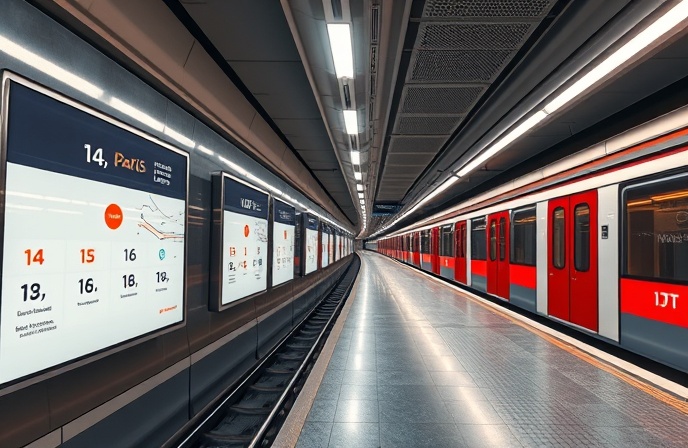
Metrobus Secures Advertising Concession for Grand Paris Express Expansion
In a landmark deal signaling a commitment to both modernization and sustainability, Metrobus, a subsidiary of Médiatransports, has been awarded a 12-year concession to manage advertising spaces across the burgeoning Grand Paris Express rail network. This significant contract, announced this week, covers 45 stations along the southern extension of metro line 14 and the forthcoming lines 15 South, 16, 17, and 18 of the Île-de-France Mobilités (IDFM) network. The joint award, made by the Société des grands projets and IDFM, effectively grants Metrobus exclusive rights to commercialize advertising opportunities within these critical transit hubs. This strategic move highlights the evolution of revenue generation within public transport and the increasing emphasis on environmentally conscious practices in the industry. The agreement underscores the critical importance of integrating advertising revenue to support the vast costs of these essential infrastructure projects.
A Sustainable Advertising Model
The Société des grands projets and IDFM have set a precedent by prioritizing environmental responsibility in the concession agreement. This approach moves beyond conventional practices, setting a maximum energy consumption threshold for advertising displays throughout the network. This proactive stance aims to significantly reduce overall energy usage and minimize the environmental footprint associated with advertising infrastructure. The result is a deliberate reduction in advertising density compared to typical deployments, focusing on quality over quantity. This strategic decision reflects the growing expectation for public transport operators to embrace sustainable practices, particularly during the design phase.
Metrobus’s Commitment to Innovation
In response to this environmentally focused approach, Metrobus has outlined a comprehensive strategy that includes several key innovations. Firstly, Metrobus will drastically reduce the number of advertising displays, by a substantial 40% across the designated stations. This decrease reflects the density restrictions of the agreement. Secondly, they will deploy low-energy advertising fixtures constructed from recyclable stainless steel, chosen for their modular design and extended lifespan. The fixtures are designed to last over seven years, exceeding the industry standard of five years. These innovative measures are aimed at minimizing waste. Technical and environmental criteria were unified and collectively weighted at 45% during the evaluation process. This holistic approach ensures the integration of sustainability principles into every aspect of the advertising operation.
Promoting Responsible Advertising and Public Service
Beyond the infrastructure, Metrobus has pledged to promote responsible advertising practices. A cornerstone of this commitment involves prioritizing advertisers who actively demonstrate commitment to sustainable development and corporate social responsibility (CSR). This includes encouraging advertising campaigns that actively promote environmentally and socially positive behaviors. Furthermore, Metrobus is obligated to dedicate at least 30% of platform advertising space to non-commercial content. This space will be allocated for public service information, as well as cultural messaging. This strategic allocation aligns with the goal of informing and engaging commuters in a meaningful manner. This approach creates a balance between commercial activities and a broader public service.
Advertising Concession: A Phased Rollout
It is important to note that, in 2028/2029, another tendering process is expected to launch for the advertising concessions covering the eastern and western sections of line 15. This phased approach suggests that, while a large-scale contract has been finalized, IDFM and the Société des grands projets are adopting a measured strategy to manage the allocation of commercial spaces. This model allows them to evaluate the performance of the first phase and potentially refine their approach for future contracts. It also provides opportunities for other providers to compete, promoting innovation and competition.
Conclusion
The Metrobus contract represents a significant development in the advertising landscape of the Grand Paris Express project. It not only ensures a revenue stream for the IDFM, critical to funding the expansion of public transport infrastructure, but also establishes a benchmark for sustainable practices within the industry. The reduction in advertising density, the emphasis on low-energy fixtures, and the focus on responsible advertising all reflect a forward-thinking approach. The inclusion of significant space for public service messaging further underlines the commitment of Metrobus and its partners to serve commuters beyond commercial interests. The phased rollout of advertising concessions on line 15 highlights the ongoing evolution of these practices. As the railway industry continues to expand, the practices demonstrated by this contract will likely be influential, setting new standards for responsible advertising partnerships and the integration of sustainability into the very foundation of railway commercial strategy. This is further evidence that commercial viability and environmental responsibility are not mutually exclusive.
Company Summary
Metrobus, initially founded in 1949, holds a long-standing partnership with RATP. It has established itself as a major player in the French public transportation sector. Their focus remains on commercializing advertising spaces across metro, tram and bus networks in several major urban areas, including Lille, Marseille and Rennes. Metrobus’s experience, coupled with its commitment to sustainability and innovation, positions it well to manage the complexities and demands of the Grand Paris Express. The company’s deep understanding of the French transport landscape and its ability to adapt to emerging industry requirements solidify its position within the industry.
RELATED POSTS

May 25, 2023 12:21 am
The railway industry is undergoing a period of significant transformation,...
November 22, 2022 8:57 am
The Financial Performance and Strategic Outlook of Alstom: An Analysis...

October 3, 2017 9:28 am
Baikal-Amur Mainline to complete the railway bridge over the Lena...

July 22, 2025 5:33 am
Union Pacific and CHP team up for enhanced rail safety...

February 13, 2016 12:25 pm
French National Railways (SNCF) has awarded a €186m contract to...
December 17, 2025 4:39 pm
Croatia reopens the Koprivnica–Novo Drnje rail section, a key part...