
Germany’s High-Speed Rail: Nuremberg-Bamberg Upgrades & Future
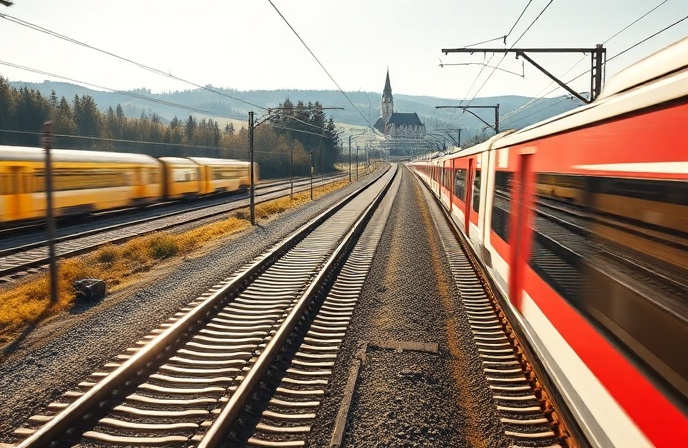
The Nuremberg – Bamberg rail line upgrade, featuring four tracks, is complete! This key **railway infrastructure** project enhances **high-speed** connections and service across the network.
“`html
Introduction
The upgraded section of the Nuremberg – Bamberg rail line between Altendorf and Strullendorf, featuring four tracks, has been completed following four years of infrastructure work. This 52 km project, part of the German Unity Transport Project No. 8, involved an investment of approximately EUR 2 billion and is a key component of Germany’s rail network.
Project Completion and Infrastructure Upgrades
The upgraded section between Altendorf and Strullendorf, part of the Nuremberg – Bamberg rail line, is now operational. The project included 40 km of newly built tracks, 45 km of overhead lines, and modern noise barriers. Platforms at Hirschaid and Strullendorf are fully accessible, with Buttenheim set to follow later in the year. The total investment in the project was around EUR 2 billion.
Operational Enhancements and Service Improvements
The separation of slower and faster services across four tracks allows for smoother and more punctual operations. Since late 2023, the Franken-Thuringia Express has been running every 30 minutes between Nuremberg and Bamberg. From mid-2024, Germany’s fastest interregional train service has been operating on the same line, connecting Nuremberg and Erfurt at speeds of up to 190 km/h. S-Bahn services have also been enhanced, including the opening of Forchheim Nord station and new connections between Forchheim and Erlangen since 2023.
Strategic Importance and High-Speed Corridor
The Nuremberg – Bamberg rail line is a central component of the high-speed corridor linking Munich and Berlin, with an average of 350 trains passing through daily. Long-distance ICE traffic has expanded significantly, with 31 daily services now running in both directions between Nuremberg and Erfurt, around half of which are Sprinter trains. Bamberg now sees 30 ICE services daily. Since the launch of the upgraded high-speed line between Berlin and Munich, ICE passenger numbers have risen more than threefold, and the rail service now claims around 70 percent of the market share on that route.
Future Developments and Network Integration
Future projects include a freight train tunnel beneath Fürth, the extension of the S-Bahn between Fürth and Eltersdorf, and an upgrade of the Bamberg rail junction. The Bamberg rail junction is part of a 500-km network stretching from Nuremberg to Berlin via Erfurt and Leipzig. A new 15-kilometre double-track freight line between Nuremberg and Eltersdorf is under construction, including a 7.5-km tunnel specifically for freight services. The tunnel will feature 25 km of track, 28 km of overhead lines, and seven emergency exits. The upgrade of the Nuremberg – Bamberg rail line is integrated into the national Deutschlandtakt initiative.
Conclusion
The completion of the Altendorf–Strullendorf section of the Nuremberg – Bamberg rail line, along with planned future projects, is designed to enhance regional and long-distance travel, improve operational efficiency, and integrate with the national Deutschlandtakt initiative for a more efficient rail network.
Last June 2025, we published an article about Renfe’s Aranjuez maintenance hub. Click here to read – Future of Rail: Renfe’s Railway Technology Hub, Aranjuez: Essential Guide
Deutsche Bahn
Deutsche Bahn is a key entity involved in the German Unity Transport Project No. 8, contributing to the investment in the Nuremberg – Bamberg rail line upgrades.
“`
RELATED POSTS
July 7, 2025 3:33 am
Saudi e-fuel plant signals global rail decarbonization push, potentially benefiting...

August 10, 2007 8:49 pm
The Chinese Ministry of Railways (MOR) will install $91m worth...

May 21, 2020 1:59 am
Investing in New Zealand’s Railway Infrastructure: A Comprehensive Analysis This...
December 9, 2016 3:57 pm
The South Korea Sudokwon high-speed line - for which Alstom...
November 30, 2020 7:01 am
Enhanced Passenger Information Systems at Major London Stations: A Case...
January 3, 2018 12:15 am
Revolutionize your railway with modernized infrastructure, cutting-edge technology, and sustainable...