
Germany: Deutsche Bahn Spearheads AI-Powered Remote Train Operations
RemODtrAIn project: Deutsche Bahn leads initiative for AI-powered remote train operation, enhancing safety and tackling driver shortages in the railway sector.
Lead Paragraph:
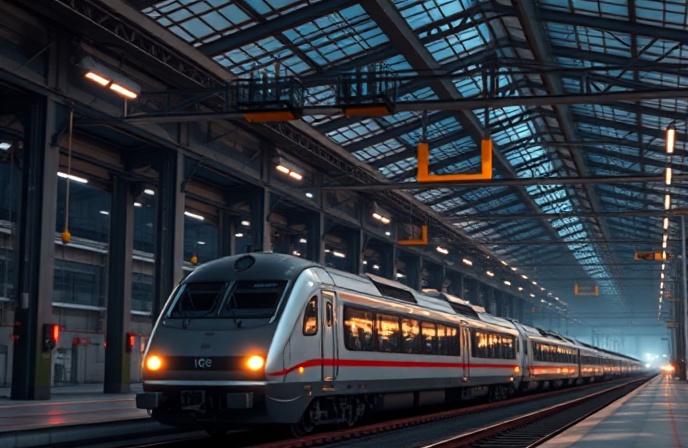
A significant step towards autonomous railway operations is underway as the RemODtrAIn consortium launches a pilot program for remote train operation with AI-powered obstacle detection in depots. Spearheaded by Deutsche Bahn and involving a dozen leading organizations, the EUR 17 million project aims to enhance safety, reliability, and availability in train maneuvering, addressing critical industry challenges like driver shortages.
| Key Entity | Critical Detail |
|---|---|
| Consortium | RemODtrAIn (Remote operated train with AI-based Obstacle Detection) |
| Lead Partner | Deutsche Bahn (DB) |
| Core Technology | AI-based Obstacle Detection & 5G Remote Operation |
| Projected Timeline | Vehicle validation scheduled for 2028 |
| Funding | EUR 17 million government program |
| Key Testing Locations | ICE depot in Cologne-Nippes; Smart Rail Connectivity campus in Annaberg-Buchholz; S-Bahn Berlin |
Main Body:
The RemODtrAIn project, building upon prior initiatives like AutomatedTrain and safe.trAIn, is set to revolutionize depot operations by developing and testing a secure remote train operation system integrated with advanced AI for obstacle detection. This ambitious endeavor sees an ICE 4 train being outfitted with state-of-the-art 5G technology, enabling real-time control from a dedicated operations center within the depot. The consortium’s ultimate goal is to establish a robust and dependable remote operational capability that can function effectively even within the dynamic and variable conditions characteristic of public 5G networks.
Strategic Impact
This project represents a pivotal advancement in the railway industry’s pursuit of automation and remote control, particularly for intricate maneuvers within operational depots. By focusing on depot movements, parking, and ensuring train availability, RemODtrAIn directly tackles operational efficiencies. The development of universally applicable vehicle sensors is also a key outcome, contributing to the broader expansion of automation solutions that can effectively mitigate the ongoing shortage of qualified drivers, a pressing concern for rail operators globally.
Operational Details
Testing and validation will be conducted across multiple strategic locations. Initial trials will commence at the ICE depot in Cologne-Nippes, with a focus on the integrated remote operation system. Concurrently, the communications and sensor components will undergo rigorous evaluation at the Smart Rail Connectivity campus in Annaberg-Buchholz, utilizing a Desiro Classic train. Further testing of the 5G communication infrastructure is planned for the Annaberg-Buchholz test field, while the AI obstacle detection system is slated for trials on the S-Bahn Berlin network. This multi-faceted testing approach ensures detailed validation before the full vehicle validation scheduled for 2028.
Industry Context
The railway sector is at an inflection point, with increasing pressure to optimize operations, enhance safety, and adapt to evolving labor market dynamics. The RemODtrAIn project’s focus on remote operation and AI-driven safety features addresses these challenges head-on. For industry leaders, this development signifies a tangible move towards operational resilience and efficiency gains, potentially unlocking new service models and cost savings. Deutsche Bahn’s pragmatic approach, integrating testing into real-world scenarios and adapting existing processes, offers a blueprint for other operators looking to embrace advanced automation technologies.
Last June 2025, we published an article about Renfe’s cutting-edge Aranjuez maintenance hub. Click here to read – Future of Rail: Renfe’s Railway Technology Hub, Aranjuez: Essential Guide

Railway infrastructure, rolling stock and transport technologies specialist focused on global rail industry developments, high-speed rail systems, signaling technologies and freight transportation. Covering railway investments, public transport modernization, rail operations and international mobility projects across Europe, Asia and North America.
RELATED POSTS

September 6, 2026 5:19 am
Hitachi delivered Taiwan's first N700ST high-speed train from Japan in...

September 6, 2026 6:17 am
Hungary ordered a national ban on most freight trains from...

September 6, 2026 1:17 am
Hitachi Toshiba Supreme Consortium confirmed the first of 12 N700ST...

September 5, 2026 4:19 pm
CPK launched formal tender talks with four consortia to design...
September 7, 2026 8:16 am
Midea, Gree and TCL shipped air conditioners via China Railway...

September 6, 2026 4:12 am
Alstom delivered the first of 100 new G Class trams...