
Eurostar & Deutsche Bahn Plan London-Germany High-Speed Rail
Eurostar and Deutsche Bahn plan a direct high-speed rail link! London to Germany, including Frankfurt, Cologne, services potentially starting in the early 2030s.
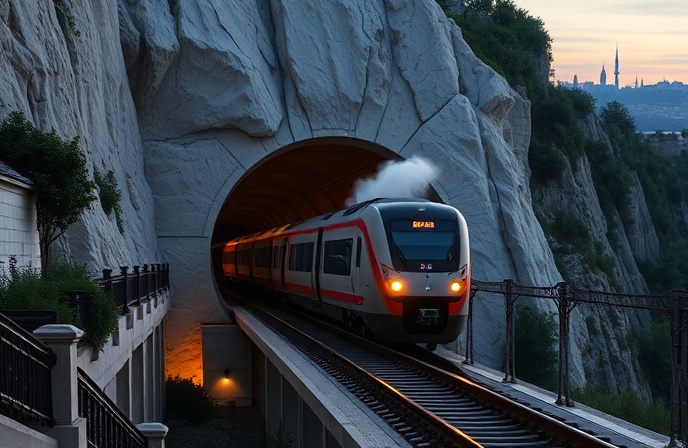
Eurostar and Deutsche Bahn Sign Memorandum of Understanding for Direct London-Germany High-Speed Rail Link. The landmark agreement, signed in early December, signals a significant step towards launching direct high-speed passenger services between London and key German cities including Cologne and Frankfurt, potentially commencing in the early 2030s.
| Key Entity | Critical Detail |
|---|---|
| Companies Involved | Eurostar, Deutsche Bahn (DB) |
| Core Action | Signed Memorandum of Understanding (MoU) to explore direct high-speed rail services |
| Target Destinations | London, Cologne, Frankfurt |
| Projected Launch | Early 2030s |
| Estimated Journey Times | Approx. 4 hours (London-Cologne), Just over 5 hours (London-Frankfurt) |
Strategic Collaboration to Enhance Trans-European Connectivity
Eurostar and Deutsche Bahn (DB) have formalized their commitment to establishing a direct high-speed train service connecting the UK capital with major German urban centres. The Memorandum of Understanding (MoU), executed in early December, lays the groundwork for what is anticipated to be a revolutionary step in international rail travel, offering passengers a seamless city-centre to city-centre experience.
The proposed service aims to significantly reduce travel times, with projections suggesting journeys of approximately four hours between London and Cologne, and just over five hours to Frankfurt. This would eliminate the need for passenger interchanges, providing a direct and convenient alternative to air travel. The envisioned routes will utilize double-deck high-speed trains, a design that promises increased passenger capacity and enhanced energy efficiency.
This development gains further traction following the Office of Rail and Road’s (ORR) recent approval for Virgin Trains’ access to the Temple Mills International depot in East London. This crucial infrastructure development provides a vital gateway for new cross-border services, including those planned through the Channel Tunnel, bolstering the momentum for future international rail initiatives.
Operational Exploration and Future Requirements
Both Eurostar and Deutsche Bahn will now embark on a comprehensive exploration of essential operational elements. This includes the meticulous planning of timetables, the assessment and development of terminal facilities at both ends of the proposed routes, and the establishment of the necessary operational and legal frameworks to support the launch of these direct cross-border services. Eurostar has emphasized that the realization of this service is contingent upon the satisfactory fulfillment of all technical, operational, and legal prerequisites.
Industry Context
The strategic collaboration between Eurostar and Deutsche Bahn represents a significant confluence of operating expertise and extensive network reach, bolstered by growing political support for enhanced European rail connectivity. UK Prime Minister Sir Keir Starmer’s endorsement underscores the broader implications of this initiative, positioning it as a critical step towards re-establishing Britain at the heart of a more interconnected Europe. This development is poised to stimulate increased trade, tourism, and investment by offering a sustainable and efficient travel solution that directly addresses the evolving needs of international business and leisure travellers.
Last June 2025, we published an article about Renfe’s cutting-edge Aranjuez maintenance hub. Click here to read – Future of Rail: Renfe’s Railway Technology Hub, Aranjuez: Essential Guide
The ambition behind this cooperation is to unlock a service that, as both operators acknowledge, would be exceedingly difficult for any single entity to achieve independently. The ultimate success of direct high-speed rail services between the UK and Germany hinges on the outcomes of further feasibility studies, the securing of requisite government approvals, and thorough technical validation, all of which will determine if this ambitious vision materializes within the next decade.
RELATED POSTS
December 29, 2016 6:45 pm
Bombardier Transportation and partner Hartasuma today announced the launch of...

February 23, 2017 7:24 am
"Brussels is modernizing its metro with new M7 trains and...
October 29, 2025 9:54 am
Vale and Wabtec partner to test **ethanol in locomotives** on...
December 9, 2025 11:40 am
Turkey has obtained €350 million from Asian Infrastructure Investment Bank...
December 15, 2024 2:02 am
Master EN 50126-1: the essential standard for railway RAMS management....
September 24, 2019 8:19 pm
Introduction This article examines the crucial railway infrastructure improvement project...