
Dunkirk & Modalis Launch Road-Rail Terminal to Cut Emissions
Port of Dunkirk and Modalis Group launch a new road-rail terminal in France, boosting green freight and reducing congestion. The **railway** project aims for a modal shift.
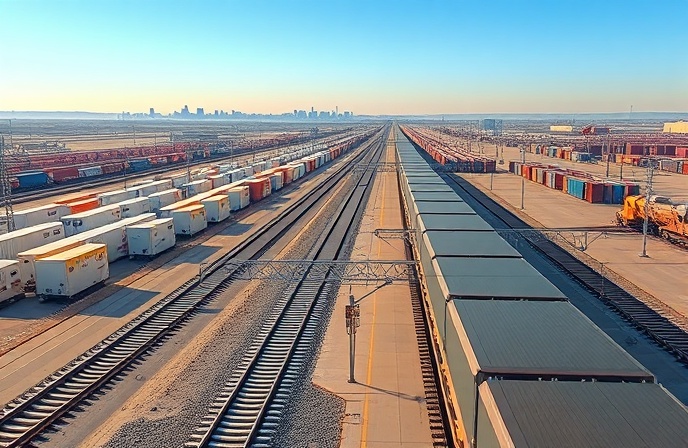
Port of Dunkirk and Modalis Group Launch New Road-Rail Terminal to Boost Green Freight and Reduce Congestion. Construction has commenced on a state-of-the-art road-rail terminal in Dunkirk, a strategic joint venture between the Port of Dunkirk and Modalis Group, set to commence operations in March 2026. This facility is poised to significantly curtail road congestion and CO₂ emissions within the Hauts-de-France region by optimizing freight flows and promoting a modal shift to rail.
| Key Entity | Critical Detail |
|---|---|
| Project Owners | Port of Dunkirk & Modalis Group |
| Core Action | Construction launched for new road-rail terminal |
| Investment Value | EUR 25 million |
| Operational Start Date | March 2026 (Spring 2026) |
| Location | Dunkirk, France (9.6 hectares, Loon-Plage railway line) |
| Capacity | Up to four 750m trains; over 600 transport units storage |
The new terminal, strategically situated on 9.6 hectares along the Loon-Plage railway line within a key industrial hub and proximate to vital Ro-Ro links to the UK and Ireland, represents a significant step forward in decarbonizing European logistics. Its primary function will be to facilitate the seamless transfer of freight from road to rail, a critical component in achieving ambitious environmental targets.
Strategic Impact on Freight Flows and Emissions
This development is designed to have a transformative impact, projecting the removal of up to 50,000 intermodal transport units from road networks annually. This modal shift is estimated to prevent nearly 70,000 tons of CO₂ emissions, directly contributing to national and European objectives for cleaner transportation. The terminal’s design, accommodating up to four 750-meter trains with a capacity of 130–150 semi-trailers each, and offering storage for over 600 transport units, underscores its significant operational scale and potential to alleviate road congestion in a heavily trafficked corridor.
Commitment to Sustainability and Operational Efficiency
Central to the transshipment terminal’s design and operation is an unwavering commitment to sustainability. The project will leverage modern, low-emission equipment, including electric locomotives for all rail maneuvers and HVO (hydrotreated vegetable oil) fueled vehicles. HVO-fueled vehicles offer an 85% reduction in CO₂ emissions, while the exclusive use of electric locomotives for internal movements minimizes the terminal’s environmental footprint. Additionally, a shared maintenance area for wagons, containers, and semi-trailers will be accessible to all operators, fostering increased operational efficiency and reducing costly empty runs.
Last June 2025, we published an article about Renfe’s cutting-edge Aranjuez maintenance hub. Click here to read – Future of Rail: Renfe’s Railway Technology Hub, Aranjuez: Essential Guide
Industry Context: Driving Decarbonization and Modal Shift
With transport accounting for nearly 30% of France’s CO₂ emissions, the development of greener freight transport solutions is a pressing national priority. This new road-rail terminal directly addresses this by actively shifting traffic from road to rail, thereby reducing sole reliance on road transport. It is an instrumental project aligning with the France Logistique 2030 Plan and the European Green Deal’s objective to double rail freight volumes by 2050. The EUR 25 million investment, co-financed by Modalis and the Port of Dunkirk, positions Dunkirk as a new-generation multimodal platform accelerating the decarbonization of freight transport across Europe.

Railway infrastructure, rolling stock and transport technologies specialist focused on global rail industry developments, high-speed rail systems, signaling technologies and freight transportation. Covering railway investments, public transport modernization, rail operations and international mobility projects across Europe, Asia and North America.
RELATED POSTS

October 5, 2026 6:12 pm
AECOM and Jacobs secured a contract in September 2026 to...

October 4, 2026 11:08 pm
Sound Transit confirmed the September 30 opening of Seattle Pinehurst...
October 6, 2026 9:17 am
Illinois approved $1.1M in state funds to upgrade two McHenry...

October 6, 2026 2:14 am
Union Pacific launched export rail shipments with Ferromex to deliver...
October 6, 2026 12:16 am
FTA awarded $233 million in grants to eight US rail...
October 5, 2026 3:13 pm
DART launched a 90-day fare enforcement pilot across 5 light-rail...