
China Shenhua Pioneers Wireless Freight “Virtual Convoy” for Efficiency Gains
China’s “virtual convoy” test sets a world first! Seven wireless freight trains operated together, promising increased **railway** capacity and efficiency for **freight trains**.

China has successfully conducted a groundbreaking railway test, achieving a world-first “virtual convoy” of seven heavy freight trains. Operated wirelessly and without mechanical couplings, the synchronized operation demonstrated a potential paradigm shift for rail freight efficiency and capacity.
| Key Entity | Critical Detail |
|---|---|
| Lead Organization | China Shenhua (part of China Energy Investment Corporation) |
| Core Action | Wireless, synchronized operation of seven 5,000-ton freight trains (totaling 35,000 tons) |
| Location | Baoshen railway, Inner Mongolia, China |
| Timeline | Recent test (specific date not provided, presented as a current achievement) |
| Key Technology | Intelligent wireless control system, real-time radio signals, advanced algorithms, “two-dimensional” control model |
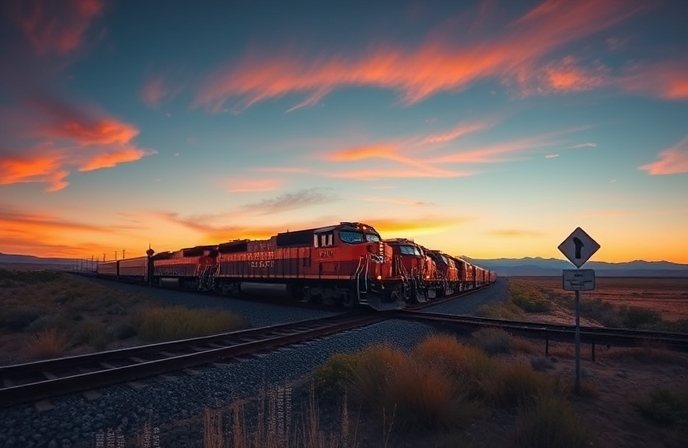
This pioneering test saw seven individual freight trains, each weighing 5,000 tons, operate in a compact formation on the Baoshen railway without physical connection. The trains, achieving a combined mass of 35,000 tons—equating to more than three Eiffel Towers—were meticulously synchronized for acceleration and braking solely through an intelligent wireless control system. This achievement marks the first instance of multiple heavy freight trains functioning as a “virtual convoy,” coordinated in real-time via radio signals and sophisticated algorithms.
Strategic Impact on Freight Capacity
The development, spearheaded by China Shenhua in collaboration with research institutes and industrial partners, addresses a critical challenge in traditional freight operations: the necessity of mechanical couplings. By enabling wireless coordination, the technology bypasses the inherent limitations of single-unit, physically linked trains. The system’s success in maintaining safe distances and precise synchronization during acceleration and braking is a testament to its advanced design, which employs a real-time “two-dimensional” control model with two-way communication between trains and ground infrastructure. Industry analysts suggest this innovation could boost freight line capacity by over 50% without requiring substantial infrastructure upgrades.
Operational Details and Future Potential
During the test, trains positioned at different locations along the Baoshen line were seamlessly integrated into a single “virtual train.” They maintained close formation until reaching Wanshuiquan South, where they automatically separated and proceeded to the station independently, with wireless control maintained throughout the maneuver. This capability is particularly relevant for strategic corridors like the Baoshen line, a vital coal transport route between the Shenmu and Ordos regions, promising enhanced safety and energy efficiency by allowing multiple trains to operate within the same time slots.
Last June 2025, we published an article about Renfe’s cutting-edge Aranjuez maintenance hub. Click here to read – Future of Rail: Renfe’s Railway Technology Hub, Aranjuez: Essential Guide
China is positioning this technological feat as a potential “technological model” for nations seeking to enhance the efficiency of long-distance, heavy freight rail transport while mitigating the significant costs associated with new line construction. Although currently in the testing phase, the successful execution of this “virtual convoy” concept indicates its viability as a future solution for high-tonnage rail logistics.
Industry Context
The implications of this “virtual convoy” technology extend far beyond current freight applications. Experts foresee its adaptation for high-speed trains, urban transit systems, and conventional lines, presenting a robust model for the widespread digitization of railway control systems. For railway operators and logistics providers globally, this development signals a significant opportunity to optimize network utilization, reduce operational costs, and improve overall service reliability, making it a crucial consideration for strategic planning in the evolving landscape of rail transportation.
RELATED POSTS

October 24, 2025 4:54 pm
A new diesel-electric **train** enhances services for HŽPP passengers. ...

June 30, 2025 3:33 pm
Foothill Gold Line seeks new design-build approach for final light-rail...
July 3, 2025 6:33 pm
Union Pacific unveils a modernized website, improving customer experience and...

June 6, 2018 11:20 pm
Upgrade your passenger experience with digital kiosks! Real-time information...
January 25, 2017 4:26 pm
Here's an excerpt tailored for railway professionals:"The Port of Long...

September 26, 2011 6:27 pm
Qatar Railways, the operator of Qatar’s planned QR130bn ($36bn) rail...