
Burgos-Vitoria HSR: Spain’s Atlantic Corridor High-Speed Rail Boost
Spain’s Adif AV awards €391M contract for Burgos-Vitoria high-speed rail section, crucial for Atlantic Corridor.
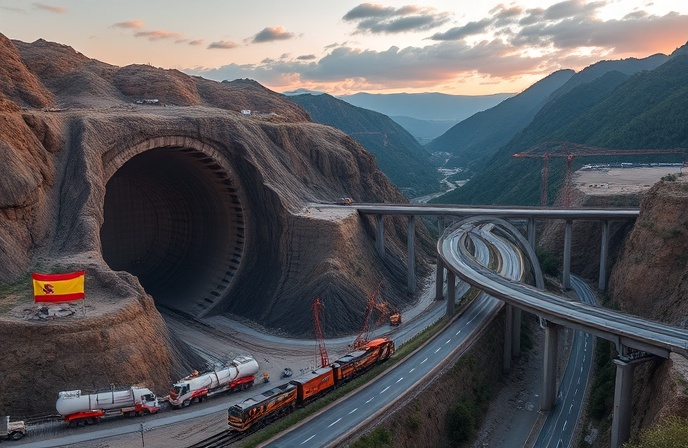
Adif AV Awards €391 Million Contract for Burgos-Vitoria High-Speed Line Section
Adif AV, Spain’s railway infrastructure manager, has awarded a substantial contract, valued at €391 million, for the construction of the trackbed for a critical section of the Burgos-Vitoria high-speed line. This project, announced recently, marks a significant step forward in the development of the Atlantic Corridor, a strategic initiative to connect the Basque Country with Spain’s high-speed rail network and, ultimately, the French border. The contract covers the initial 8.4-kilometer stretch between Pancorbo and Ameyugo in the province of Burgos. The primary objective of this project is to establish a modern, efficient high-speed rail link that integrates seamlessly into the existing transport infrastructure while tackling complex engineering challenges. The planned works will commence shortly after formalization of the awarded contract.
Challenging Terrain: The Engineering Scope
The 8.4 km section of the Burgos-Vitoria high-speed line presents a significant engineering challenge. Approximately 77% of the route navigates complex terrain, involving the construction of three tunnels and three viaducts. Key structures include the 4-kilometer Pancorbo tunnel and the adjacent 1.1-kilometer viaduct. The viaduct has been designed with two aesthetically pleasing V-shaped piers on either side of the central span that crosses the N-I road. Additionally, two more tunnels, the 611-metre Ameyugo I and the 524-metre Ameyugo II, will be constructed. Finally, there will also be the construction of viaducts over the 28-metre long La Mala stream and the N-I road (176 m). These structures will be critical for allowing the high-speed line to integrate smoothly into its surroundings and to safely interface with existing infrastructure such as the N-I road, which the high-speed line crosses twice.
Standard Gauge and Route Design
The Burgos-Vitoria high-speed line is being built to standard gauge (1435 mm), ensuring compatibility with the rest of the European high-speed network. The project encompasses the development of a new double-track railway line and includes a single-track bypass at Miranda de Ebro. This bypass will provide operational flexibility, allowing trains to either serve the town or bypass it entirely, minimizing travel times and optimizing network efficiency. The detailed route for construction has been divided into seven sections, with the Pancorbo-Ameyugo section being the first one currently tendered. This phased approach enables efficient management of resources and allows for the progressive implementation of the project, paving the way for the further development of the Atlantic Corridor.
Strategic Importance: Connecting Regions and Nations
The Burgos-Vitoria high-speed line is a core component of the Atlantic Corridor, a strategic initiative aimed at linking the Basque Country to the existing high-speed rail network and, further, to the French border. Extending the existing Madrid-Valladolid-Burgos high-speed line, the new line will reach the Basque Country, where it will connect with the high-speed networks under construction between the region’s three capital cities. Furthermore, this connection to the French border will be essential to facilitating international trade and passenger transport, improving connectivity within Spain and promoting integration with the broader European rail network. This enhanced infrastructure will provide significant economic and social benefits to the connected regions, promoting both domestic and international travel.
Conclusion
The awarding of the €391 million contract by Adif AV for the Burgos-Vitoria high-speed line section marks a pivotal advancement in Spain’s high-speed rail network. This project, focusing on the 8.4-kilometer stretch between Pancorbo and Ameyugo, showcases impressive engineering feats, particularly the tunnels and viaducts designed to traverse challenging terrain. The implementation of standard-gauge tracks and the provision of a bypass at Miranda de Ebro will further enhance operational efficiency and connectivity. More importantly, the project’s strategic significance within the Atlantic Corridor highlights the importance of connecting the Basque Country with the rest of Spain and, ultimately, France. This project sets the stage for the next phase of the high-speed line. Continued investment and innovative engineering will drive railway improvements, solidifying Spain’s position as a leader in European rail transport, creating efficient transport links, and facilitating both domestic and international traffic across the continent. The future of rail travel looks bright, with projects such as this setting new benchmarks in speed, safety, and environmental integration.
RELATED POSTS

February 25, 2023 5:57 am
This article explores the transformative potential of 5G private networks...
February 12, 2018 10:25 am
Upgrade aging railway rolling stock for enhanced safety, efficiency, and...

July 10, 2025 9:34 pm
Tyseley Depot expansion boosts West Midlands Railway capacity, accommodating new...
November 25, 2020 5:45 pm
The ongoing labor shortage within the Japanese railway industry, coupled...

September 30, 2025 10:54 am
Alstom unveils new **train** technology and a Smart Derailment Detector...

July 3, 2012 8:05 am
The Union Cabinet of India has given the go-ahead for...